
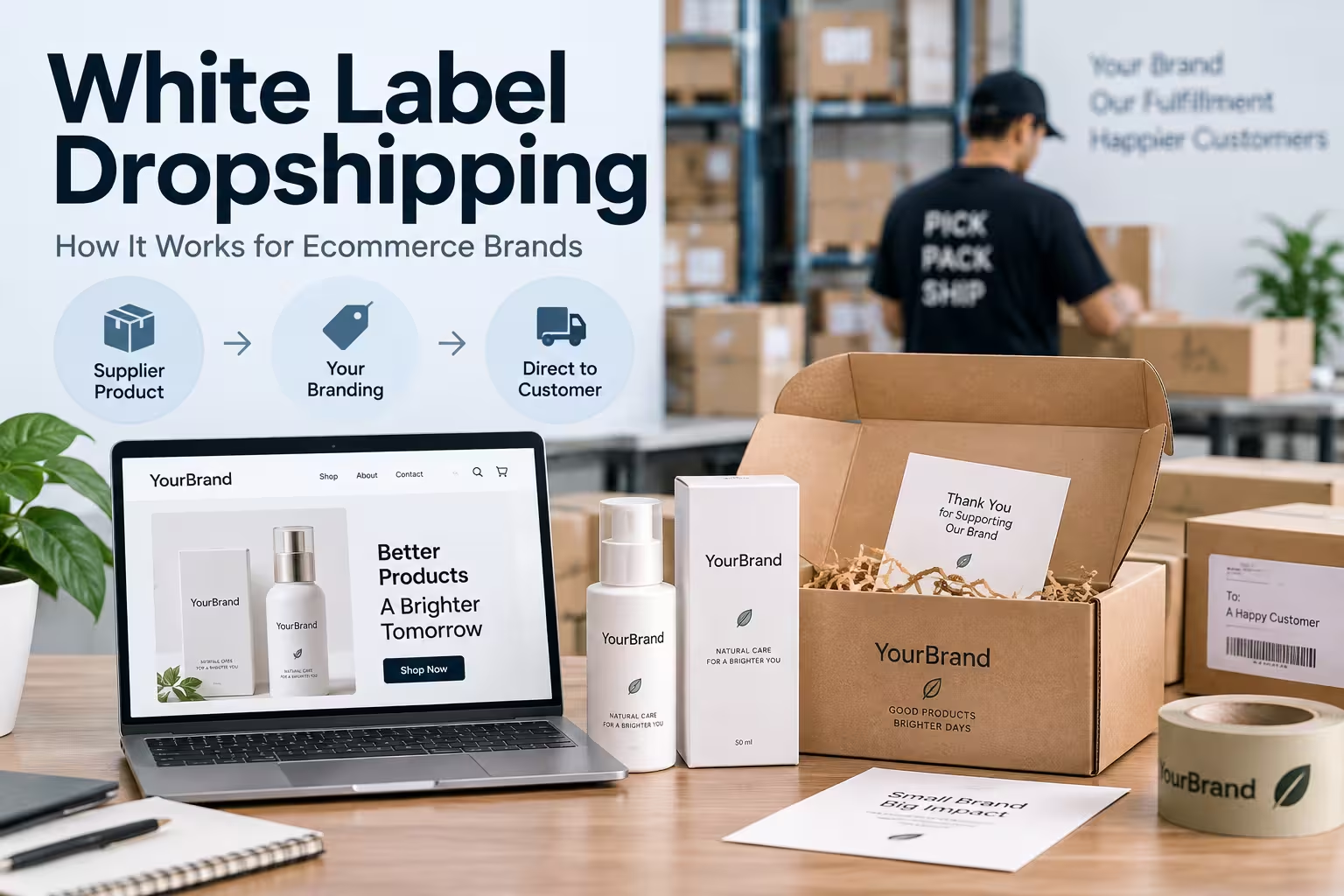
White label dropshipping is a business model where an ecommerce brand sells products manufactured by a supplier — under the brand’s own name, logo, and packaging — while that same supplier picks, packs, and ships each customer order directly. The brand owner never touches inventory. The supplier’s identity stays invisible to the end customer.
Understanding how white label dropshipping works for ecommerce brands is the first step toward building a catalog that customers associate with your name, not a factory’s.
Quick reference
- What it is: Sell an existing supplier product under your own brand; supplier fulfills orders
- Branding scope: Logo, label, stickers, packaging sleeve, inserts — not formula or structure changes
- Inventory: Typically held at the supplier’s warehouse, pre-branded or branded at pick time
- Minimum order: Varies by supplier; branding setups often require a small minimum print run for labels or custom boxes
- Time to launch: Faster than private label because no product development is involved
- Key distinction from generic dropshipping: Products carry YOUR brand identity, not the supplier’s or a generic name
- Key distinction from private label: The product specification stays as the supplier made it
What Is White Label Dropshipping?
An ecommerce brand selling a “vitamin C serum” with its own logo on the bottle, fulfilled by a supplier in Guangdong without the brand owner ever seeing the product — that is white label dropshipping in one sentence.
The term “white label” comes from the physical blank label historically placed on a product so that a reseller could print their own branding on top. In dropshipping, the same logic applies: the supplier keeps the product as-is, applies the brand’s visual identity, and ships directly to the customer.
What makes this distinct from ordinary dropshipping is brand ownership. Generic dropshipping typically means selling a supplier’s product under the supplier’s packaging — or no packaging at all. White label dropshipping means every box, pouch, or bottle that arrives at a customer’s door carries your brand name, not the factory’s.
Once a SKU is selected, branding elements are applied — and this is where the white label layer lives. The typical scope includes: logo placement on the product itself (via label, sticker, or silk-screen), a branded outer box or packaging sleeve, branded inserts inside the box (care cards, thank-you notes, QR codes), and any brand name printed on the label.
which is precisely what white label dropshipping makes operationally possible without owning a warehouse. For ecommerce brands using ecommerce fulfillment and competing on customer experience rather than price, that repeat-purchase mechanism is the structural case for the model.
It is also distinct from private label dropshipping, though the two terms get used interchangeably enough to cause real operational mistakes — more on that in a dedicated section below.
White label dropshipping suits established and emerging ecommerce brands that want to own a brand identity without investing in product development. Successful brands in categories like wellness, beauty, home goods, and pet supplies use this model precisely because the underlying products are already proven — what they’re building is the brand layer on top, not a novel formulation or mechanism.
Selling without any branding is increasingly harder to compete on. Suppliers are visible, products are commoditized, and there is no customer loyalty attached to a generic item. White label dropshipping gives a brand something to defend — and something customers remember.

How Does White Label Dropshipping Work?
The operating flow has three distinct phases. Understanding where each phase starts and stops prevents the most common mistake brands make: confusing “can I put my logo on this?” with “can I change how this product works?” Those are different questions with different answers.
Choose an Existing Product
The brand selects a supplier SKU that already exists — with set materials, dimensions, fill weight, formula (where applicable), and technical specifications locked in. Nothing in the product itself changes.
This is the white label boundary in its clearest form.
The supplier has already done the product development: the moisturizer formula is tested, the stainless steel water bottle gauge is set, the yoga mat density is fixed. The brand is choosing from a menu of finished goods, not commissioning a new item. Suppliers typically offer catalogs of these white-label-ready SKUs, sometimes with multiple existing color or size variants to choose from.
The selection decision is really a branding fit question: does this product’s quality, specification, and existing customer reception match what our brand promises? Ordering samples before committing to a branding setup is non-negotiable here. A brand staking its name on products it has never held is accepting a risk that unit economics alone cannot fix.
Add Your Brand to the Product
Once a SKU is selected, branding elements are applied — and this is where the white label layer lives. The typical scope includes: logo placement on the product itself (via label, sticker, or silk-screen), a branded outer box or packaging sleeve, branded inserts inside the box (care cards, thank-you notes, QR codes), and any brand name printed on the label.
What branding does not include: changing the product formula, altering the structural dimensions, switching materials, or adding features that don’t already exist on the supplier’s version. Those changes move the project toward OEM or private label territory, which involves tooling, development cycles, and minimum order quantities orders of magnitude higher.
Branding is applied in one of two ways. Pre-branded inventory means the supplier prints and applies all brand materials before products go into storage — useful when the brand is confident in demand and wants faster pick-pack time.
On-demand branding means the supplier applies the label or packaging sleeve at the time of order fulfillment, which reduces the risk of holding pre-branded dead stock but adds a step to each order cycle. Both methods are used in white label dropshipping operations; the right choice depends on order volume and the complexity of the branding application.
The Supplier Fulfills Customer Orders
When a customer places an order on the brand’s Shopify store or another ecommerce platform, the order routes to the supplier. The supplier picks the correct SKU, ensures branding is correctly applied (either pre-done or applied at that step), packs the order, and ships it directly to the customer’s address.
The brand receives tracking information, which is passed back to the customer. From the customer’s perspective, they ordered from a brand, received branded packaging, and have no visibility into who manufactured or shipped the products. That is the white label experience working as intended.
Platform integration matters more than most guides acknowledge. On Shopify specifically, white label dropshipping works through supplier apps (AutoDS, DSers, and supplier-native integrations are common) that sync product listings, route orders automatically, and push tracking numbers back to Shopify’s order timeline — so customers get carrier notifications without any manual step from the brand operator. WooCommerce and BigCommerce support similar integrations through webhook-based order routing.
The practical test before launch: place a test order end-to-end and confirm that tracking updates appear in the customer-facing order status page within the carrier’s first scan. If that sync breaks at volume, customers contact support — and branded packaging that arrived late with no tracking update undoes the brand-building the white label model was supposed to deliver.
Order fulfillment compatibility is worth confirming before launch. Suppliers that handle 50 white label orders per day without issue may experience quality slippage at 500 orders per day if their packing process isn’t built for that scale.[4] At ASG Dropship, we apply a structured quality inspection discipline across our order volume — evaluating branding accuracy, label placement, packaging integrity, and insert correctness on a statistically defined sample basis before batches ship. The specific standards and thresholds we use are informed by industry quality frameworks; confirm the approach that applies to your operation with your fulfillment partner or a qualified quality assurance professional.[2]
In practice, this means that for every batch of branded orders, a defined sample is inspected against branding specifications — correct label placement, undamaged packaging, right insert in right box — before the batch ships.[5] If the defect rate in that sample exceeds the acceptable threshold, the batch is held and the root cause is addressed before more orders go out.
Our 2,400+ brand partners don’t have to gamble on whether branded packaging is applied correctly at volume because that inspection protocol runs on every batch, not just spot checks.[6]
White Label Dropshipping vs Private Label Dropshipping
The two terms are often treated as synonyms. They are not, and conflating them leads brands to either underestimate what private label requires or overestimate what white label can deliver.
| Dimension | White Label Dropshipping | Private Label Dropshipping |
|---|---|---|
| Product base | Existing supplier SKU, unchanged | Product developed or significantly modified for the brand |
| Branding | Logo, label, packaging on a shared product | Full branding on an exclusive product |
| Product changes | Not included — spec stays as supplier made it | Formula, materials, dimensions, features can be changed |
| Development work | None required | Prototyping, testing, tooling typically required |
| Setup speed | Fast — weeks from agreement to first order | Slow — months to production |
| Exclusivity | Other brands may sell the same base product | Product is typically exclusive to your brand |
| Minimum order | Lower — often label-print minimums only | Higher — production run minimums apply |
The practical implication: A brand that picks white label dropshipping and then asks the supplier to change the formula or create a custom mold is actually asking for private label dropshipping work — with lead times, development costs, and minimum order commitments that white label was supposed to avoid. Clarify the category before writing a purchase order.
Private label dropshipping is a real model: some suppliers do run small-batch production runs and fulfill them on a per-order basis. But the setup is structurally different from white label, and the two should not be treated as the same service.
What Can You Customize in White Label Dropshipping?
The customization boundary is the most misunderstood aspect of white label dropshipping — and crossing it accidentally is how brands end up with a supplier relationship that doesn’t deliver what was expected.
Typical White Label Customization
The following changes are standard in white label programs and do not require product development:
- Logo and brand name printed, stickered, or labeled on the product itself
- Custom packaging — branded box, pouch, or sleeve in your brand’s colors and typography
- Branded inserts — thank-you cards, usage instructions, warranty cards, QR codes linking to your brand’s digital assets
- Color and size variants the supplier already offers (switching from black to white, selecting from existing size options)
- Label copy — your product name, ingredient list formatted to your brand standards, your customer service contact
These changes are cosmetic and administrative. They don’t alter what the product is or how it performs. For ecommerce brands — particularly those building brand identity through consistent visual presentation across social media, email marketing, and packaging — this scope is often sufficient to create a distinctly branded customer experience.
✅ Do this: Request a physical branded sample before approving any white label setup. A digital mockup of your logo on a label looks nothing like the actual printed result on the product’s surface texture. Sample approval is the single check that prevents a costly first production run of off-brand-looking products.
What Is Usually Not White Label
The line gets crossed when a brand asks to change the product itself rather than its presentation. These requests typically fall outside white label scope:
- Formula changes — altering ingredient percentages, switching active compounds, or modifying a formulation
- Structural changes — different dimensions, a new cap mechanism, altered internal components
- New molds — any change requiring custom tooling
- Material substitution — switching from one material type or grade to another
- New features — adding a function the existing SKU does not have
When a brand needs any of the above, the project has moved into OEM, ODM, or full private label territory. That is not a problem — it is just a different process with different timelines, costs, and supplier relationships. The mistake is assuming white label customization covers it, then discovering at the sample stage that it does not.
One honest trade-off worth naming: because the base product is shared across multiple brands selling from the same supplier SKU, white label does not give you product exclusivity. Another ecommerce brand could sell the same base item under a different logo. The differentiation lives entirely in your brand identity — your positioning, your marketing, your customer experience — not in the product specification itself. For some categories, that is fine.
For brands where product differentiation is the core competitive claim, private label is the more defensible path.
🚫 Avoid: Describing your white label products as “proprietary formula” or “exclusive blend” in your marketing if they are standard supplier SKUs. Advertising regulations generally treat implied exclusivity claims as potentially deceptive, and U.S. ecommerce sellers using these phrases on white label products may face regulatory exposure beyond reputational risk — confirm the specific rules that apply to your situation with a qualified legal or compliance professional familiar with FTC advertising guidance[3]. The brand damage from being called out publicly is disproportionate to any short-term conversion lift.
Winning Products vs Branding: Which Should You Prioritize First?
This is the decision most white label dropshipping guides skip entirely, and it is where early-stage brands consistently make the wrong call.
The standard advice is “nail your branding before launch.” That is correct as a general principle and wrong as an operational sequence for most new sellers. Here is why: branding decisions made before you understand how customers respond to the product tend to get remade six months later.
A color palette chosen before you have customer data gets changed when you realize your buyers skew older than the brand’s original visual language assumed. A product name that felt right before first sales gets retired when a different framing converts at twice the rate in ads.
Counterintuitively, brands that spend the most time on branding before placing any label order often end up rebranding mid-stream — because they were branding a hypothesis, not a validated product-market fit.
The more durable sequence: validate product-market fit first, then invest in brand depth. In white label dropshipping, this means selecting products with demonstrable demand — confirmed through supplier sales data, category search volume, and ideally a small test run with minimal custom branding (a sticker label, not a full custom box) — before committing to a full branded packaging investment.
Once you know the product converts and customers reorder, the branding investment has a real return to target.
The calculus flips once a product is proven. At that point, brand differentiation becomes the primary competitive lever. Two sellers offering the same white label product to the same audience are not competing on price for long — they are competing on which brand customers trust enough to reorder from. According to the Dotcom Distribution packaging study[1], branded unboxing experiences measurably shift repeat purchase behavior.
That effect only compounds over time if the product underneath is solid.
So: lead with products that already have evidence of demand, use minimal branding to test, and scale the brand layer once you have validation. The brands that scale fastest in white label dropshipping are typically not the ones with the best logos at launch — they are the ones who waited until they had a real signal before building a brand around it.
Key Strategies to Avoid Failing in Private Label Dropshipping
Most white label dropshipping programs that fail do so for the same small set of reasons. None of them are mysterious.
Suppliers selected on price alone. The cheapest supplier for a white label product is almost never the right supplier for a white label program. A low per-unit cost that comes with inconsistent branding application, slow fulfillment, or no QC process for branded orders means that customers receive a degraded version of what the brand promised — and customer complaints accrue against the brand name, not the supplier’s.
Evaluate suppliers on branding capability and order accuracy rate, not just unit cost.
No pre-launch sample approval. Brands that skip the physical sample stage and go straight to a live order based on digital mockups routinely discover print quality issues, label placement errors, or color mismatches that should have been caught before a single customer order shipped. Sample approval costs almost nothing relative to the reputational cost of a first-run QC failure at scale.
Misunderstanding the customization boundary. As covered above, asking a white label supplier for formula or structural changes mid-engagement wastes time and damages the supplier relationship. Brands that audit what they actually need — cosmetic branding versus genuine product modification — before approaching suppliers avoid this entirely.
Launching without confirming order routing and tracking sync. Platform integration failures (orders not routing to suppliers, tracking not syncing back to Shopify or WooCommerce) create customer service problems that disproportionately damage branded experiences. Test the full order flow before going live with customer-facing traffic.
Over-investing in branding before product validation. As discussed in the previous section, custom boxes, branded inserts, and full packaging suites are meaningful investments. Committing that investment to an unvalidated product means carrying the cost of a rebrand — or dead branded inventory — when the product doesn’t find its market.
Marketing claims that outrun what the product can deliver. “Proprietary blend,” “exclusive formula,” “clinically proven” — these phrases on white label products may attract scrutiny under advertising regulations and carry credibility exposure with any customer who looks closely. U.S. sellers should confirm the specific rules that apply with a qualified legal or compliance professional familiar with FTC advertising guidance[3]. Keep marketing claims tethered to what the product actually does, not what a branded version of it implies.
The brands that succeed in white label dropshipping over multiple years are the ones that treat supplier relationships as a long-term operational partnership, not a transactional cost-minimization exercise. Suppliers who trust a brand partner’s process are more likely to escalate QC issues proactively, hold branded inventory carefully, and prioritize that brand’s orders during high-volume periods.
Expert Tips for Scaling a White Label Dropshipping Business
Mechanics get you launched. These points are what separate brands that plateau at a few thousand monthly orders from those that build durable catalog businesses.
Negotiate branding setup costs separately from per-unit costs. Most suppliers bundle branding setup fees (plate costs, tooling for custom boxes, design approval rounds) into the initial agreement without itemizing them. Brands that separate setup costs from per-unit economics get a clearer picture of their actual break-even volume — and have more leverage to negotiate when reordering at scale.
Build a secondary supplier relationship before you need it. Single-supplier dependency in white label dropshipping is an operational risk that most brands discover only when a primary supplier has a production delay, a customs hold, or a capacity issue during peak season. A secondary supplier pre-qualified on the same SKU category — even if they’re not the primary — is cheap insurance.
The time to qualify a backup supplier is not when your primary supplier has a problem.
Use order data to time branding changes. When a product is working, resist the urge to refresh the packaging for aesthetic reasons alone. Packaging changes require re-approval, often reset inventory positions, and interrupt the compounding brand recognition that customers build from repeated exposures to the same unboxing experience. Change packaging when there is a customer feedback signal that the current design is underperforming — not on a scheduled refresh cycle.
Customers notice insert quality more than box quality. A premium thank-you card with a personal-feeling message and a specific reorder incentive (a discount code, a referral link, a how-to QR code) consistently generates more brand interaction than an upgraded outer box at the same cost. When allocating the branding budget, inserts have an outsized return relative to their unit cost.
Treat return rate by SKU as a brand health signal. In white label dropshipping, a rising return rate on a specific product is almost always a product-fit signal, not a logistics signal. Customers don’t return products because the box was wrong — they return products because the product didn’t match what the brand promised.
Monitoring return rate by SKU, not just aggregate return rate, gives early warning of the gap between brand promise and product reality before it compounds into review damage.
At ASG Dropship, our brand partners with the strongest year-over-year growth share one operational habit: they treat order fulfillment data — accuracy rates, return rates, repeat purchase rates by SKU — as brand health metrics, not just logistics metrics. The suppliers that surface this data proactively are the ones worth building a long-term program with.
What Should You Confirm Before Launching a White Label Dropshipping Product?
The brands that hit problems after launch almost always skipped at least one of these confirmations before it. A pre-launch checklist is not optional process — it is the difference between a brand-building operation and a customer service crisis.
Branding MOQ. Confirm the minimum quantity required to set up your branded label, custom box, or branded insert. Minimum print runs for custom packaging vary widely by supplier and packaging type — sticker-applied labels often have no meaningful minimum, while custom-printed boxes typically require somewhere between 200 and 500 units, though suppliers in different tiers set this number differently.
Know this figure before committing, because it defines your opening inventory exposure.
Where and when branding is applied. Is your logo pre-applied before products go into storage? Or is it applied at the time of order pick? Pre-branded stock is faster to ship but ties up capital in branded inventory that can’t be redirected if your design changes. On-demand branding is more flexible but adds time to each order cycle.
Confirm which method the supplier uses — and test it on a sample order before going live.
Branded inventory storage. If any pre-branded stock is held at the supplier’s warehouse, confirm the storage terms: how long they will hold it, whether there are storage fees, and what happens to pre-branded inventory if you need to change your design or exit the SKU.
Order fulfillment compatibility. Verify that the supplier can handle your expected peak order volume with the same branding accuracy as a single test order. Ask specifically: what is the process when a mis-branded order ships? Is the customer reshipped at supplier cost, or is a credit issued? The escalation path for branding errors is more revealing than any stated accuracy percentage.
Tracking and returns handling. Confirm that order tracking updates will be passed to your store’s system in a format your customers can use. Confirm who handles returns — does the customer send the products back to the supplier, or to a third-party address? Does the returned product get inspected and restocked, or is it destroyed?
The returns process defines a significant part of the branded customer experience — and customers who have a poor return experience associate that experience with your brand, not the supplier’s.
Sample approval before first live order. Approve a physical branded sample — box, label, insert, product — before any customer-facing order ships. The sample stage catches misaligned colors, label placement issues, poor print quality, and any gap between what was agreed and what the supplier actually produced.
Turning a Passion Category Into a White Label Business
One pattern that holds across white label dropshipping success stories: the founders who build durable catalog businesses almost always start in a category they understand as customers first.
This is not motivational advice — it is a structural advantage. A founder who has personally used and evaluated ten competing products in a category before selecting a white label SKU brings product judgment that a purely data-driven SKU selector does not.
They know which quality signals matter to real users in that category, which supplier claims are meaningful and which are marketing copy, and which branding details resonate with buyers who actually know the product.
Categories where this advantage compounds most clearly: fitness and wellness, cooking and food, hobby-specific accessories (fishing, cycling, hiking), and pet products. These are all categories with engaged communities that care about product quality, trust peer recommendations, and have strong opinions about brands.
A white label dropshipping brand that enters with genuine category knowledge — reflected in product selection, copy, and packaging — reads differently to those customers than a brand that selected the SKU from a bestseller list.
The operational starting point: identify the three products in your passion category that you would recommend to a friend, then search for white label suppliers offering the same or equivalent SKU. The gap between “what I’d actually buy” and “what’s available to white label” narrows considerably when you know the category well.
White label dropshipping is how ecommerce brands convert category expertise into a scalable product business — without the capital commitment of product development, and without the margin compression of selling someone else’s branded goods. The model works best when the brand behind it has a genuine point of view on the products it sells.
Frequently asked questions
Do white label dropshipping suppliers require a minimum order quantity (MOQ)?
Not always. Some white label dropshipping suppliers can fulfill individual customer orders without requiring a product MOQ, but branded packaging, printed labels, custom boxes, and inserts often have their own minimum print quantities. Before launching, confirm the MOQ for both the product and each branding component so you know how much branded inventory you may need to commit to upfront.
Can I use my own branded packaging for white label dropshipping?
Yes. Many white label dropshipping suppliers can ship orders using your logo, branded boxes, packaging sleeves, labels, inserts, or thank-you cards. However, custom packaging may require a separate MOQ or setup fee. Request a physical sample before launch to check print quality, logo placement, colors, and packaging condition before customer orders begin shipping.
Can white label dropshipping work with Shopify?
Yes. White label dropshipping can work with Shopify when the supplier or fulfillment partner supports order and tracking integration. Customer orders can be sent automatically to the fulfillment system, while tracking numbers are synced back to Shopify after shipment. Before launch, place a test order to confirm that order routing, branded packing, shipping status, and customer-facing tracking all work correctly.
Can multiple brands sell the same white label product?
Yes. In most white label arrangements, the underlying product is not exclusive to one seller. A supplier may offer the same base SKU to multiple ecommerce brands, with each brand using its own logo, packaging, and marketing. If you need an exclusive formula, material specification, mold, or product design, you may need a private label or OEM arrangement instead.
Is white labeling legal for ecommerce brands?
Yes, white labeling is generally a legitimate ecommerce business model as long as the seller has permission to brand and resell the product and follows the applicable product, labeling, advertising, and consumer-protection requirements in its target market. Brands should avoid making unsupported claims such as describing a standard supplier product as a proprietary or exclusive formula when it is not. Requirements can vary by product category and country, so regulated products may require additional compliance checks.
Sources
[1] Packaging & Unboxing Experience Report 2026: Consumer — openpr.com
[2] ANSI/ASQ Z1.4 & Z1.9 Sampling Plan Standards for Quality… — asq.org
[3] Advertising and Marketing — ftc.gov
[4] Everything You Need To Know About White Label … — ecommerce-express.com
[5] Dropshipping vs. Private Label: Which is Best For Your … — printful.com
[6] Private Label vs White Label Dropshipping: What’s Best for … — doba.com