
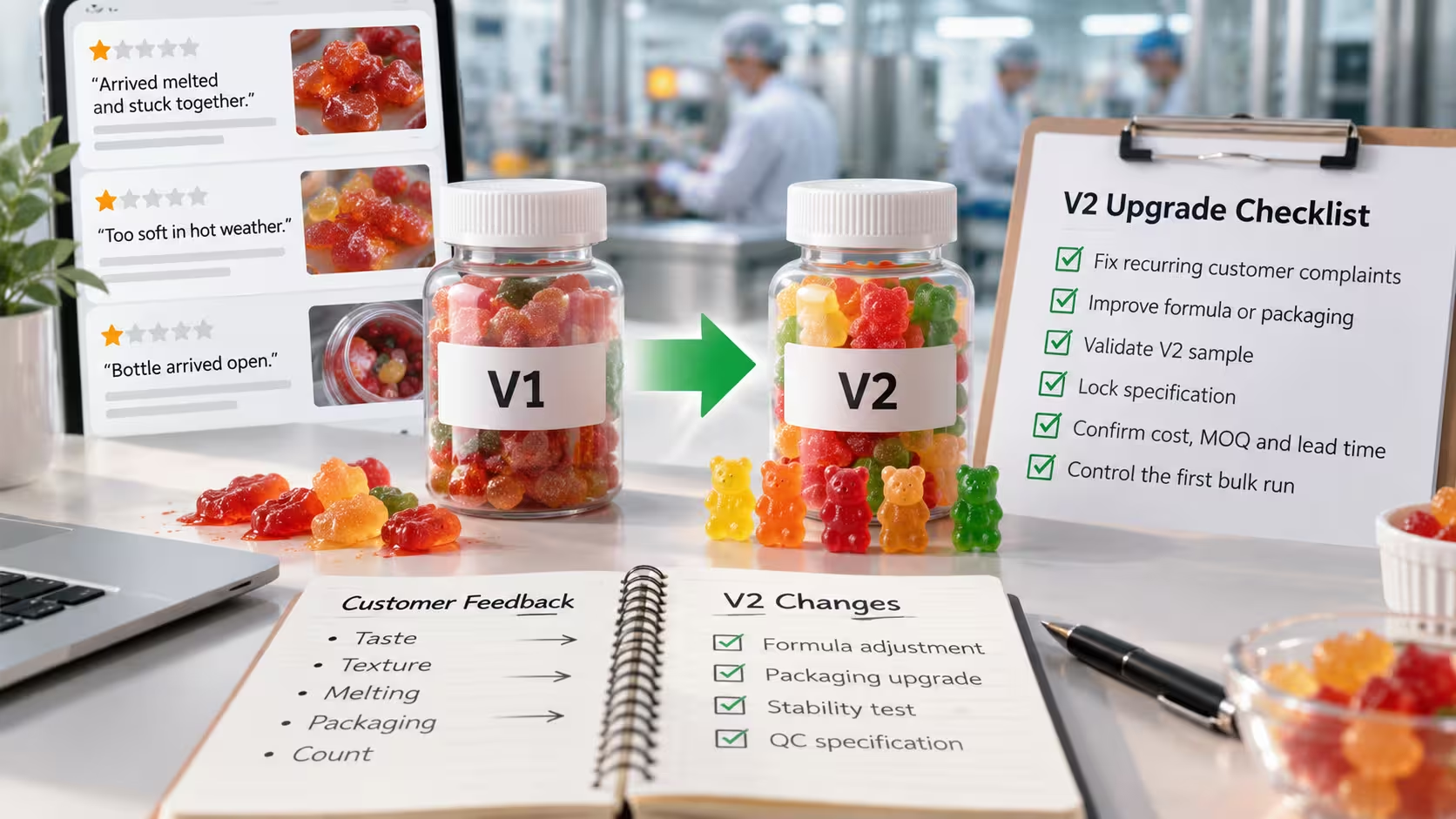
Your best-selling gummy SKU has 4.2 stars and a recurring one-star theme: “arrived melted and stuck together.” The reorder window is closing, and the factory wants your PO by Friday. Fix the product now, or you print the same defect across another few thousand units.
Upgrading a winning gummy product before the next bulk order means turning real customer feedback into a measurable V2 specification, validating a revised sample against the original problem, and locking every change on paper before the repeat production run ships.[2] Done right, you fix the defect without breaking the flavor, cost, or lead time your economics depend on.
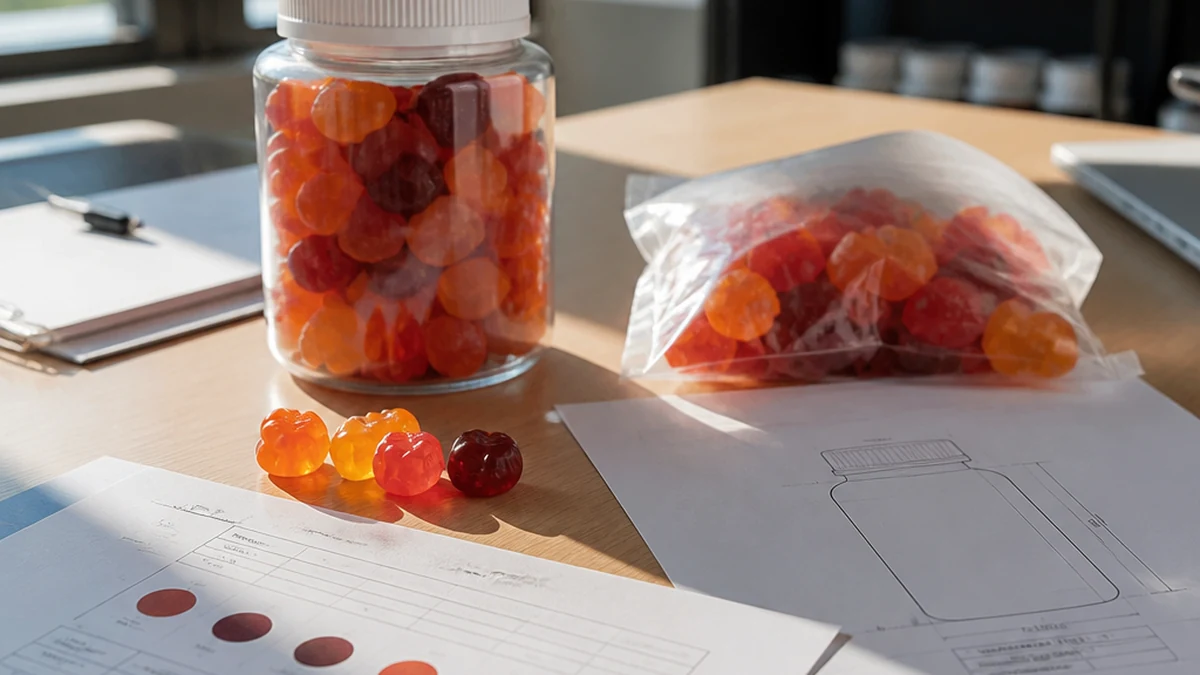
We run structured quality inspection at scale across our partner runs — the exact acceptance levels and sampling methods vary, so confirm what applies with the relevant authority or standard — and the pattern is consistent: the brands that win their reorder are the ones who treat a V2 upgrade as a controlled change, not a hopeful tweak. This guide walks the six stages our team uses with brand partners moving a proven gummy SKU into its next hybrid dropshipping-to-bulk transition.
Quick reference
- What triggers a V2 upgrade: a complaint theme that repeats across independent buyers AND multiple production batches — not isolated reviews
- First filter: separate product defects from shipping/fulfillment problems; a new batch won’t fix a hot-truck melt
- Protected variables: write down what must NOT change (flavor, texture, tested active dose) before listing what should
- Vague → measurable: “too soft” becomes a firmness range + a temperature/time survival test an inspector can run
- Sample rule: any change to what goes in the mouth requires a fresh chewable V2 sample; packaging-only can sometimes be photo-approved
- Cost reality: packaging swaps add ~1–3 weeks; texture or flavor reformulation adds ~3–6 weeks plus stability testing, and can raise MOQ
- Lock before you order: the written spec and the sealed golden sample must match exactly, or production runs to whichever is cheaper
- First V2 run: inspect against the new spec using the acceptance level you agree with the factory, keep V1 and V2 inventory separated by lot code, and track defect themes post-launch
What Should You Upgrade Before the Next Bulk Order?
Not every complaint deserves a formula change. Before you touch the recipe, you have to separate signal from noise — and separate a product defect from a fulfillment problem that a new batch won’t fix.
Recurring complaints vs. isolated negative reviews
A single one-star review is an anecdote. The same complaint recurring across independent buyers or multiple batches is a signal that deserves investigation, but the root cause may sit in the product specification, production process, packaging, storage, or fulfillment.
Pull every review, support ticket, and return reason for the SKU. Tag each by theme — texture, taste, melting, dosage, count, packaging. Only themes that repeat across independent buyers and multiple batches qualify for a V2 change. One reviewer who hated the flavor while 200 loved it is not a mandate to reformulate.
🔍 Worth checking: Sort complaints by production batch, not just by date. A defect that spikes in one batch and disappears in the next is a manufacturing variance, not a design flaw — and reformulating would waste your reorder.
Product defects vs. shipping and fulfillment problems
“Arrived melted” reads like a product complaint. Often it’s a shipping and packaging problem — gummies left in a hot truck, or a mailer with no thermal liner.
Splitting these matters because the fixes live in different places. A product defect changes your formula or spec. A fulfillment problem changes packaging, carrier, or the next order time for next day delivery routing. Reformulating a gummy to survive a heat event you could have solved with an insulated mailer is expensive engineering aimed at the wrong target.
Product, packaging, and batch-related issues
Sort every qualifying complaint into three buckets before writing a single line of the brief:
| Issue type | Example complaint | Where the fix lives |
|---|---|---|
| Product | “Too hard to chew,” “tastes bitter” | Formula / texture spec |
| Packaging | “Bottle arrived open,” “no freshness seal” | Packaging + labeling spec |
| Batch | “This lot clumped, last one didn’t” | Process control / QC spec |
If your gummy vitamins clump, that’s usually a batch and packaging issue — humidity control, anti-stick coating, or desiccant — not a reason to rebuild the recipe. Unclumping gummy vitamins is fixed with a desiccant packet and moisture-barrier packaging far more often than with a new formula.
Turning Customer Feedback Into a V2 Product Brief
You now have themes. A brief turns them into instructions a factory can act on and a QC inspector can measure.
Which problems should be fixed first?
Rank the buckets by frequency times severity. A complaint that shows up frequently and drives returns outranks a rare cosmetic gripe.
Fix the return-drivers first. Everything that pushes a refund or a one-star review hits your unit economics twice — once on the refund, once on the lost lifetime value.
What should change and what should stay the same?
This is the discipline most founders skip. Write down what must NOT change before you write what should.
Your winning SKU sells because of specific attributes — a flavor profile, a texture, and any active dose that buyers already trust.
Those trusted attributes are your protected variables. If your product contains active ingredients, treat the per-piece content as a locked, tested value; changing texture must never drift the dose. List the protected attributes explicitly so the factory doesn’t “improve” the thing customers came for.
Turning vague complaints into measurable requirements
“Too sticky” is not a spec. A factory can’t test against a feeling.
Translate each complaint into a number or a pass/fail check:
- “Too soft / melts” → define an agreed firmness criterion and a temperature/time conditioning test appropriate to the product and expected distribution conditions.
- “Clumps together” → define an agreed separation or anti-sticking acceptance check after controlled temperature/humidity conditioning.
- “Tastes off after a month” → flavor stable through the printed shelf life under storage conditions
- “Bottle count wrong” → net count verified against a defined tolerance; confirm the exact count-verification method and acceptable tolerance with the relevant authority or standard in the US
How Product Changes Affect the Next Production Run
Every change you approve ripples into cost, minimum order quantity, and lead time. Know which changes are cheap and which reset the clock.
Formula changes vs. packaging-only changes
A packaging-only change — new pouch, added desiccant, a freshness seal — usually keeps your existing formula, tooling, and approved gummy base. Lead time barely moves.
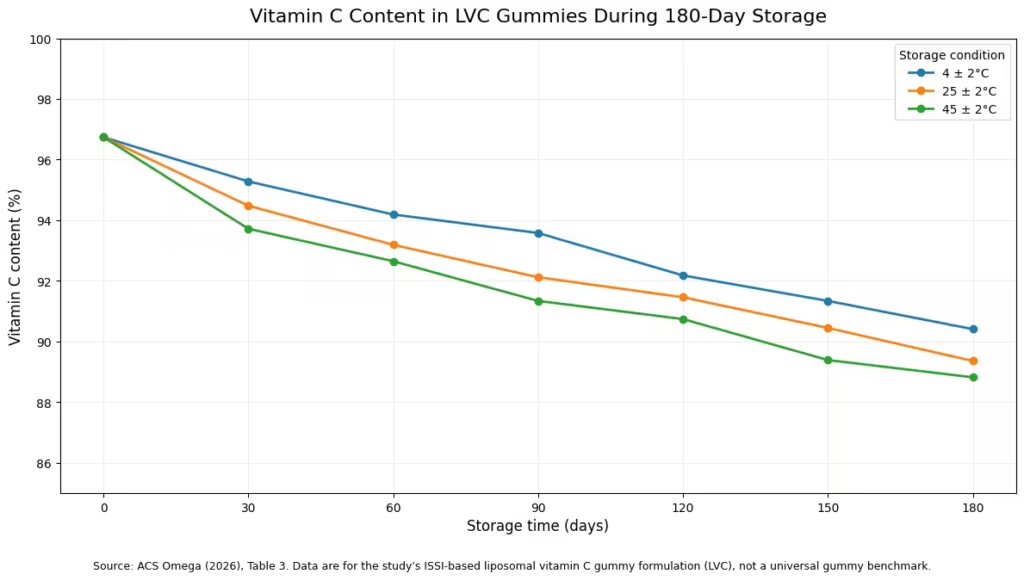
A formula change is a different animal. Adjusting firmness, sweetener load, or the coating that stops pieces sticking can require new ingredient sourcing, a re-run of stability testing, and fresh compliance review if actives are involved. A packaging fix ships in weeks; a formula fix can add a month or more before the bulk order is even eligible to run.
When a revised sample is required
Any change that touches what goes in the mouth requires a new sample. Full stop. Packaging-only changes can sometimes be approved from photos and a physical pack sample, but a texture, flavor, or dose change always needs a chewable V2 sample in your hands before the run.
✅ Do this: Ask the factory for the revised sample AND a retained sample of your current V1 from the same line, so you compare against the exact product your customers are reviewing — not a memory of it.
How upgrades affect cost, MOQ, and lead time
Here’s the part that surprises people. A “small” upgrade can raise your bulk purchase price or your minimum order quantity, because a new ingredient or a specialty pouch often carries its own supplier MOQ.
| Change type | Typical cost impact | MOQ impact | Added lead time |
|---|---|---|---|
| Packaging swap | Low–moderate | May raise MOQ to pouch supplier’s minimum | 1–3 weeks |
| Coating / anti-stick | Low | Usually none | 1–2 weeks |
| Firmness / texture reformulation | Moderate | Possible new base MOQ | 3–6 weeks + stability |
| Flavor change | Moderate | Flavor-house minimums apply | 3–5 weeks |
Whether bulk buying is cheaper still holds — per-unit bulk order price drops as volume rises. But an upgrade that forces a higher MOQ ties up cash. Model the landed cost of the V2 at your real order volume before you commit.
How to Validate the Revised Gummy Sample
A sample that looks great on your desk can still fail in a customer’s mailbox. Validation is where you prove the fix works — and prove it broke nothing else.
Does the V2 sample actually fix the original problem?
Test the sample against the measurable requirement you wrote, not against your gut. If the complaint was melting, put the V2 through the temperature and time condition you specified. If it was clumping, run the drop-and-separate check after conditioning the pieces in a humid environment.
A V2 that passes your written test is validated; a V2 that “seems better” is not. Document the result with numbers or photos.
Comparing V1 and V2 side by side
Blind the test where you can. Put the retained V1 and the new V2 in front of the same three or four people without telling them which is which, and score each on the protected attributes — flavor, chew, sweetness — plus the fixed defect.
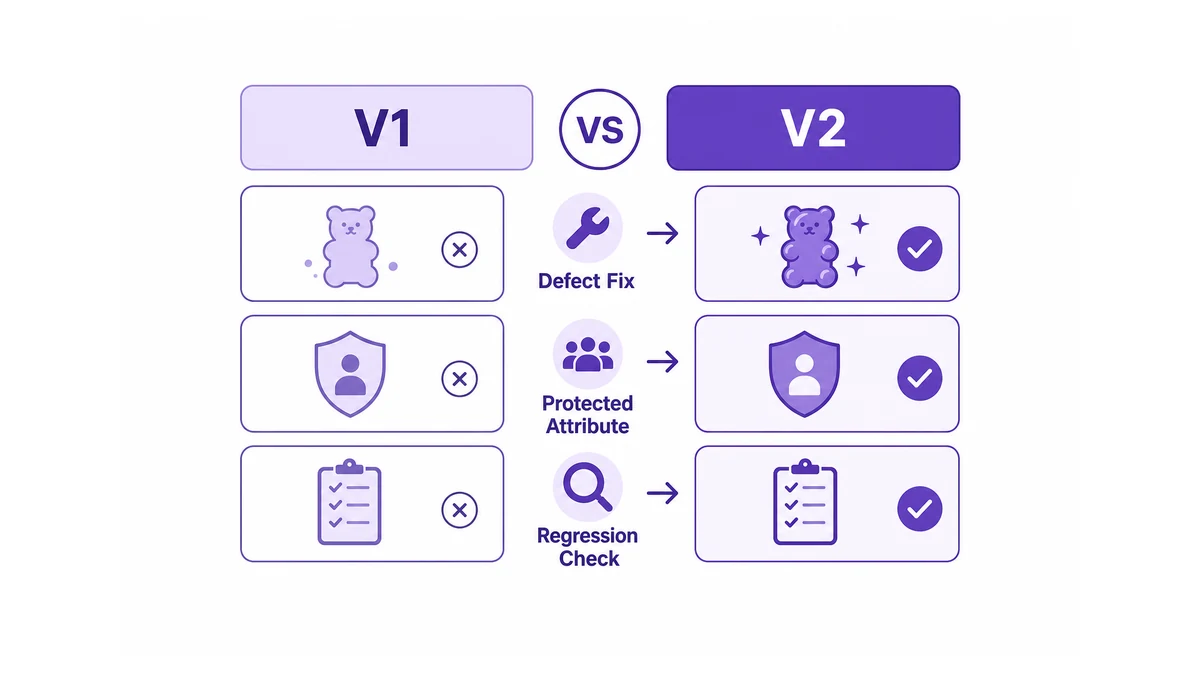
You’re looking for two things: the defect is gone, and the protected attributes still score as high as V1. If testers now prefer V1’s flavor, your fix introduced a regression.
Avoiding upgrades that create new problems
The classic trap: you firm up the gummy so it survives shipping, and now buyers say it’s too hard to chew. You solved melting and created a texture complaint.
Every upgrade is a trade-off, not a free win. Before you approve the V2, ask what the change might cost elsewhere — mouthfeel, dissolve rate, appearance, shelf life. Counterintuitively, the “better” sample is sometimes the one that changed less. Test the full attribute set, not only the thing you set out to fix.
Locking the V2 Specification Before Bulk Production
An approved sample that isn’t written down is not a specification — it’s a hope. The factory runs to the document, not to the sample sitting on your shelf.
Updating the product specification and approved sample
Rewrite the product spec to reflect V2: the new firmness range, the coating, the packaging, the count-by-weight tolerance, the storage conditions. Physically seal and label the approved V2 golden sample with a date and version number, and confirm the factory retains a matched copy.
The approved sample and the written spec must agree exactly — if they conflict, production defaults to whichever is cheaper for the factory.
Locking packaging, labeling, and batch requirements
Lock the pouch or bottle, the desiccant, the tamper-evident seal, and the label artwork as a single approved packaging spec.
State the batch requirements too: the inspection level you agree with the factory, the specific defects that trigger rejection, and the QC checks tied to each fixed complaint.
Recording every approved change before the repeat order
Keep a one-page change log: what changed from V1 to V2, why, who approved it, and the date. This is the document you hand the factory with the reorder and the reference you check the incoming batch against.
✅ Do this: Send the factory a written change summary and get their acknowledgment in writing before you wire the deposit. Verbal “yes we understand” on a call does not survive a shift change on the production floor.
Managing the First V2 Bulk Production Run
The first V2 run is the highest-risk batch you’ll ship. It’s a new spec at full volume, and any gap between your document and the line shows up in thousands of units at once.
Checking the upgraded batch against the new specification
Inspect the incoming batch against the V2 spec and the golden sample — not against V1. The inspector’s checklist should call out the fixed defect explicitly: run the melting test, the separation test, the count-by-weight, whatever your requirements specified.
We apply a consistent inspection discipline across every partner run, and the first V2 batch is where that discipline earns its keep. Approve the batch only when it passes the V2 checks; a batch that would have passed as V1 is not automatically a valid V2.
Keeping V1 and V2 inventory clearly separated
If you still hold V1 stock, keep it physically and digitally apart from V2. Mixed inventory means a customer reviewing your “fixed” product might receive the old defect — and your review data becomes uninterpretable.
Use distinct lot codes and, ideally, a visible packaging marker so warehouse and support teams can tell them apart at a glance.
Tracking reviews, returns, and defects after launch
Watch the same complaint themes you fixed. If “arrived melted” was a recurring share of reviews and drops toward zero on V2, the upgrade worked. If it holds steady, your fix targeted the wrong cause — likely a shipping problem you mistook for a product defect back in stage one.
Track returns and defect rates by version so the next reorder decision runs on data, not impressions. That feedback loop is the whole point: each bulk order should ship a measurably better product than the last.
Out-of-scope advisory: regulated ingredients
This guide covers upgrading conventional vitamin and supplement gummies — texture, firmness, packaging, and defect fixes on a proven SKU. Regulatory compliance for controlled or regulated ingredients is outside that scope, but if it applies to you, note the following advisory:
If your product contains cannabinoids such as THC or CBD, these can be federally regulated substances in the US and the applicable rules vary. Any label declaration should match the tested content in the locked formula, and the exact labeling, dose, and handling requirements can carry legal consequences. Confirm what is permitted and how it must be handled with the relevant authority or standard before treating any such ingredient as routine and before you finalize a spec.
For the record: the general trade meaning of a bulk order is simply a large quantity purchased at a per-unit discount, and there’s no universal count that defines it — “bulk” is set by each supplier’s minimum, whether you’re buying gummies, apparel, or anything else. The number that matters for your upgrade isn’t a definition; it’s the MOQ your V2 spec actually triggers.
Pull your review export this week, tag the themes, and draft the two-column “change / don’t change” list before you reply to the factory’s PO request. That single document is what turns a lucky first product into a repeatable one.
Have a project or a spec sheet in hand? Talk to asg dropship — real engineers answer.
Frequently asked questions
Can a gummy manufacturer reformulate an existing SKU instead of starting from scratch?
Yes. Many contract manufacturers can review an existing gummy formula or specification and determine whether it can be reproduced, modified, or reformulated for the next production run. For a proven SKU, the useful starting point is the current specification, Supplement Facts panel, available batch data, and a clear list of the defects or attributes you want to change. Feasibility still depends on the formula, process, packaging, and target-market requirements.
Does changing gummy packaging require new stability testing?
Not automatically, but the existing stability data should not be assumed to cover a different bottle, pouch, closure, seal, or desiccant configuration. Packaging can change moisture and oxygen exposure, which can affect gummy texture, sticking, potency, and shelf life. A documented assessment should determine whether the existing evidence remains applicable or whether bridging work or additional stability testing is needed.
Will a gummy formula change require updates to the Supplement Facts label?
It can. If the V2 formula changes the declared dietary ingredients, their amounts per serving, serving size, or other ingredients, the finished label needs to reflect the formulation actually being sold. A packaging-only improvement may not change the Supplement Facts panel, but brands should review the final formula and artwork together before releasing the revised production run. FDA requires dietary supplement labels to declare serving information, dietary ingredients and their amounts, as well as other ingredients where applicable.
Can gummy supplements be shipped in hot weather without melting?
They can be shipped in warm conditions, but no gummy should be treated as immune to extreme heat. Formula type, packaging, storage conditions, transit time, and shipping method all affect heat exposure. Current gummy manufacturers specifically address hot-weather shipping as a buyer question, and some note that packaging and shipping plans need to be considered together rather than relying on the gummy formula alone.
Sources
[1] Acceptable Quality Limit, AQL — qima.com
[2] The Industrial Gummy Making Process: A Step-by-Step Guide — tgmachine.com
[3] Production Lines, Equipment & 8 Gummy Formats – MPS Candy — lygjiayun.com
[4] Gummy Manufacturing Process: Industrial Guide — lomfiller.com
[5] The Best Gummy Candy Production Line — jymachinetech.com