
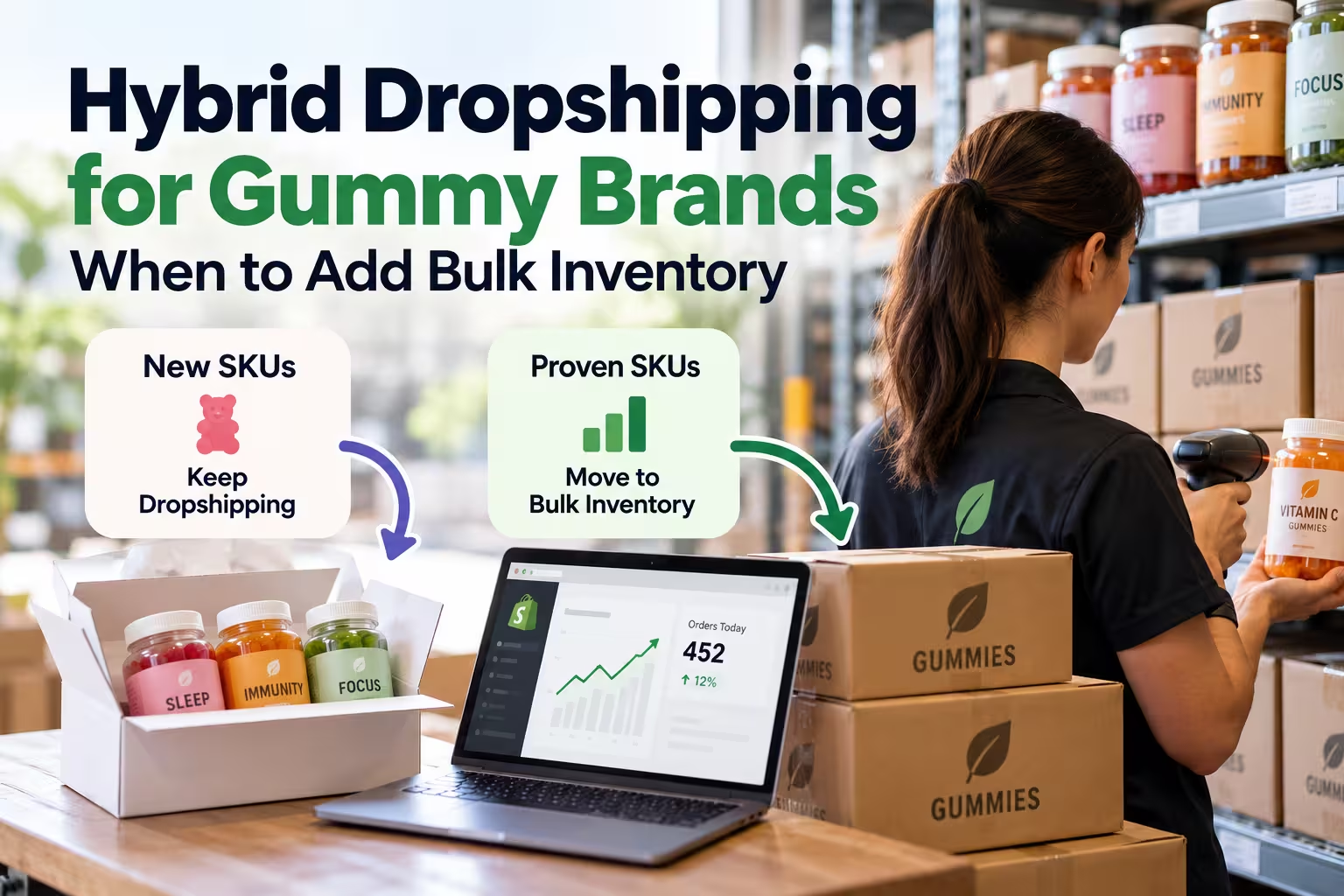
Your gummy store just crossed 40 orders a day on one hero SKU, and the per-order sourcing math that felt fine at launch now stings on every invoice. The fulfillment method that let you validate flavors without capital is quietly eating the margin you built.
That is the moment to stop treating dropshipping and stocked inventory as either/or. The answer is a hybrid dropshipping model — keep dropshipping unproven SKUs while moving your proven gummy sellers into stocked inventory to protect margin, shipping speed, and reorder velocity.
This guide on hybrid dropshipping for gummy brands and when to add bulk inventory shows the signals, the setup, and the math for deciding when a specific gummy SKU has earned stocked stock.
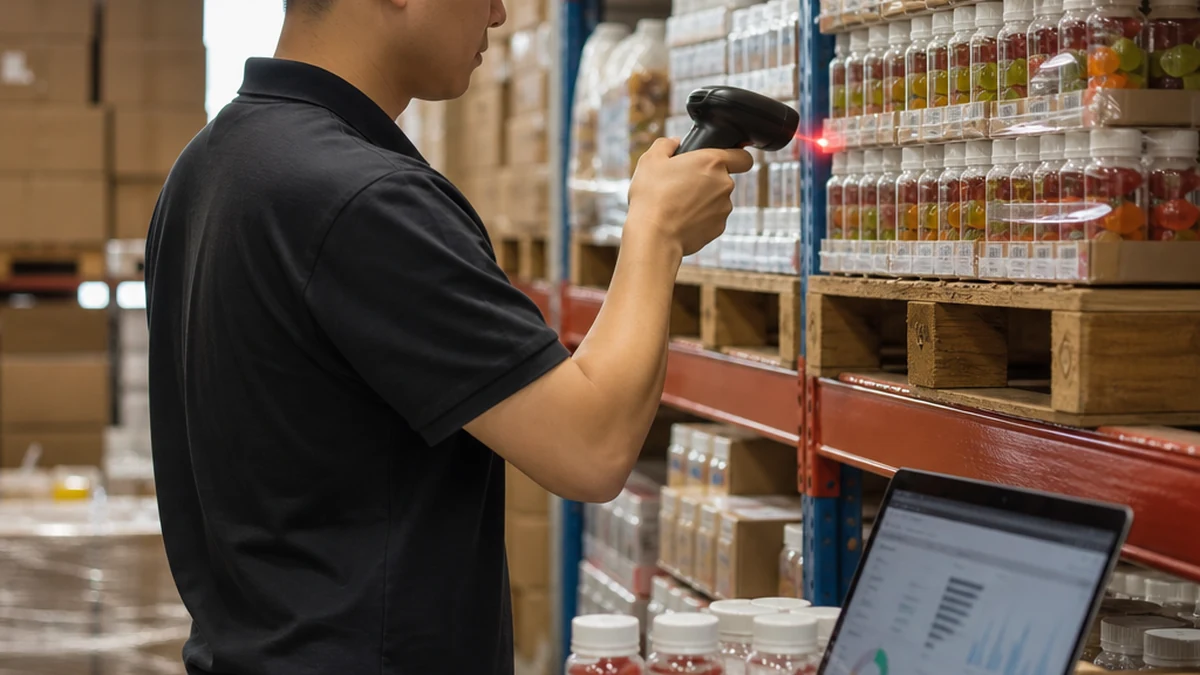
At ASG Dropship, we run AQL 2.5 inspection discipline across a high volume of daily orders and a broad catalog of SKUs, and the brands who scale cleanly are almost always the ones who stage this transition SKU by SKU — not all at once. AQL 2.5 is a recognized sampling threshold under the ISO 2859-1 standard.
If you are still mapping which products deserve stock, our SKU stocking checklist breaks down the sales-history signals worth trusting, and you can explore our ecommerce fulfillment setup once your shortlist is set.
Why Per-Order Dropshipping Gets More Expensive as Gummy Sales Grow
A per-order model is built for uncertainty. It shines when you do not yet know which flavor sells, because you pay only for what customers actually order. Once demand on a gummy SKU becomes predictable, that same flexibility starts working against your unit economics.
Per-unit purchasing and fulfillment costs at higher order volumes
Buying one unit at a time means you pay a single-unit price every time, plus a pick-and-pack fee on each order. Is buying in bulk cheaper? For a proven SKU with steady sales, almost always — because manufacturing and freight both reward batch quantity.
A gummy bottle sourced per order might carry a manufacturing cost several dollars above the same bottle produced in a 5,000-unit batch. Multiply that gap across hundreds of monthly orders and the leak is obvious. What is bulk manufacturing buying you? Lower cost per unit, priority in the production queue, and freight consolidated into full cases instead of onesie parcels.
Why larger order volume requires tighter batch and inventory control
At low volume, quality variance hides. At scale, one soft or discolored batch reaches dozens of customers before you notice.
Gummies are moisture- and heat-sensitive — pectin and gelatin bases are known to soften and stick above roughly 77°F (25°C) and lose texture in high humidity, a documented instability[3] — so larger order volume demands the batch and inventory management discipline that per-order shipping never forced on you.
This is where stocked inventory quietly helps: a single inspected production run gives you one lot number to trace, rather than a stream of loosely controlled per-order pulls. That control is the difference between catching a defect in the warehouse and catching it in a customer review.
Shipping speed and repeat-purchase expectations for growing gummy brands
Supplement buyers reorder. A customer who liked your sleep gummy in March expects it in April — fast. Per-order fulfillment through a distant supplier stretches transit windows, and slow shipping is a leading driver of subscription and repeat-purchase churn[4].
Holding proven SKUs closer to your customers cuts days off delivery and protects the repeat-purchase behavior your lifetime value depends on. Speed is not a luxury in supplements; it is retention.
How Hybrid Dropshipping Works for Gummy Brands
Does dropshipping need inventory? Not to start — but a growing gummy brand benefits from adding some. Hybrid dropshipping keeps both fulfillment methods running side by side, each doing the job it is best at.
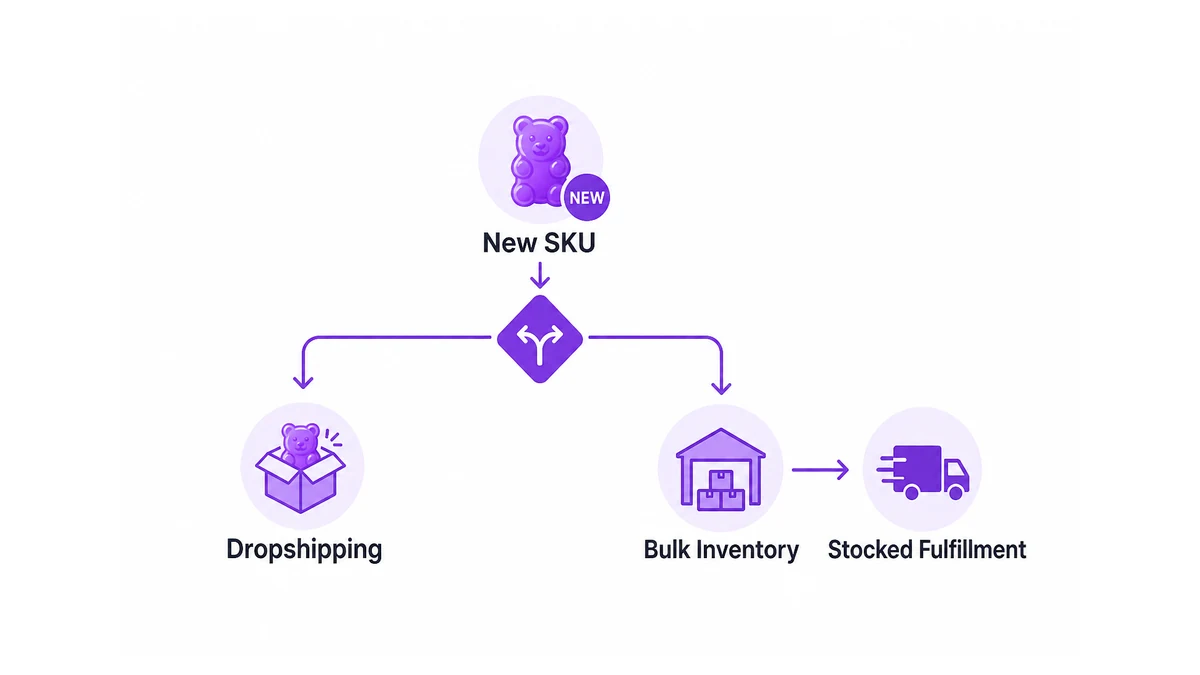
What a hybrid dropshipping model actually looks like
In a hybrid model, your catalog splits by evidence. New and experimental gummy products stay on per-order dropshipping, so you risk no capital validating them. Proven, high-velocity SKUs move into stocked inventory held at a fulfillment center.
Your storefront looks identical to the customer. Behind it, each order routes to the fulfillment path that fits the SKU — a routing rule, not a store rebuild.
Dropship new SKUs while stocking proven gummy products
The rule of thumb is simple: dropship to discover, stock to scale. A flavor with three months of stable sales and healthy reorder velocity is a stocking candidate. A flavor you launched last week is not.
✅ Do this: Keep every unproven gummy SKU on dropshipping until it shows a sustained period of steady, non-promotional sales before you commit capital to a bulk run.
Staging the transition this way is the guardrail against the classic mistake — buying 5,000 units of a flavor that customers try once and abandon. The dropship-first phase is what makes that gamble avoidable.
Where bulk gummy inventory can be held for fulfillment
Stocked gummies need a home with climate control and inventory-managed pick-and-pack. That can be a third-party fulfillment center, a supplier-managed warehouse that ships on your behalf, or a hybrid arrangement where the manufacturer holds bulk stock and releases orders directly.
Because we run fulfillment and sourcing at industrial scale, a brand’s proven bulk inventory can sit in the same operation that inspects the production run — keeping one lot, one warehouse, and one accountable party across sourcing, QC, and shipping rather than splitting them across vendors.
Buying From Wholesale Suppliers for Your Proven Gummy SKUs
Once a SKU is proven, per-order sourcing gives way to wholesale purchasing — and the supplier relationship changes shape entirely. Wholesale means committing to minimum order quantities in exchange for tiered price breaks, so the manufacturer or supplier plans a production run around your forecast instead of pulling stock one bottle at a time.
For gummies, that also means negotiating on the things per-order sourcing hides: co-packing terms, the base (pectin vegan versus gelatin), fill accuracy, and the shelf-life window you receive on the finished lot.
Vet wholesale suppliers on three points before you commit capital. First, third-party lab documentation — a certificate of analysis per batch, which reputable dietary-supplement manufacturers issue under current good manufacturing practice[5]. [6] Second, real production-plus-freight lead time in writing, not a quoted best case. Third, sampling discipline on the finished run, because a wholesale batch amplifies any formulation defect across thousands of units.
A supplier that inspects to a defined AQL and hands you the lot number and expiry is one you can build reorder cadence around. A supplier who cannot produce a COA is a liability disguised as a price break.
Offering BOPIS Without Abandoning Your Hybrid Model
Buy Online, Pick Up in Store (BOPIS) sits awkwardly with dropshipping — you cannot let a customer reserve for pickup something you do not physically hold. This is precisely where the stocked half of a hybrid model unlocks a fulfillment option per-order sourcing never could. Only your proven, bulk-stocked gummy SKUs are BOPIS-eligible; the dropshipped experimental flavors stay online-only, because there is no local stock to reserve against.
For a gummy brand, BOPIS carries a temperature caveat most retailers overlook. A pickup counter near a sunlit storefront or an un-airconditioned back room can soften a pectin batch before the customer arrives. If you offer BOPIS, hold pickup stock in the climate-controlled zone and only move it forward at pickup time.
Done right, BOPIS shortens delivery to zero for local repeat buyers, removes the shipping cost on those orders, and turns your best sellers into a foot-traffic driver — but it works only for SKUs you have already committed to stock. That gating is the point: hybrid fulfillment decides which SKUs qualify.
Using Pickup Outlets and Locker Networks to Cut Delivery Cost
Third-party pickup outlets — parcel lockers, click-and-collect points, and carrier pickup networks — are the middle ground between direct-to-door delivery and in-store BOPIS. They let stocked gummy SKUs reach a customer without a residential last-mile leg, which is often the single most expensive segment of a parcel journey.
Routing proven SKUs from bulk inventory to a nearby pickup outlet consolidates several deliveries into one carrier drop, trimming per-order shipping on exactly the products whose margins you are trying to protect.
The gummy-specific catch is dwell time. A parcel locker can bake in afternoon sun, and an uncollected package sitting for days is the enemy of a heat-sensitive product. Restrict pickup-outlet fulfillment to SKUs with sturdier bases and pair it with a prompt-collection reminder so batches do not linger.
Pickup outlets also give you geographic reach without opening physical stores — you extend the retention benefit of fast, local fulfillment to regions where BOPIS is not feasible, using the same bulk-stocked winners that already cleared your break-even math.
When Should a Gummy Brand Add Bulk Inventory?
Not every SKU earns stock, and timing it wrong ties up capital in slow-moving product. Three operational signals tell you a specific gummy SKU is ready.
Stable sales and predictable reorder velocity
The first signal is boring, and that is the point. You want a SKU whose weekly sales barely move — no dependence on a single promotion, no seasonal spike doing the heavy lifting. When you can forecast next month’s units within a tight band, you can size a production batch without gambling.
Predictable reorder velocity from repeat customers is the strongest form of this signal, because it shows real product-market fit, not one-time curiosity.
Per-order sourcing and shipping costs reducing margins
The second signal shows up on your P&L. When per-order manufacturing and parcel shipping have compressed a SKU’s contribution margin to the point where growth stops feeling profitable, bulk purchasing is the lever. If bulk pricing would meaningfully lift that SKU’s margin, the case is building.
Supplier lead times creating replenishment risk
The third signal is stockout risk. If your supplier’s lead time on a hot SKU means you can run dry before replenishment arrives, per-order fulfillment is now a liability. Holding a bulk buffer absorbs that lead-time gap and keeps your best seller in stock during demand spikes.
🔍 Worth checking: Before committing to bulk, ask the manufacturer for their actual production-plus-freight lead time in writing — the gap between quoted and real lead time is where replenishment plans break.
Setting Up a Hybrid Inventory and Fulfillment Flow
Adding bulk stock does not mean rebuilding your operation. It means adding one lane to the road you already drive.
Decide which gummy SKUs should be stocked
Rank your catalog by units sold, margin, and reorder rate over the last 90 days. The top few SKUs — the ones with stable demand and thin per-order margins — are your stocking shortlist. Everything else stays on dropshipping until it earns promotion.
Coordinate bulk production, warehousing, and fulfillment
Once you pick a SKU, the flow is: place a bulk production order, run inspection on the finished batch, move it into the fulfillment warehouse, and connect that stock to your store’s order routing. The single hardest link is inspection — a bulk gummy run amplifies any formulation or moisture defect across thousands of units at once.
We hold AQL 2.5 discipline on every batch precisely because a stocked run has no per-order safety net; the inspection is the safety net.
Sync inventory levels with ecommerce orders and replenishment
Your storefront must know how many stocked units remain, so it can route orders correctly and reorder before you run out. On Shopify, you manage this through inventory tracking per variant; how to bulk edit inventory on Shopify comes down to using the bulk inventory update from a CSV or the inventory editor rather than touching SKUs one by one.
Sellers running marketplace channels handle the equivalent when they upload bulk inventory in Amazon via feed files, and QuickBooks users add multiple inventory items through an import sheet rather than manual entry.
Set a reorder point for each stocked SKU — the unit level that triggers a new production run based on lead time and daily sales — so replenishment stays automatic.
Gummy-Specific Risks When Moving Into Bulk Inventory
Gummies are not t-shirts. They expire, they soften, and they come in flavor variants that do not sell evenly. Three risks deserve your attention before you place a bulk order.
Avoid buying bulk before demand is proven
The most expensive mistake is buying stock on hope. A SKU that spiked once during a promotion is not proven — it is a data point. Committing capital to bulk before demand is stable is how brands end up with a warehouse full of product they discount to clear.
🚫 Avoid: Sizing your first bulk run to your best sales week. Size it to your worst steady week, then reorder as velocity confirms.
Plan around shelf life and storage requirements
Every gummy batch carries an expiration date, and pectin or gelatin bases degrade faster in heat and humidity. Your bulk quantity must sell through comfortably inside that shelf life, with margin to spare. Storage has to be climate-controlled — a hot warehouse turns a clean batch into melted, clumped inventory nobody can ship.
Prevent slow-moving flavors from creating excess stock
A five-flavor gummy line rarely sells five flavors equally. Order bulk quantities weighted to real per-flavor sales data, not an even split. Otherwise the two weak flavors become dead stock while the hero flavor stocks out — the worst of both problems at once.
Comparing Per-Order and Bulk Inventory Costs for Gummies
The decision comes down to arithmetic, not gut feel. Here is how to run it for any single SKU.
Compare unit cost at different purchasing volumes
How to calculate bulk pricing starts with the manufacturer’s price breaks. Request quotes at several volumes and compare landed cost per unit — manufacturing plus freight plus any fulfillment fee — at each tier.
| Purchasing model | Cost drivers per unit | Best for |
|---|---|---|
| Per-order dropshipping | Single-unit price + per-order pick/pack + parcel shipping | New or unproven SKUs |
| Small bulk run | Batch price break + consolidated freight + storage | Emerging SKUs with early traction |
| Full bulk production | Lowest batch price + full-case freight + carrying cost | Proven, high-velocity SKUs |
Include storage, fulfillment, freight, and inventory carrying costs
Bulk is not just a lower unit price. Add warehousing, per-order fulfillment, inbound freight, and the carrying cost of capital tied up in stock. A realistic bulk comparison counts every one of these — the lower manufacturing cost only wins if these additions do not erase the gap.
Calculate the sales volume needed to justify bulk inventory
Find the monthly unit volume where total bulk cost per unit drops below your per-order cost per unit. That break-even volume is your green light. Below it, keep dropshipping; above it with stable demand, stock.
Roughly, a SKU selling a few hundred stable units a month with a meaningful manufacturing price break is where most gummy brands cross into bulk territory — but run your own numbers, because your freight and storage costs move the line.
Why Hybrid Fulfillment Makes Sense as Gummy Brands Scale
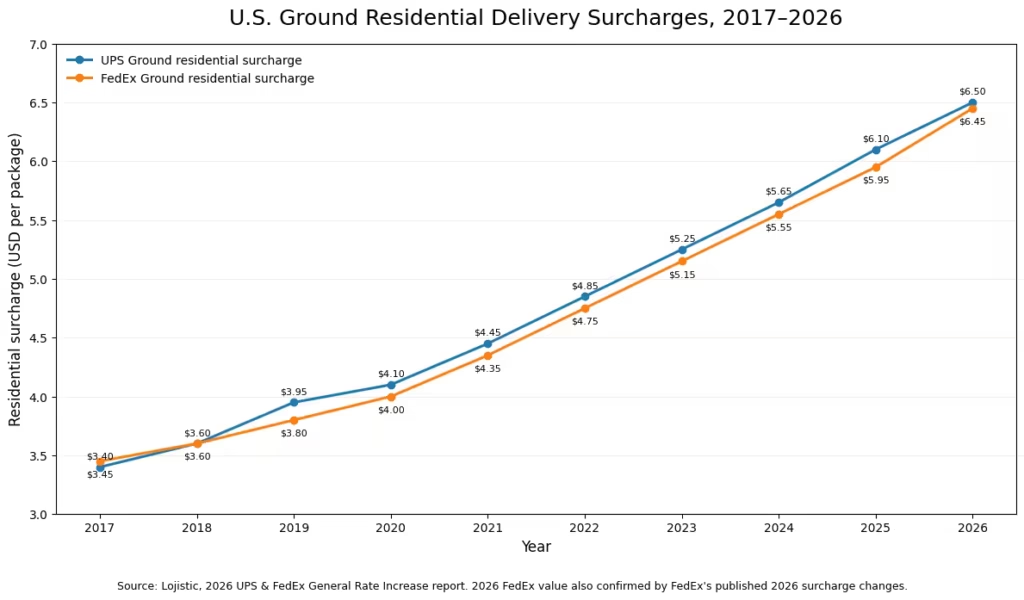
Two forces are pushing gummy brands toward hybrid fulfillment in 2026. The first is cost pressure: parcel carriers have raised rates and added dimensional-weight and surcharge fees year over year, which punishes the onesie-parcel economics of pure dropshipping hardest on heavy, bottled products like supplements.
The second is retention economics — as customer-acquisition costs climb, brands lean harder on repeat purchases, and repeat buyers reward the fast, reliable delivery that only local stock delivers.
Hybrid fulfillment answers that directly: it keeps the zero-risk validation of dropshipping for discovery while moving proven winners onto bulk economics that actually hold margin. In 2026 that combination reads less like an option and more like the default operating model for a supplement brand that intends to still exist in three years.
Stage the Transition SKU by SKU
Treat each stocking decision as a small, reversible bet — prove velocity, run the break-even math, commit one SKU, then reassess before the next. That cadence helps keep capital from getting stranded in slow-moving flavors.
Build a Hybrid Fulfillment Plan for Your Gummy Brand
Is drop shipping dead in 2026? Not at all — it remains the smartest way to launch and test gummy SKUs with zero inventory risk. What changes as you grow is that your proven winners outgrow it, and hybrid dropshipping for gummy brands, and knowing when to add bulk inventory, lets you keep both advantages instead of choosing.
Build your plan SKU by SKU. Pull 90 days of sales history, flag the two or three SKUs with stable velocity and squeezed margins, request bulk price breaks and real lead times from your manufacturer, and run the break-even math above. Keep everything else on dropshipping. The most profitable products to stock are simply your own proven repeat-buy SKUs — the flavors customers already come back for.
When a SKU clears the break-even threshold with stable demand and shelf life you can sell through, that is your signal to stock — start with one, prove it, then promote the next.
Quick reference
- When to add bulk inventory: a gummy SKU with 8–12 weeks of stable, non-promotional sales and predictable reorder velocity
- Is buying in bulk cheaper: yes for proven SKUs — batch price breaks plus consolidated freight beat single-unit sourcing
- Keep on dropshipping: all new, experimental, or seasonal SKUs until demand is proven
- Break-even trigger: the monthly unit volume where total bulk cost per unit (manufacturing + freight + storage + carrying) drops below per-order cost per unit
- Wholesale supplier vetting: COA per batch, written lead time, defined AQL sampling
- BOPIS and pickup outlets: eligible only for bulk-stocked SKUs; hold pickup stock climate-controlled
- Gummy-specific limits: climate-controlled storage required; size each run to sell through well inside shelf life
- Flavor risk: weight bulk quantities to real per-flavor sales data, never an even split
- Inspection standard we apply: AQL 2.5 sampling on applicable production batches
Have a project or a spec sheet in hand? Talk to asg dropship — real engineers answer.
Frequently Asked Questions
How much gummy inventory should I order for my first bulk run?
Base the first bulk order on proven sales velocity rather than your best promotional week. Review recent non-promotional sales, supplier lead time, minimum order quantity, available cash, storage capacity, and the product’s remaining shelf life. For a proven gummy SKU, a conservative first run is usually safer than buying enough for an optimistic forecast. The goal is to cover expected demand and replenishment time without leaving slow-moving stock in the warehouse close to expiry.
How do I calculate a reorder point for bulk gummy inventory?
A practical starting formula is:
Reorder point = average daily sales × replenishment lead time + safety stock
For example, if a gummy SKU sells consistently each day, the reorder point should cover the units you expect to sell while the next batch is being produced and transported, plus a buffer for demand spikes or supplier delays. Use the supplier’s actual production-to-warehouse lead time rather than the shortest quoted production time. Because gummies have a finite shelf life, safety stock should protect against stockouts without creating excessive aged inventory.
Can a 3PL store bulk gummy inventory and fulfill individual ecommerce orders?
Yes. A suitable 3PL or fulfillment partner can receive a bulk gummy production run, store the inventory, synchronize stock with your ecommerce store, and pick, pack, and ship individual customer orders as they arrive. Before moving inventory, confirm that the provider can manage lot numbers, expiration dates, inventory accuracy, first-expiring-first-out rotation where required, and the storage conditions specified for the product. This allows a brand to buy proven SKUs in bulk without operating its own warehouse.
How should bulk gummy inventory be stored to prevent melting or clumping?
Bulk gummies should be stored in a cool, dry, temperature-controlled environment according to the manufacturer’s validated storage specifications. Heat, humidity, direct sunlight, and repeated temperature changes can affect texture and cause gummies to soften, stick, or clump during storage and fulfillment. Before sending a large production run to a warehouse or 3PL, confirm its temperature and humidity controls and make sure the conditions match the requirements for the specific formulation and packaging.
Sources
[1] ISO 2859-1:2026(en), Sampling procedures for inspection… — iso.org
[2] Acceptable Quality Limit, AQL — qima.com
[3] Pectin vs Gelatin: Heat Stability Guide — probiotainnovations.com
[4] 22% Churn Rate Reduced to 9.4% with Improved… — linkedin.com
[5] Small Entity Compliance Guide: Current Good… — fda.gov
[6] The New Food Current Good Manufacturing Practices and… — pmc.ncbi.nlm.nih.gov
[7] Dropshipping Failure Rate: Real Statistics & Why 90% Fail… — blog.launchese.com
[8] Why Over 90% Of Dropshippers Fail (Dropshipping… — appscenic.com