Dropshipping VS Private‑Label: Which Business Model Fits Your Store in 2026?
janson@asgdropship.comASG Team
10 min readUpdated Aug 26, 2026
Only 10–20% of dropshipping stores survive past their second year[1], yet the model still attracts first-time founders because the barrier to entry is essentially zero. Private label, by contrast, requires real capital and real decisions — but the stores that make it through tend to build something that actually compounds.
This article lays out exactly what each model demands, what each one returns, and which one fits where you are right now.
Quick reference
Dropshipping startup cost: typically under $500; no inventory required
Private label startup cost: $3,000–$15,000+ including sampling, packaging, production, and freight
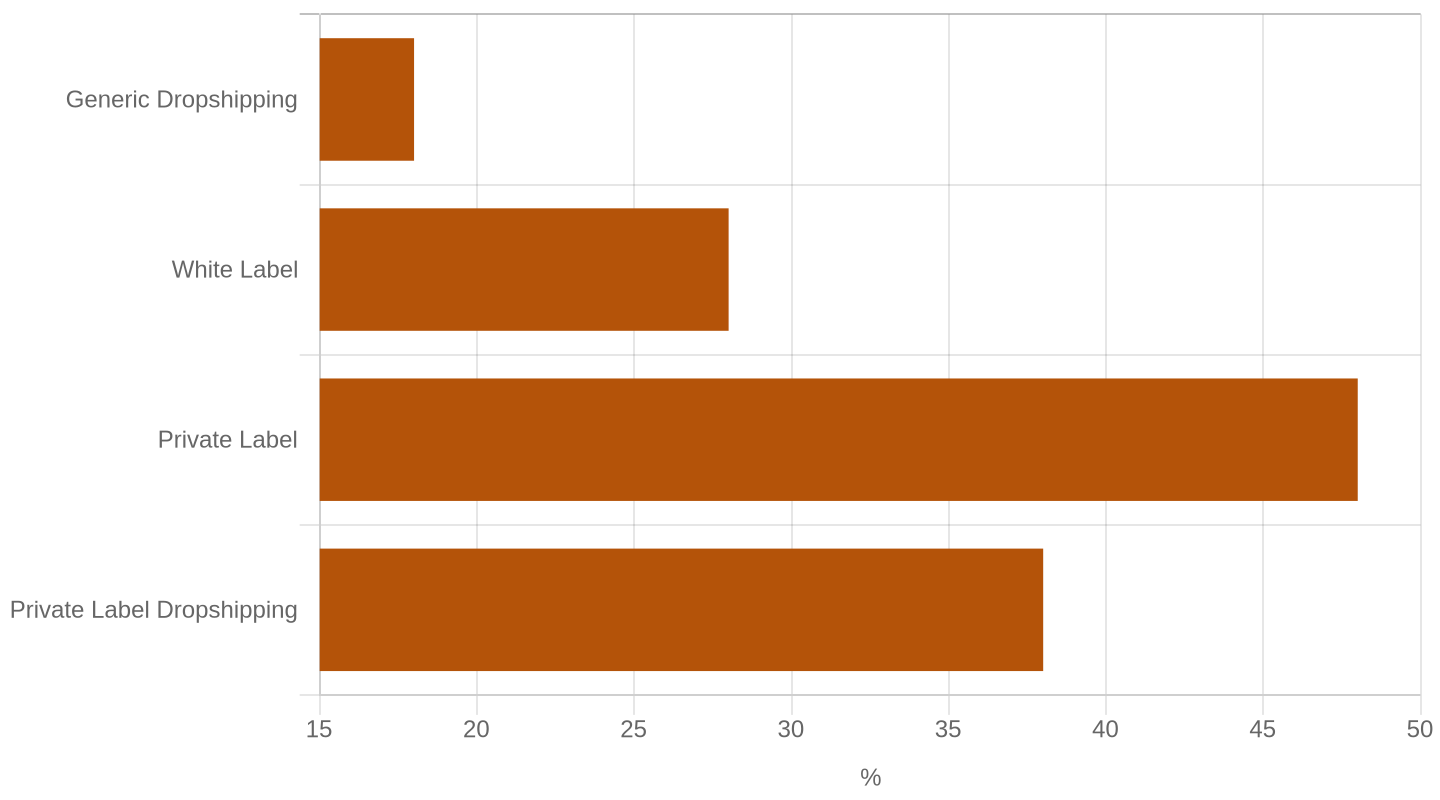
Gross margin — dropshipping: commonly 10–30% on commodity SKUs
Gross margin — private label: commonly 35–60% depending on category and customization
Time to first sale — dropshipping: 1–3 days from store launch
Time to first sale — private label: 60–120 days from supplier engagement
MOQ typical range (private label, China): 200–1,000+ units depending on product complexity
Brand ownership: zero with dropshipping; full with private label
Defensibility: low (any competitor can list the same SKU) vs. high (only you sell your branded product)
Private label vs white label: white label = stock product, your branding only; private label = customized product + your branding
OEM vs private label: OEM implies factory-designed to your spec; private label typically builds on existing bases with your customization
How Dropshipping Works — and Who It Actually Suits
The fulfillment flow from supplier to customer
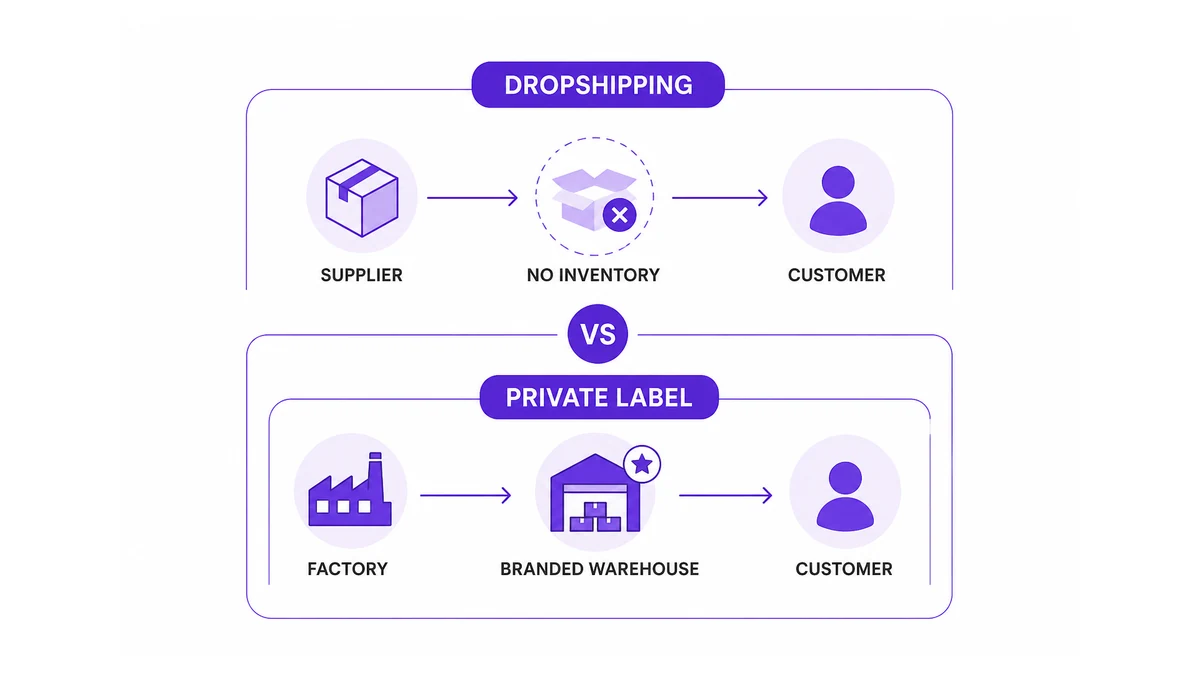
In a dropshipping operation, your store is purely a marketing and ordering layer. A customer places an order; you forward it to a third-party supplier — typically based in Dongguan or Yiwu — who picks, packs, and ships directly to that customer under plain or light-branded packaging. You never touch inventory.
The gap between what you charge and what the supplier invoices is your gross margin. That sounds clean. The operational reality is messier: you’re dependent on the supplier’s stock levels, their shipping carriers, and their quality consistency — none of which you control.
When comparing dropshipping with private label, the fulfillment flow is the first thing to stress-test, because every failure point in dropshipping traces back to that dependency chain.
Startup costs and margin reality
Startup costs for a pure dropshipping store can sit below $500 — a Shopify plan, a domain, and a small ad budget.[3] That low bar is real. What’s also real: supplier-set pricing leaves typical gross margins between 10% and 30% on commodity products, and paid traffic on Meta or TikTok now costs enough that many stores operate at breakeven or worse until they find a winning SKU.[4]
Gross margin matters less than contribution margin after ad spend. At a 20% gross margin and a 15% customer acquisition cost as a share of revenue, you’re left with 5% — before platform fees, chargebacks, and returns.[5]
🔍 Worth checking: Before committing to a supplier, request their average shipping time to the continental US and a sample tracking report from the last 30 days.[6] A supplier who won’t share that data is a liability.
Why so many dropshippers fail to scale
The PAA question “why do so many dropshippers fail?” has a blunt answer: the product is not theirs. Any competitor can list the same SKU tomorrow, undercut by two dollars, and capture the same buyer. There is no moat.
A winning ad creative generates sales. Then it gets copied. Then margins compress. Then a new supplier starts selling direct-to-consumer on the same channel. This cycle repeats until the store either pivots to private labeling or exits.
Reaching $10,000 per month in dropshipping revenue is achievable — many stores hit it briefly. Sustaining it is where the model breaks down, because revenue built on generic products has no retention mechanism. Repeat-purchase rates on unbranded dropshipped goods typically run far below those of branded products in the same category. customer retention rate
How Private-Label Manufacturing Works — and What It Demands
From product brief to branded inventory
Private labeling means you source a product — or have one manufactured — and sell it under your own brand name, with your own packaging, labeling, and positioning. The manufacturer stays invisible. Your brand is what the customer sees, buys, and remembers.
The four steps from brief to production typically run: product specification → factory sourcing and sampling → packaging design and compliance review → production run and quality inspection. At ASG Dropship, we run AQL 2.5 inspection discipline across production batches, which means statistically, no more than 2.5% of units in a lot can carry minor defects before the lot is rejected — a standard most boutique agents skip entirely.
Private label is sometimes confused with white label and OEM. White label means you buy a stock formulation or product and put your brand on it — minimal customization. OEM (original equipment manufacturer) typically implies the factory designs the product to your spec. Private label sits between: you choose from existing bases and customize packaging, formulation, or both.
The distinction between private vs white label matters operationally — private label usually allows more differentiation.
Upfront investment and minimum order realities
Minimum order quantities (MOQs) for private label manufacturing in China typically start at 200–500 units for simple goods and 1,000+ for anything with custom tooling or formulation. A realistic first private label investment — including sampling, packaging design, production, and freight to a US 3PL — often lands between $3,000 and $15,000 depending on category.
That’s real money. It’s also the price of a real asset: a branded product that a competitor cannot list on their own store tomorrow.
✅ Do this: Order at least two sample rounds before approving production. The first sample identifies manufacturing gaps; the second confirms fixes. Skipping the second round is the single most common cause of full-run rejections we see from new brand partners.
What private-label dropshipping looks like as a hybrid
Private-label dropshipping combines custom branding with dropship fulfillment — you own the product design and packaging, but the supplier ships individual orders directly to customers, so you still hold zero inventory. This hybrid suits founders who want brand control but aren’t ready to pre-purchase and warehouse large production runs.
This is where the question “is private-label dropshipping worth it?” has a clear yes — with the right supplier. The condition is that your supplier must store your branded inventory and fulfill on-demand. Standard dropship suppliers don’t do this; you need a partner with a warehouse and pick-and-pack capability built around your SKUs. We run this for over 2,400 brand partners today.
🚫 Avoid: Assuming any Chinese dropship agent can handle private-label fulfillment. Most are set up for generic stock. Ask specifically whether they can store your branded units, print your labels per order, and ship in your custom packaging.
Head-to-Head: The Key Differences Between Dropshipping and Private Label
Video: Dropshipping Vs Private Label Which Is Right For Your Business
Capital and risk exposure
Dropshipping carries near-zero inventory risk — you only pay the supplier after a sale. Private label requires upfront capital for production runs before a single order is placed. That’s the defining trade-off.
Dimension
Dropshipping
Private Label
Startup capital
Under $500
$3,000–$15,000+
Inventory risk
None
Moderate–high
Gross margin range
10–30%
30–60%+
Brand ownership
None
Full
Speed to first sale
Days
60–120 days
Defensibility
Low
High
The capital requirement is a filter, not a flaw. It screens out the competition.
Speed to first sale
A dropshipping store can be live and processing orders within 72 hours of setup. A private label product — from brief through sampling, production, quality inspection, and freight — typically takes 60 to 120 days before the first unit lands at a US warehouse.
That lag is real. For founders who need cash flow now, dropshipping or private label used in a sequenced strategy makes more sense than forcing private label before you have working capital.
Brand control and customer loyalty
With dropshipping, you control the marketing but not the product, not the packaging, and not the post-purchase experience. A customer who loves the item has no particular reason to return to your store — they can find the same product elsewhere.
Private labeling flips that. Your brand is on the box. Your insert card is inside. Your retention email sequence references a product the customer can only get from you. That exclusivity is what drives repeat purchases — and repeat purchases are what make a store an asset rather than a treadmill.
Why Private Label Builds More Durable Business Value
Pricing power and repeat-purchase rates
Generic versus private label products compete differently in the market. A generic dropshipped product competes on price alone — any supplier can undercut you. A private label product competes on brand perception, formulation, and customer experience. That difference shows up directly in what you can charge.
Private label gross margins of 40–60% are achievable in categories like supplements, beauty, pet, and home goods — compared to 15–25% typical of commodity dropshipping in the same niches. The FDA’s guidance on labeling requirements[2] adds compliance overhead to private label, but it also raises the barrier for copycats.
Repeat-purchase rates tell a similar story. Branded products with distinct packaging and a clear value proposition consistently generate higher customer lifetime value — the foundation of a business that can be valued and sold, not just operated.
✅ Do this: When evaluating private label suppliers, ask for their branded vs white label pricing differential in writing. Brands that invest in custom packaging often get preferential production slots because they represent predictable, recurring volume.
Typical gross margin by fulfillment model
Is private-label dropshipping worth the switch?
For a store already generating $5,000–$10,000 per month in dropshipping revenue, the switch to private label or private-label dropshipping is almost always worth modeling. The math: if your current gross margin is 20% and private labeling the same category pushes it to 45%, you can spend more on customer acquisition, invest in retention, and still improve net margin.
The risk is real — MOQs, longer lead times, and a harder supplier relationship to manage. But the upside is a brand asset with genuine defensibility. Drop shipping dead? As a standalone long-term strategy for building equity, the numbers increasingly say yes. As a cash-flow starter that funds private label development, it remains useful.
Choose Your Model: A Decision Framework for Your Store
The right model is determined by three variables: available capital, timeline to first sale, and how important brand defensibility is to your five-year plan.
Choose dropshipping if:
– Your testing budget is under $2,000 and you need to validate demand before committing to inventory
– You are sourcing a fast-trend category (viral TikTok products, seasonal items) where a 90-day production cycle would miss the window
– You are using dropshipping revenue to fund a future private label launch — a sequenced strategy, not a destination
Choose private label if:
– You have $5,000+ available for the first production run and can absorb a 90-day ramp before revenue
– You are building in a category where brand trust drives repeat purchases (supplements, skincare, pet nutrition, baby products)
– You’ve already validated demand through dropshipping or a prior business and need to stop competing on price
Choose private-label dropshipping if:
– You want branded product control but need the supplier to hold inventory and fulfill per order
– Your order volume doesn’t yet justify a domestic 3PL but you need custom packaging to support your brand positioning
One honest caveat: the hybrid model requires a supplier who is actually built for it. Most aren’t. Vetting that capability — bonded warehouse, per-order pick-and-pack, custom label printing, real-time inventory visibility — before you commit to a production run is non-negotiable. Ask for a reference from a current brand partner operating in your volume range.
Frequently asked questions
Can I make $10,000 per month dropshipping?
Yes, but it is uncommon and rarely passive. Hitting $10,000 per month in net profit typically requires strong paid-ad skills, a winning product, and margins above 20% — a combination most beginners underestimate. Stores relying on AliExpress suppliers and thin margins usually generate revenue that looks impressive until ad costs, Shopify fees, and chargebacks are subtracted. Realistic first-year net profit for a U.S.-based dropshipping store is closer to $1,000–$3,000 per month, and only for operators who test aggressively and cut losers fast.
Is private label dropshipping worth it?
Private label dropshipping — where a supplier ships your branded product directly to customers — sits between standard dropshipping and full private label. It is worth it if your supplier offers reliable fulfillment and low minimum order quantities, because you gain brand differentiation without holding inventory. The tradeoff is slower setup, branded packaging fees, and less control over shipping times. For U.S. sellers targeting repeat buyers, the brand equity built usually outweighs those friction points compared to selling generic products anyone else can list tomorrow.
Is drop shipping dead in 2026?
Dropshipping is not dead, but the easy version of it — copy a winning product, run Facebook ads, profit — is largely gone. Rising U.S. ad costs, saturated niches, and customers who can price-check on Amazon in seconds have eliminated thin-margin, generic-product stores. Dropshipping still works in 2026 for sellers who own a distinct angle: a specific niche audience, a domestic supplier with fast shipping, or a content channel that drives cheap traffic. Without one of those edges, failure rates remain above 80%.
Why do so many dropshippers fail?
Most dropshippers fail because they underestimate customer acquisition costs and overestimate margins. A $30 product with a $10 cost sounds profitable until U.S. Facebook or Google ad spend runs $15–$25 per conversion. Beyond math errors, common failure points include choosing oversaturated products, relying on overseas suppliers with 3–4 week shipping times that trigger chargebacks, and skipping brand-building entirely. Repeat-purchase rates on unbranded dropshipped goods typically run far below those of branded products in the same category, meaning revenue built on generic products has no retention mechanism. Without a defensible advantage — niche authority, superior supplier terms, or owned traffic — dropshipping stores compete on price against sellers who will always go lower.