
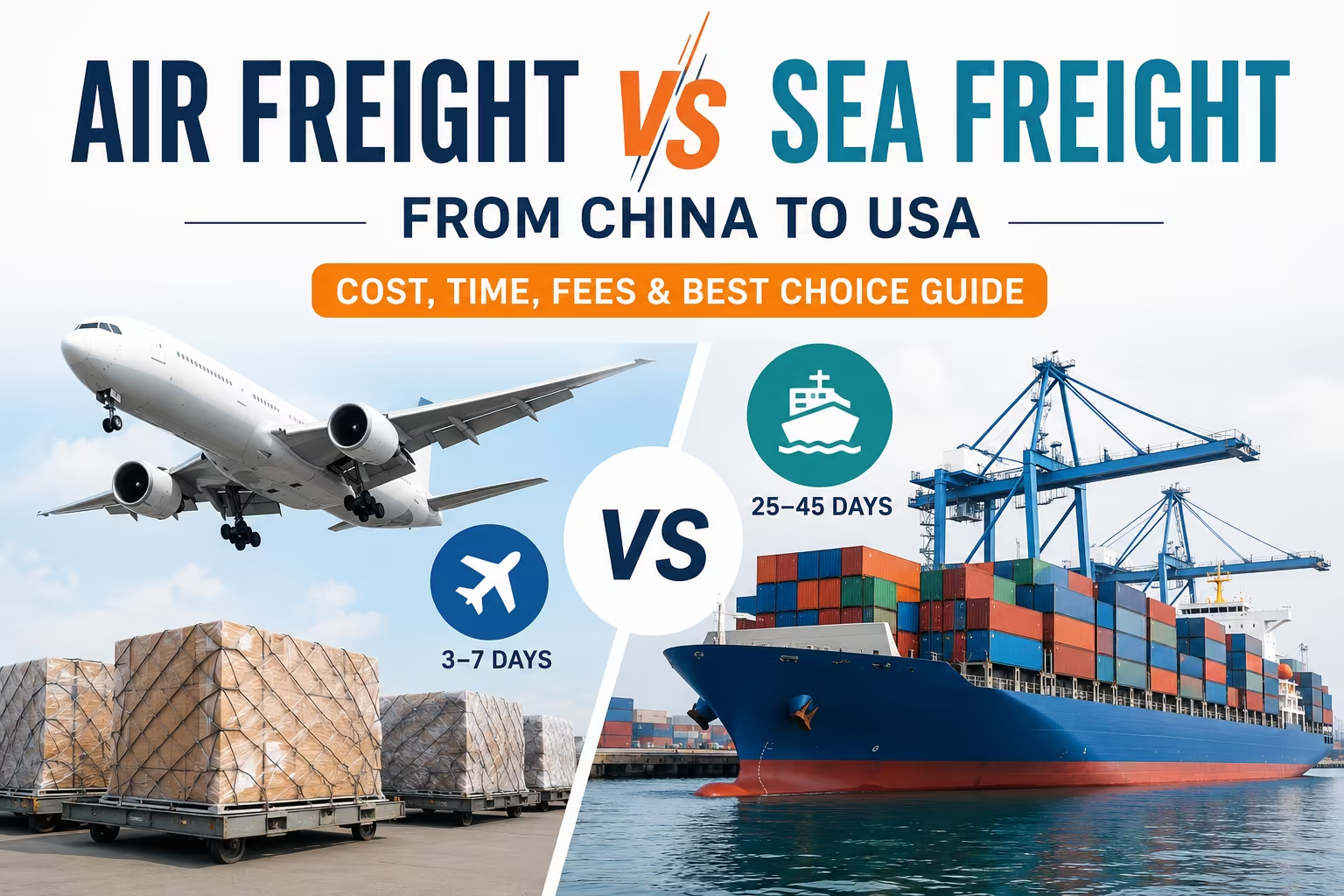
When importing goods from China to the United States, selecting between air freight and sea freight is one of the most consequential logistics decisions for e-commerce sellers, brand owners, and businesses working with a China sourcing agent. Your choice directly shapes landed costs, inventory turnover, stock-out risk, carbon emissions and overall product profitability, which is why freight planning should be addressed before common supply chain mistakes begin affecting fulfillment and inventory availability. While air shipping delivers fast transit speeds, ocean freight offers dramatic cost savings at the expense of longer lead‑times. This complete comparison breaks down real-world pricing, door-to-door transit timelines, hidden fees, CO₂ footprints, lithium-battery shipping restrictions and practical decision-making frameworks, so you can reliably pick the right shipping mode or coordinate the right logistics strategy with a qualified dropshipping agent based on your products, inventory goals and budget.
Quick reference
- Air freight cost (China → USA): ~$4–$9/kg base rate, all-in $5.50–$10.50/kg with surcharges
- Sea freight LCL cost (China → USA West Coast): ~$60–$120/CBM ocean leg (approximately $0.20–$0.40/kg at typical 300 kg/CBM cargo density)
- Sea freight FCL cost (20-foot container, China → USA West Coast): ~$1,200–$2,500; per-kg equivalent varies significantly with cargo density and container utilization
- Air freight transit time: 3–7 days door-to-door
- Sea freight transit time (West Coast): 25–35 days door-to-door
- Sea freight transit time (East Coast): 35–45 days door-to-door
- CO₂ emissions: Air ~500–900g/tonne-km vs. sea ~10–20g/tonne-km
- Dimensional weight formula (air): L × W × H (cm) ÷ 6,000
- Lithium battery air freight: Requirements depend on battery type, watt-hour rating, whether batteries are standalone or packed with/contained in equipment, and the applicable IATA Packing Instruction; carrier approval or cargo-aircraft restrictions may apply.
- Value density breakpoint: Lower-value-density products generally favor sea freight, while high-value, lightweight products are more likely to justify air freight; evaluate freight as a percentage of product value rather than relying on a single $/kg cutoff.
Real Cost Comparison: What You Actually Pay for Air vs. Sea from China
The short answer: sea freight is usually far cheaper on a per-unit or per-kg-equivalent basis, but the size of the gap depends heavily on shipment density, volume, route, and local charges.
How air freight from China to the USA is priced
Air freight rates from China to the USA are quoted in price per kilogram, applied to whichever is greater — actual weight or volumetric (dimensional) weight. Carriers calculate volumetric weight as (L × W × H in cm) ÷ 6,000 for most international air cargo. A lightweight but bulky product like a yoga mat or folded chair cushion can end up billed at 3–4× its actual weight.
Current spot rates for China-to-USA air freight run approximately $4–$9 per kg for general cargo, with express courier (DHL/FedEx/UPS) at the upper end and charter or consolidated air freight at the lower end [2]. Fuel surcharges, security surcharges, and destination handling fees add another $0.50–$1.50/kg on top of the base rate, bringing the all-in cost to approximately $5.50–$10.50/kg. For a 50 kg shipment, expect total air freight cost of $250–$550 depending on routing and service level.
How sea freight from China to the USA is priced
Ocean freight pricing has two structures: LCL (less-than-container load), billed per cubic meter (CBM), and FCL (full container load), billed as a flat rate per container. LCL rates from China to US West Coast ports run roughly $60–$120 per CBM for the ocean leg alone [3]. At a typical cargo density of around 300 kg/CBM, this equates to roughly $0.20–$0.40/kg for LCL shipments. FCL rates for a 20-foot container run $1,200–$2,500 depending on origin port and season; for high-density cargo, FCL ocean freight can work out to approximately $0.20–$0.50/kg, though the per-kg figure varies significantly with actual cargo density and container utilization.
The math becomes clear at scale. A 1,000 kg shipment of 0.5 kg products (2,000 units) at $0.30/kg sea freight costs $300 for the ocean leg. The same shipment by air at $6/kg costs $6,000. The freight cost per unit goes from $0.15 by sea to $3.00 by air — a difference that can materially reshape your unit economics.
Hidden charges that shift the true cost gap
Both modes carry surcharges that aren’t in the headline quote. For air freight: fuel surcharge (currently 20–35% of base rate), security screening fee, airport handling, and customs brokerage. For sea freight: origin inland haulage, port handling (THC), destination drayage, customs brokerage, and ISF filing ($25–$75). LCL shipments also carry a documentation fee and consolidation charge per CBM.
🔍 Worth checking: Always ask for an all-in quote that includes origin charges, ocean/air freight, destination charges, customs brokerage, and delivery to your warehouse. The gap between a “base rate” quote and landed cost can be $300–$800 on a mid-size shipment.
The practical takeaway: sea freight’s cost advantage is real and large, but it requires 2–3× more administrative overhead to manage correctly, especially for first-time shippers navigating ISF filings, commercial invoices, and packing lists.
Transit Time Realities: How Long Each Mode Takes from China to the US
Speed is the clearest difference between air and sea freight — but the real question is how much speed you’re actually buying after all the ground-level steps are counted.
Air freight transit windows from China
Door-to-door air freight from China to the US runs 3–7 days for most shipments. That includes pickup from your Dongguan or Shenzhen factory, airport acceptance, flight time (direct flights are ~12–14 hours; connections through Tokyo or Seoul add 1 day), US Customs clearance (1–2 days via formal entry or de minimis), and last-mile delivery.
Express courier services like DHL and FedEx consistently deliver in 3–5 days from major Chinese manufacturing hubs.
Customs holds are the wildcard. Air shipments flagged for examination can sit at JFK or LAX for 3–5 additional days. Having clean, accurate commercial invoices and HS codes documented reduces this risk materially.
Sea freight transit windows from China
Ocean transit from South China ports (Yantian, Nansha) to Los Angeles runs 14–18 days; to East Coast ports (New York, Savannah) it runs 28–35 days. Add 3–5 days for customs clearance and drayage, and your realistic door-to-door window is 25–40 days for West Coast delivery, 35–45 days for East Coast [4].
Port congestion can add 5–15 days without warning, as US West Coast ports demonstrated repeatedly between 2021 and 2023. Building a 10–15 day buffer into your sea freight lead time isn’t pessimism — it’s standard practice.
How buffer stock strategy changes which speed you need
If you carry 60 days of buffer stock, sea freight transit time becomes almost irrelevant. You’re always shipping the next 60-day fill well before the current stock expires. The brands that suffer are those running 20–30 days of inventory and trying to use sea freight — any delay creates a stockout.
Air freight effectively becomes a stockout-rescue tool for sea-freight brands, not their primary shipping lane. That’s actually the right way to use it — keeping China freight costs in check by defaulting to sea and air-freighting only urgent replenishment.
Carbon Footprint: The Environmental Cost of Air vs. Sea Freight
This section matters more than it used to. A growing share of US DTC brands now face customer scrutiny and ESG reporting requirements that touch Scope 3 emissions — which includes freight.
The emissions gap between air and sea freight is not close. Air cargo emits approximately 500–900 grams of CO₂ per tonne-kilometer, while container shipping emits roughly 10–20 grams per tonne-kilometer [5]. On a China-to-USA route of roughly 11,000 km, a 1,000 kg air freight shipment generates approximately 5.5–9.9 tonnes of CO₂ equivalent. The same shipment by sea generates around 110–220 kg — roughly 40–50× less.
For brands making sustainability claims, defaulting to air freight for replenishment stock is a liability, not just a cost issue. Several large US retailers now request Scope 3 freight emission disclosures from their suppliers. Even if your brand isn’t there yet, documenting your freight modal split now gives you a baseline to improve against.
The practical move for most e-commerce sellers: use sea freight as the default, use air freight only for time-critical restocks or new product launches, and document the modal split per quarter. That alone usually reduces freight emissions by 60–80% compared to air-first operations, while often improving freight cost simultaneously.
Key Factors That Should Drive Your Air-vs-Sea Decision
Choosing between air and sea freight is a unit-economics question dressed up as a logistics question. Four variables do most of the work.
Product value density and margin thresholds
Value density is the ratio of a product’s retail value to its weight. A $200 smartwatch weighing 0.2 kg has a value density of $1,000/kg — air freight at $6/kg adds 0.6% to landed cost, which is trivial.
A $15 phone stand weighing 0.4 kg has a value density of $37.50/kg — the same $6/kg air freight adds 16% to landed cost, which is often the difference between profit and loss.
A useful rule of thumb: if your air freight cost exceeds 5% of the product’s retail price, sea freight deserves serious evaluation. This isn’t a hard line, but it forces the right conversation about whether speed is worth the margin trade.
Order volume, weight, and dimensional weight rules
Below 50 kg, air freight is often competitive on a per-unit basis because you’re not filling LCL minimums efficiently. Above 200 kg, the economics of sea freight (even LCL) start winning clearly. Above 2 CBM, LCL sea freight usually beats air on both cost and the effective per-kg rate once dimensional weight is factored in.
Dimensional weight is the hidden trap in air freight for bulky-light products. Shipping a large but lightweight product — think foam packaging, pillows, or flat-pack furniture — by air means paying for phantom weight that ocean freight simply doesn’t penalize the same way.
Seasonality, stockouts, and lead-time tolerance
Brands selling into seasonal peaks (Q4, back-to-school, Prime Day) need to plan sea freight 90–120 days ahead to hit the window. Missing that boat — literally — often means air-freighting at peak rates, which can be 20–40% above off-peak air rates due to demand surges from other shippers caught in the same position.
The smarter move is a hybrid calendar: sea freight for base-stock replenishment planned 90 days out, with a small air freight budget reserved for demand-response top-ups. We’ve seen this approach reduce blended freight cost per unit by 30–45% compared to reactive air-freight-dominant operations among our brand partners.
Air Freight Restrictions: What China E-commerce Sellers Cannot Ship by Air
Not every product can travel by air. This is where many first-time China e-commerce sellers get a costly education — usually when a shipment is held at the origin airport or returned by the carrier.
The IATA Dangerous Goods Regulations[1] govern what can and cannot be shipped by air internationally. For China e-commerce sellers, the most common restricted categories include lithium batteries (standalone cells and batteries shipped separately, unless meeting strict watt-hour limits and packaging requirements), liquids, gels, aerosols, and other products that may be classified as dangerous goods depending on their composition, quantity, packaging, and applicable IATA requirements
Lithium batteries are the most practically impactful restriction. Products like power banks, e-bikes, scooters, drones, and many Bluetooth devices with integrated batteries face airline-specific rules about battery capacity. Generally, batteries up to 100Wh per cell are permitted on passenger aircraft; batteries in the 100–160Wh range may be allowed on passenger aircraft with prior airline approval; and batteries exceeding 160Wh are typically prohibited on passenger aircraft. Cargo-only flights may accommodate larger batteries subject to airline-specific approval and applicable regulations.
Many popular China e-commerce categories — portable chargers, electric tools, LED strip lights with battery packs — fall into a gray zone where carrier policies differ.
The resolution isn’t always sea freight. Some restricted goods can move by air if properly declared, packed to IATA Packing Instructions (PI 965–970 for lithium batteries), and accompanied by a shipper’s declaration for dangerous goods. This adds documentation cost and may require a freight forwarder with DG certification. When that’s too complex, sea freight with a proper Material Safety Data Sheet (MSDS) is the default path.
Ocean carriers accept a broader range of hazardous goods through regulated channels, though they have their own IMDG Code restrictions.
🚫 Avoid: Shipping lithium battery products by air without confirming your freight forwarder is DG-certified. Undeclared batteries discovered at origin airports result in shipment rejection, potential fines, and delays measured in weeks, not days.
How to Choose the Right Mode for Your Next China Shipment
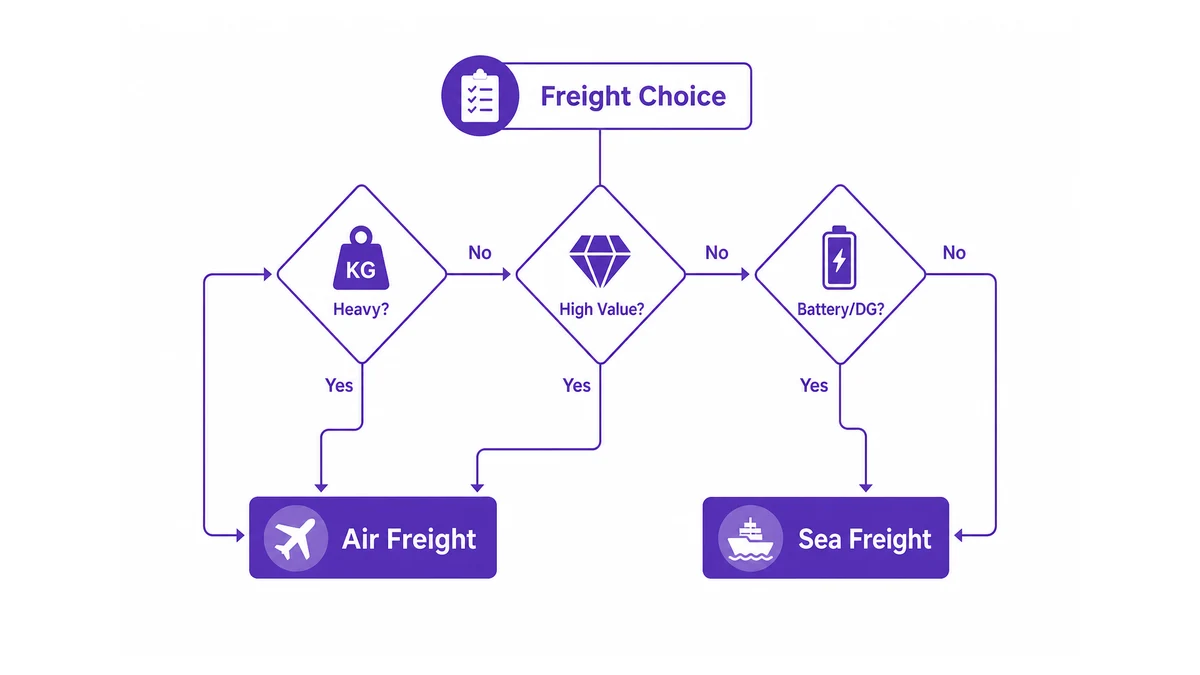
Run this checklist against every shipment before booking. The goal is making the mode decision deliberately, not by default.
When to default to air freight
Choose air freight when:
– Product value density exceeds $500/kg (the freight cost is a small percentage of landed value)
– You’re restocking a SKU that has fewer than 25 days of inventory remaining
– The shipment weighs under 100 kg and doesn’t fill an LCL minimum efficiently
– You’re shipping a product launch quantity (first batch to test market response) where speed-to-data matters more than freight cost
– Your product is perishable, time-sensitive, or tied to a specific event window
When to default to sea freight
Choose sea freight when:
– Shipment weight exceeds 300 kg or volume exceeds 2 CBM
– Your product retails under $30 and air freight would add more than 8% to landed cost
– You’re running planned replenishment with 60+ days of lead-time buffer
– Your product contains lithium batteries or other materials that complicate air shipping
– You’re shipping to an Amazon fulfillment center and can plan inventory far enough ahead
When to split shipments across both modes
The split approach — sea freight for the bulk, air freight for a “seed” quantity — makes sense in three situations. First, when launching a new product: air freight 100–200 units to test sell-through while the main sea freight shipment is in transit. Second, when a seasonal deadline is approaching and your sea freight shipment is running late: air freight a top-up quantity to cover the peak window.
Third, when you have a large SKU range with uneven velocity: fast movers ship by air, slow movers consolidate into an LCL sea container.
The decision between air and sea freight ultimately comes down to one question: how much is the speed worth relative to what it costs per unit? If air freight would exceed about 5% of the product’s retail price and your planning horizon allows 45+ days, sea freight usually deserves serious consideration.
If speed has a dollar value — from stockout prevention, a launch window, or a seasonal deadline — air freight earns its premium. The brands that manage freight cost best are those who treat mode selection as a quarterly review, not a one-time setup decision.
Frequently asked questions
Is sea freight or air freight cheaper?
Sea freight is significantly cheaper for China-to-USA shipments. Air freight typically runs $4–$9 per kilogram, while ocean freight averages $0.20–$0.50 per kilogram for FCL loads. On a 500 kg shipment, air freight could cost roughly $2,000–$4,500 at the stated base rates, compared with roughly $100–$250 at a $0.20–$0.50/kg ocean-freight equivalent. Actual sea-freight costs depend heavily on shipment volume, density, and local charges.
Which is better, air freight or sea freight?
It depends on your product margins, shipment weight, and inventory urgency. Air freight suits high-value, lightweight goods under 200 kg where stockouts cost more than the freight premium. Sea freight wins for bulky, lower-margin products where cash flow and landed cost matter more than speed. Most US e-commerce brands use sea freight for replenishment cycles and reserve air freight for launch shipments, urgent restocks, or peak-season gaps.
How long does air freight from China take?
Air freight from China to the USA typically takes 3–7 days door to door. Direct flights between major Chinese hubs like Shanghai or Shenzhen and US gateway airports run 12–15 hours, but customs clearance, first-mile pickup, and last-mile delivery add 2–5 days. Express courier services such as DHL or FedEx can hit 3–4 days. Standard air cargo through a freight forwarder is usually 5–7 days.
How long does sea freight from China to the USA take?
Sea freight from China to the USA typically takes about 25–35 days door to door for West Coast destinations and 35–45 days for East Coast destinations. Actual transit time depends on the origin and destination ports, customs clearance, port congestion, and inland delivery. Building an additional 10–15 days of buffer into inventory planning can help reduce stockout risk when delays occur.
Sources
[1] Dangerous Goods Regulations (DGR) — iata.org
[2] Air Cargo Market Analysis – April 2025 — iata.org
[3] Freightos Baltic Index (FBX): Freight Rate Container Price … — freightos.com
[4] WCSC Waterborne Commerce Statistics Center — iwr.usace.army.mil
[5] Decarbonising Transport initiative | ITF — itf-oecd.org
[6] Air Freight vs Ocean Freight: Choosing the Best Option for … — forefrontlog.com