

A sourcing agent is a local representative or company that finds, vets, and negotiates with manufacturers or suppliers on behalf of a buyer — most often across a language or geography gap. They verify factory credentials, request samples, oversee quality control, and coordinate shipping so the buyer never has to manage those details from 7,000 miles away.
For US brands buying direct from overseas manufacturers, choosing the right dropshipping agent can help close the compliance, language, and logistics gap, especially when the agent also supports supplier sourcing and coordination.
Quick reference
| Fee Type | Typical Cost | Best For | Incentive Risk |
|---|---|---|---|
| Commission | 5–10% of order value for straightforward categories, reaching 15% for complex work | Buyers with variable order volumes | Agent may favor higher-priced suppliers |
| Flat retainer | $500–$3,000/month (commonly reported range; varies significantly by scope and geography) | Brands with ongoing, high-frequency sourcing needs | Low — agent’s fee doesn’t scale with your spend |
| Per-service fees | Charged per audit, inspection, or shipment | Occasional or one-off sourcing needs | Low, but costs add up without volume |
Key facts:
– Core function: Find the right supplier, negotiate price, inspect goods, arrange logistics
– Common hubs: Guangzhou, Shenzhen, Yiwu, and alternative markets like Vietnam, Bangladesh, and Mexico
– Best for: Brands ordering direct from manufacturers but lacking local presence
– Biggest red flag: An agent who earns undisclosed kickbacks from factories they recommend
What a Sourcing Agent Actually Does
A sourcing agent sits between you and the factory. Their job is to make the Chinese supply chain — or any overseas supply chain — behave like a single accountable partner rather than a maze of unfamiliar vendors.
At ASG, we work with 2,400+ active brand partners across the United States and other Western markets. The friction points we see repeatedly are identical: buyers don’t speak Mandarin, can’t fly to Dongguan every quarter, and have no way to know whether a factory’s compliance certificates are genuine or printed that morning. A good agent closes all three of those gaps.
For brands newer to direct manufacturing, understanding the supply chain mistakes that commonly affect growing order volumes can help you identify what a sourcing agent should prevent before you commit to a supplier.
Core responsibilities: supplier vetting, negotiation, and QC
Supplier vetting is where the work actually starts. A qualified agent doesn’t just hand you a list of factories from a B2B directory — they visit the factory floor, audit production capacity, verify business licenses, and review available third-party supplier verification reports before recommending a manufacturer. For specialized product categories, they’ll run trial orders before recommending a supplier at all.
Negotiation follows. Agents who are physically present in a manufacturing hub — say, an agent in Yiwu for wholesale goods, or one in Shenzhen for electronics — can push back on pricing in real time, in Mandarin. That ability to push back in the room simply doesn’t exist over email from New York.
Quality control (QC) is the third pillar. This ranges from pre-production material checks to during-production inspections to final pre-shipment audits. We run AQL 2.5[1] discipline across 20,000 orders per day — that’s the same statistical sampling standard major retailers use, applied to brands at startup volume. A freelance agent may do a visual walk-through; a full-service sourcing agency typically employs dedicated QC staff.
The agent also handles communication translation (not just language — cultural expectations around lead times, MOQ flexibility, and payment terms differ meaningfully), sample coordination, and documentation for customs.
How sourcing agents charge for their services
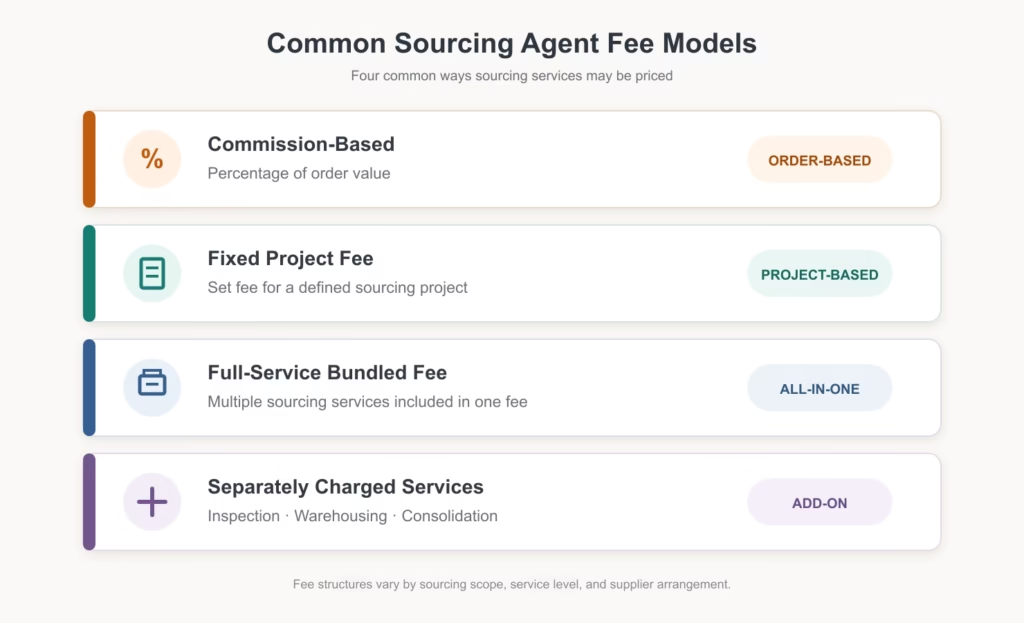
Sourcing agents do not all use the same pricing model. The fee structure usually depends on the scope of work, order value, product complexity, and whether the agent handles sourcing only or manages the process through inspection and shipment.
A common model is a commission based on the order value. The agent charges a percentage of the amount purchased from the supplier, so the sourcing fee increases as the order grows. Some agents instead charge a fixed project fee, which can be easier to budget when the sourcing scope is clearly defined.
Full-service sourcing agencies may combine several services into one fee, covering supplier identification, price negotiation, sample coordination, production follow-up, quality control coordination, and shipping support.
Buyers should therefore compare more than the headline percentage. A lower sourcing fee does not necessarily mean a lower total cost if inspection, warehousing, consolidation, or other services are charged separately.
The important point is to understand what the quoted fee includes and what will be billed separately before choosing an agent.
The Main Types of Sourcing Agents
The term covers a wide range of operators — from a single bilingual freelancer to a 200-person sourcing agency with regional offices. Knowing which type you’re dealing with changes everything about what to expect.
Independent Freelancers vs. Full-Service Sourcing Agencies
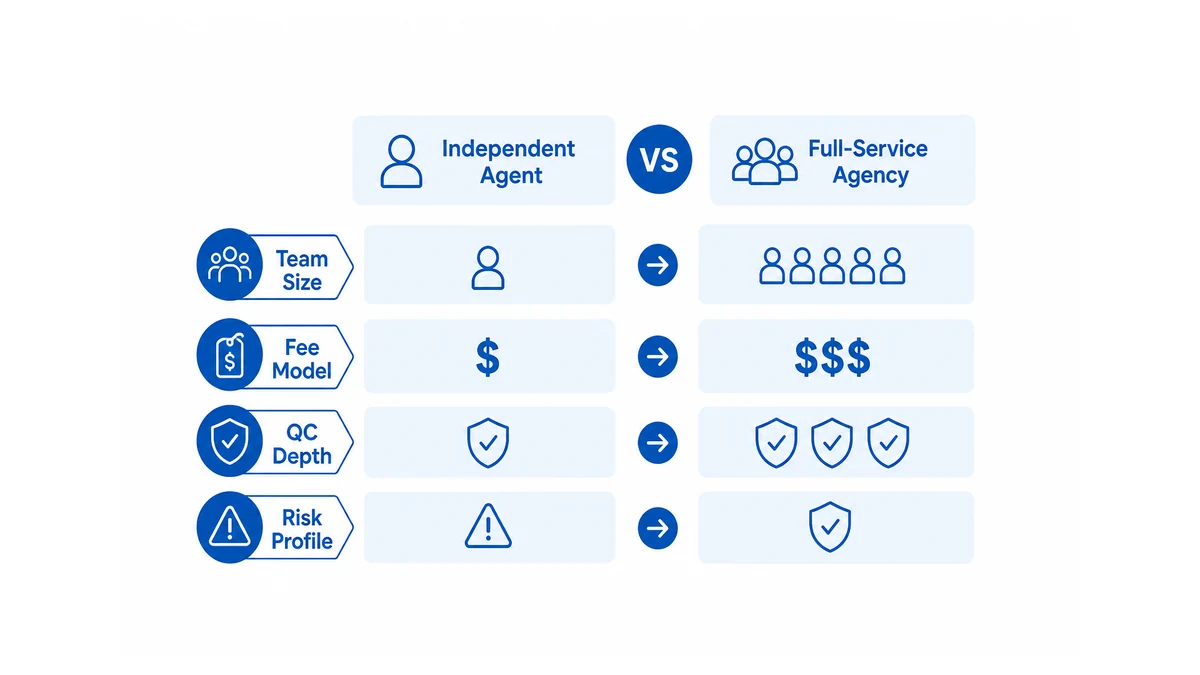
An independent agent is typically one person (or a small team) with deep roots in a specific city or product category. They’re often cheaper, more flexible on minimum volumes, and easier to reach directly. The trade-off is capacity: if they’re managing 30 clients and your shipment has a crisis, you’re number 31 in the queue.
A full-service sourcing agency brings dedicated staff for each function — a vetting team, QC inspectors, a logistics coordinator, and account managers. The overhead costs more, but the redundancy is the point. We built ASG on this model precisely because a single agent handling 45M+ shipped orders would be a structural impossibility.
Sourcing agencies also let us maintain supplier networks across categories — apparel, electronics, homeware, beauty — that no single specialist could replicate.
Sourcing agencies also provide documented processes. When we quote a supplier, every cost, every certificate, and every audit report is logged line-by-line. That paper trail matters when a shipment arrives short or a product fails compliance testing in the United States.
Here’s the counterintuitive truth most sourcing-agency pages skip: for niche product categories where personal relationships with factory owners matter more than standardized process, a skilled freelance agent who has worked that one factory for ten years can outperform a large agency’s rotating account team. Size is not always the signal of quality.
Product-Specialist vs. Region-Specialist Agents
A product-specialist knows one category deeply — textiles, consumer electronics, furniture — and has pre-vetted supplier relationships within it. They’re efficient for buyers with a clear product brief, and they spot quality issues faster because they’ve seen every failure mode in that category.
A region-specialist operates differently. An agent in Guangzhou knows that city’s manufacturing ecosystem across dozens of categories. One based in Yiwu understands the trade city’s approximately 75,000 booths spread across five districts, and which halls to prioritize for which goods.
For buyers sourcing outside China — an agent in Vietnam for apparel, or one covering Bangladesh or Mexico for goods destined for the US market — the region-specialist model often makes more sense. Supply bases in those markets are less dense, and relationships with local factories matter more than category depth.
What to Look for Before You Hire a Sourcing Agent
A good sourcing agent should make the buying process easier to understand, not less transparent. Before hiring one, look at how clearly the agent explains its fees, supplier relationships, communication process, and experience with the type of product you want to source.
You do not need to evaluate dozens of criteria at the beginning. For most buyers, transparency and communication provide a useful first filter.
Transparency in Pricing and Supplier Relationships
A sourcing agent should clearly explain how it earns money and whether additional charges apply for services such as samples, inspections, warehousing, or shipping coordination.
The agent should also be open about how suppliers are selected. Buyers should be able to understand whether recommendations are based on price, manufacturing capability, product requirements, or an existing commercial relationship.
Transparency matters because the sourcing agent is supposed to represent the buyer’s interests. If pricing or supplier selection is difficult to understand, comparing quotations and making informed purchasing decisions becomes much harder.
Communication Standards and Sample Turnaround
Communication becomes especially important when the buyer and supplier are in different countries and time zones. A sourcing agent should provide clear updates, respond within a reasonable period, and communicate problems rather than waiting until production is already delayed.
Sample handling is another useful indicator. The agent should be able to explain the expected sample timeline, coordinate revisions with the supplier, and keep the buyer informed when specifications need clarification.
The goal is not simply fast communication. Consistent and accurate communication is more valuable than quick replies that do not resolve the issue.
Where to Find a Sourcing Agent That Fits Your Business
Sourcing agents can be found through industry events, supplier networks, business directories, referrals, and online sourcing platforms. The best channel depends on what you are buying and how much supplier knowledge you already have.
For specialized or technically demanding products, an agent with experience in the relevant manufacturing sector may be more useful than a general sourcing company. For broader consumer-product sourcing, a full-service agency may offer a wider supplier network and more supporting services.
The objective is not simply to find an agent. It is to find one whose experience, supplier access, and service scope match your purchasing needs.
Trade Shows, Directories, and Referral Networks
Trade shows such as the Canton Fair are useful because buyers can meet sourcing companies and suppliers across multiple product categories and use supplier-matching services to identify potential partners.
Business directories and sourcing platforms provide a larger pool of candidates, but listings should be treated as a starting point rather than proof of reliability.
Referrals from other importers, suppliers, or industry contacts can also be valuable, particularly when the person making the recommendation has sourced similar products from the same region.
Using more than one channel helps avoid choosing an agent simply because they were the easiest one to find.
Vetting an Agent Before Signing Any Agreement
Before committing, verify that the agent is a real operating business and that its experience matches your sourcing requirements.
Ask for basic company information, relevant sourcing experience, examples of product categories handled, and a clear explanation of the services included in the proposed fee. References from previous clients can provide additional context when available.
For a first project, starting with a sample or relatively small order can also show how the agent communicates and coordinates with suppliers before you depend on them for larger purchasing volumes.
A sourcing agent should be evaluated in the same way as any other important supply-chain partner: verify first, then increase your commitment as the relationship proves reliable.
Start Your First Sourcing Conversation the Right Way
A productive first conversation starts with a clear sourcing brief. Instead of simply asking an agent to “find a supplier,” explain exactly what you need.
Provide the product name or specification, target quantity, destination market, required certifications or standards, preferred materials, packaging requirements, target price range if available, and expected delivery schedule. Buyers using a sourcing agent for a dropshipping business should also understand that outsourcing sourcing and fulfillment does not remove the seller’s legal and compliance responsibilities. For products marketed in the United States, buyers should also confirm applicable labeling and origin requirements, including the FTC’s Made in USA guidance where relevant.
Photos, drawings, reference samples, and specification sheets can make the request much clearer when the product cannot be described accurately in a few sentences.
The agent can then determine whether suitable suppliers are available, what information is still missing, and what sourcing process makes sense for the project.
You do not need to have every detail finalized before contacting an agent. But the more clearly you define the product and purchasing requirements, the easier it becomes for the agent to identify appropriate suppliers and provide realistic expectations for cost, samples, production, and delivery.
A good first sourcing conversation should end with both sides understanding what needs to be sourced, what happens next, and who is responsible for each step.
If you are ready to discuss your product requirements, contact our sourcing team with your specifications, target quantity, destination market, and expected timeline.
Frequently asked questions
What does a sourcing agent do?
A sourcing agent finds and vets manufacturers on your behalf, typically overseas. Their core tasks include identifying qualified suppliers, negotiating pricing, reviewing contracts, arranging factory audits, coordinating quality inspections, and managing shipping logistics. For US buyers, this means having a trusted local contact who speaks the supplier’s language, understands local business practices, and catches problems before defective goods ever leave the factory floor.
How much do sourcing agents charge?
Most sourcing agents charge either a flat project fee or a commission of typically 5–10% of the total order value for straightforward product categories, an industry-observed range that can reach 15% for complex or high-touch work. Some charge a monthly retainer; the $500–$3,000 range is commonly reported by practitioners in sourcing forums and communities, though the actual figure varies significantly by scope and geography. Commission-based structures are common for product sourcing, while retainers suit buyers placing frequent repeat orders. Always clarify whether the fee is on top of the factory price or built into it, since some agents are paid directly by the supplier.
How much does a sourcing agent make?
A sourcing agent’s annual earnings in the United States typically range from $45,000 to $90,000 as a salaried employee, while independent agents can earn significantly more depending on client volume and commission rates. Agents handling high-value categories like electronics or apparel for large US brands can clear six figures annually. Income varies widely based on the number of active clients, average order size, and whether the agent operates independently or through a sourcing firm.
Sources
[1] Acceptable Quality Limit, AQL — qima.com
[2] Verified Supplier — seller.alibaba.com
[3] Canton Fair Buyer Guide — cantonfair.org.cn
[4] Complying with the Made in USA Standard — ftc.gov