
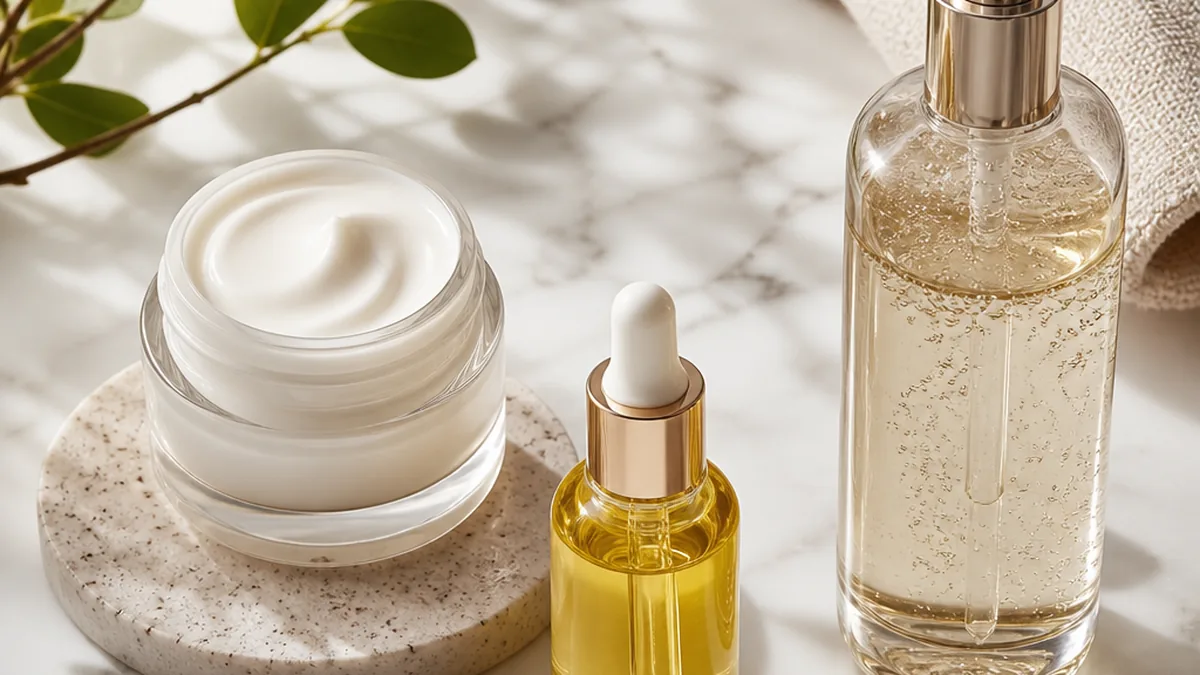
Dry skin is a barrier problem, not a moisture problem — and that distinction changes which products actually work. Adding more water to a compromised skin barrier without sealing it in is like filling a cracked bucket. The real fix is choosing the right dry skin moisturizers that support hydration, barrier protection, and long-lasting moisture retention.
What Dry Skin Actually Needs from a Skincare Formulation
Effective dry-skin formulations do three jobs simultaneously: they repair the skin barrier, draw water into the skin, and lock that water in place.
Barrier-repair ingredients: ceramides, fatty acids, and cholesterol
The outermost layer of skin — the stratum corneum — is held together by a lipid matrix composed mainly of ceramides (roughly 50%), cholesterol (25%), and free fatty acids (~10%), per dermatological lipid barrier research[1]. When that matrix degrades, transepidermal water loss accelerates and dry, flaky skin follows.
Ceramide-containing formulations are the closest thing to a universal answer for dry skin care products. Topical ceramides in a pseudo-physiological ratio (approximately 50% ceramides, 25% cholesterol, and ~10% free fatty acids by weight — note that a 3:1:1 ratio refers to a molar or formulation-target convention and differs from the weight-percentage figures above) have been shown to measurably reduce transepidermal water loss in clinical studies on ceramide-based moisturizers[2]. Brands should confirm which ratio convention their supplier is using — molar vs. weight — when briefing a formulator.
Humectants vs. occlusives: how each hydration layer works
Humectants — chiefly hyaluronic acid, glycerin, and urea — pull water molecules toward the skin from both the dermis below and the environment around it.
Hyaluronic acid is particularly effective because a single gram can hold a very large multiple of its own weight in water, though the exact figure varies by source and molecular weight — readers are encouraged to confirm the specific capacity with a dermatological or cosmetic chemistry reference, per hyaluronic acid hydration capacity research[3].
In dry climates, though, humectants without an occlusive layer on top can actually draw moisture out of the dermis and release it to the air.
Occlusives — petrolatum, dimethicone, squalane, shea butter — form a physical film over the skin surface. They don’t add water; they stop it from leaving. A complete dry-skin routine layers a humectant first, then an occlusive-rich cream or facial oil over it.
Ingredient red flags that worsen dry skin
Some ingredients consistently strip or destabilize the skin barrier, even in products marketed for sensitive skin:
- Sodium lauryl sulfate (SLS) — research suggests it can increase skin permeability and irritation even at low concentrations; the precise threshold may vary by formulation context, and readers should confirm current evidence with a cosmetic dermatologist or regulatory authority in the US, per SLS skin barrier disruption studies[4]
- Denatured alcohol (alcohol denat.) — evaporates quickly, dries the surface, and kills skin-beneficial microbiota
- Fragrance and parfum — leading cause of contact dermatitis in sensitive skin types
- High-concentration AHAs without barrier support — exfoliates needed lipids alongside dead cells if not buffered
The Essential Product Categories That Address Dry Skin Concerns
A complete dry-skin care routine spans six distinct product types. Brands that try to cover dry skin concerns with a single moisturizer leave money — and efficacy — on the table.
Gentle, hydrating cleansers (including pH-balanced whip and milky formats)
The first and most common mistake in dry skin care: an overly stripping cleanser. Skin’s natural pH sits between 4.5 and 5.5 [5]; most traditional bar soaps register at pH 9–10 [6], disrupting the acid mantle and accelerating barrier breakdown.
The right dry-skin cleanser cleans without surfactant overload. Milky cleansers use gentle surfactant systems (glucosides, lactylates) at low concentrations. Whip-format cleansers deliver a light, air-integrated lather that rinses with minimal friction. Both formats preserve skin lipids better than standard foaming face washes.
Toners and essences that prep skin without stripping
Alcohol-free toners and multi-layering essences add a hydration step immediately after cleansing, when the skin surface is most receptive. Essences formulated with fermented ingredients or beta-glucan have an additional skin-calming benefit for sensitive skin.
Skip any toner that lists alcohol denat. in its first five ingredients — it negates the cleanser’s gentleness work.
Moisturizers: creams, balms, and overnight masks
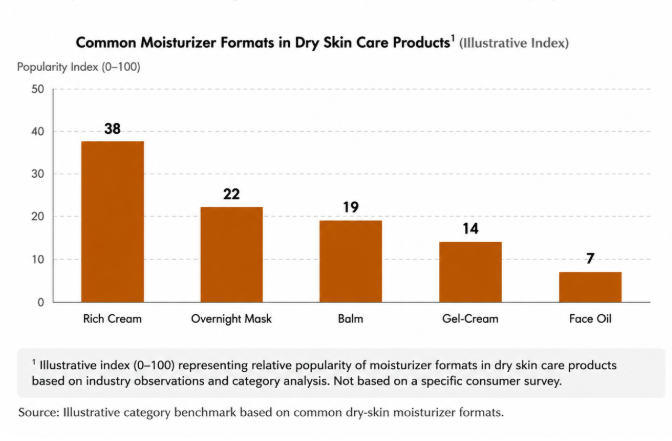
This is the highest-revenue category in dry skin care products. Creams (water-in-oil or oil-in-water emulsions) are the daily workhorse. Balms are occlusive-heavy, lower water content, suited to very dry or compromised skin. Overnight masks add occlusion intensity using a film-forming agent that washes off in the morning.
Texture is a real differentiation lever. A lighter gel-cream appeals to combination skin that goes dry seasonally; a dense cream or balm signals serious care to the consumer with chronically dry skin.
Targeted serums and facial oils
Serums carry actives at higher concentrations than moisturizers — hyaluronic acid, ceramide precursors, niacinamide (the effective concentration range for dry-skin benefit should be confirmed with a cosmetic chemist or current US dermatological guidelines, as cited ranges vary), peptides. They’re applied before the moisturizer; the cream’s occlusive layer on top then helps reduce transepidermal water loss and retain the humectant actives at the skin surface, rather than letting them evaporate.
Facial oils (rosehip, marula, squalane) function as a finishing occlusive and are especially effective layered over a serum in winter or very low-humidity environments.
SPF moisturizers for daytime barrier protection
UV radiation degrades ceramides in the skin barrier directly. A dry-skin care routine without daytime SPF protection actively works against the barrier-repair work done by all the other products. SPF 30–50 in a moisturizer base — especially one containing dimethicone or emollient esters — rounds out a complete regimen.
Dry-Skin Product Categories: Quick Comparison
The table below summarises the six core product categories, their primary function, key actives to look for, and typical formats — making it easier to brief suppliers or compare SKU coverage across a range.
| Product Category | Primary Function | Key Actives | Typical Formats | Routine Step |
|---|---|---|---|---|
| Hydrating Cleanser | Remove impurities without stripping the acid mantle | Glycerin, glucosides, panthenol | Milky, whip, balm-to-foam | Step 1 |
| Toner / Essence | Re-hydrate and prep skin immediately post-cleanse | Hyaluronic acid, beta-glucan, fermented extracts | Liquid, watery essence | Step 2 |
| Serum | Deliver concentrated actives deeper into the skin | Ceramide precursors, niacinamide, peptides | Lightweight fluid, ampoule | Step 3 |
| Moisturizer (Cream / Balm / Overnight Mask) | Seal in hydration and support barrier repair | Ceramides, petrolatum, dimethicone, shea butter | Rich cream, balm, wash-off mask | Step 4 |
| Facial Oil | Provide finishing occlusion; reinforce lipid barrier | Squalane, rosehip oil, marula oil | Dry oil, nourishing oil | Step 4b (optional) |
| SPF Moisturizer | Protect barrier from UV-induced ceramide degradation | Broad-spectrum UV filters, dimethicone, emollient esters | Fluid SPF, SPF-enriched cream | Step 5 (AM only) |
How Top Retail Brands Formulate for Dry Skin — Benchmark Takeaways
Understanding product categories is only the first step. The next question for brands is how successful products translate these principles into actual formulations. Studying what the best-selling dry skin care products do right gives private-label brands a concrete formulation target to match or exceed.
Cleanser benchmarks: La Roche-Posay Toleriane and Etude SoonJung as formulation references
Two cleansers consistently cited in dermatologist-recommended routines for sensitive, dry skin set a useful formulation benchmark.
La Roche-Posay Toleriane Hydrating Gentle Face Cleanser uses a sulfate-free surfactant system with glycerin and La Roche-Posay’s thermal spring water as a calming co-active. Its pH is formulated to be compatible with the skin’s acid mantle, and the fragrance-free, preservative-light formula makes it suitable for reactive sensitive skin. The key formulation lesson: minimal active surfactant, glycerin as humectant, and a branded water ingredient that doubles as a marketing story.
Etude SoonJung pH 6.5 Whip Cleanser takes a different approach — the whip format reduces total surfactant-to-skin contact time. Its pH 6.5 target is notably above the skin’s natural range of 4.5–5.5 (representing a meaningful difference on the logarithmic pH scale) but dramatically below most cleansers. The SoonJung formulation also includes panthenol and madecassoside for post-wash calming. Lesson: format innovation (whip vs. standard foam) can become the product’s primary differentiator even when actives are modest.
For brands building a dry-skin cleanser SKU, these two products define the floor: sulfate-free, pH-controlled, fragrance-free, with at least one humectant or soothing active.
Moisturizer benchmarks: texture, occlusion level, and ingredient density
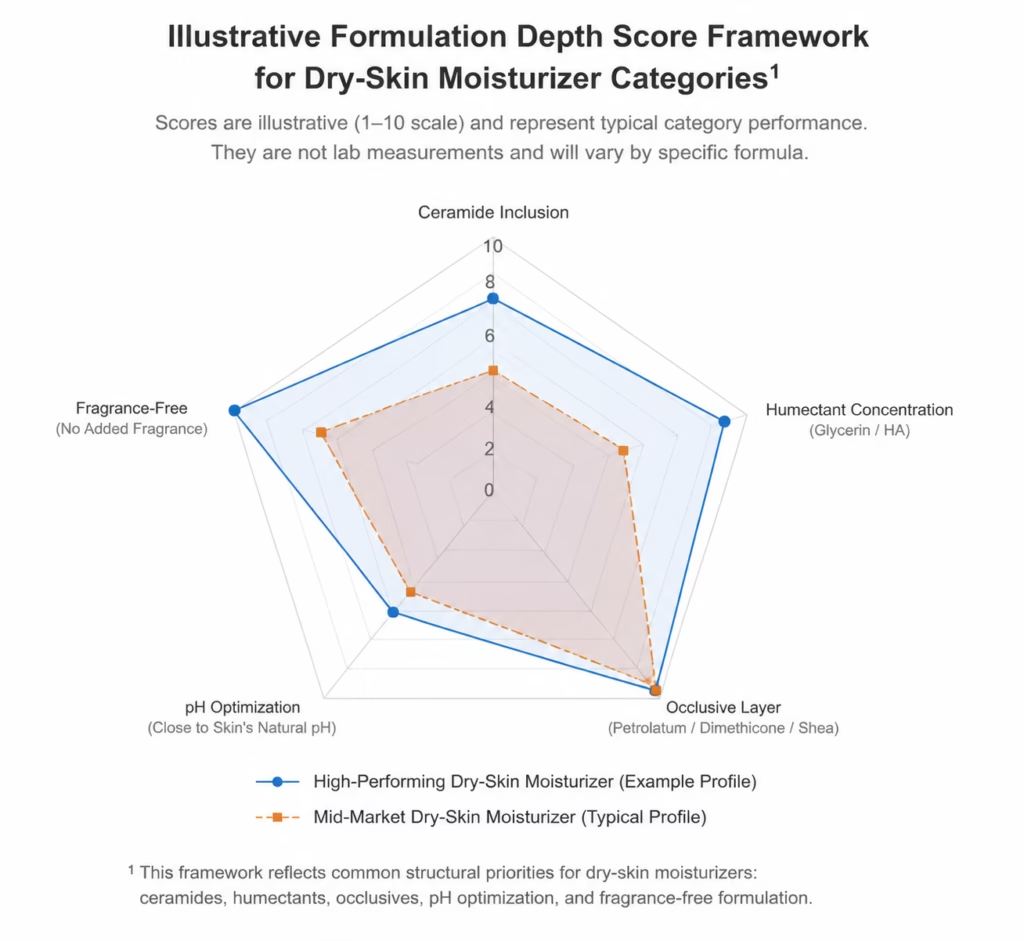
The best-reviewed dry skin moisturizers on the market share three structural features: a ceramide-containing base, a visible glycerin or hyaluronic acid entry on the ingredient list within the first five INCI names, and an occlusive component (petrolatum, dimethicone, or shea) for the final moisture seal. Brands that position at a premium also tend to include a patented lipid complex or fermented ingredient that makes the formula difficult to directly compare.
🔍 Worth checking: Before briefing a supplier on a moisturizer formula, request their existing base formulas for ceramide-containing creams — most mid-tier Chinese manufacturers carry two or three stock ceramide bases that you can customize with actives rather than building from scratch.
Key Criteria for Evaluating a Dry-Skin Skincare Supplier
The supplier selection criteria that matter for dry-skin products differ from general cosmetics. You’re evaluating formulation chemistry capability, not just filling and packaging.
Formulation and R&D depth: custom vs. stock-formula suppliers
Ask any supplier candidate to show you their existing dry-skin portfolio formulas with full INCI lists. A supplier with genuine R&D depth can explain why each ingredient is at its listed percentage — not just recite it. Stock-formula suppliers are fine for speed-to-market; custom R&D capability is required when differentiation is part of your brand positioning.
At ASG Dropship, we work with 2,400+ active brand partners, and the most consistent sourcing mistake we see is brands choosing a supplier based on price per unit before confirming that supplier can actually replicate the formulation profile they’re targeting. That’s a quality failure that shows up three months post-launch, not on day one.
Quality certifications and third-party testing standards
Minimum baseline for the US market: FDA cosmetic facility registration[7] [8], relevant Good Manufacturing Practice certification (brands should confirm which GMP standards are currently recognized or applicable to their product category with the relevant US authority, as standards and requirements in this area can change), and a documented stability testing protocol. Dermatologist-tested or hypoallergenic claims require additional third-party challenge testing.
For sensitive skin positioning, a patch-test protocol on human subjects is increasingly expected by US retailers.
The supplier selection criteria checklist should include verification of actual certificates — not just claims on a website. Ask for the certificate document itself, check the registration number, and verify the issuing body.
MOQ flexibility and sample process
A dry-skin skin care line typically launches with four to six SKUs. Suppliers who require high minimum order quantities per SKU on custom formulas can lock up significant capital in inventory before you have a single sale — brands should carefully negotiate MOQ terms and model the inventory investment for their specific situation.
Look for suppliers offering tiered MOQs (500–1,000 units for initial runs) with a clear path to lower unit costs at scale. Sample turnaround — from brief to finished formula sample — should be four to six weeks for a stock-base modification, eight to twelve for a fully custom formula.
Transparency in costing and ingredient documentation
A trustworthy supplier provides a line-by-line cost breakdown: raw material cost per kg, fill volume, packaging, labeling, and freight — separately. Hidden margins bundled into “formulation fees” or vague per-unit charges are a red flag. For dry-skin formulations specifically, ask for documentation of the ceramide source (synthetic vs. plant-derived vs. fermented) and the hyaluronic acid molecular weight profile — both affect cost and efficacy significantly.
✅ Do this: Request a complete Safety Data Sheet and Certificate of Analysis for every active ingredient in the formula before signing any supply agreement. This documentation doubles as your due-diligence record under applicable US cosmetic regulatory requirements — brands should confirm current responsible party obligations with a US regulatory specialist, as requirements may evolve, per relevant regulatory guidance.
Private-Label vs. OEM vs. ODM: Choosing the Right Supply Model for Your Brand
The supply model choice determines your formulation control, time-to-market, and total investment — not just your unit economics.
Private-label: speed-to-market with existing dry-skin formulas
Private-label means taking a supplier’s existing tested formula, adding your brand packaging and label. For dry-skin care products, this works well when the existing formula already hits your target ingredient profile (ceramides, no sulfates, fragrance-free). Realistic timeline: eight to twelve weeks from agreement to finished goods. MOQs are lowest here, typically 300–500 units per SKU.
The trade-off: your formula is available to other brands from the same factory. Differentiation must come from branding, packaging, and channel strategy rather than the formula itself.
OEM/ODM: building a differentiated formula from scratch
OEM (you own the formula, the supplier manufactures to your spec) and ODM (the supplier develops and manufactures a proprietary formula for you) both require a longer runway — typically sixteen to twenty-four weeks including stability testing — and higher minimum investment. For brands positioning as dermatologist-backed or clinical-grade dry skin care, the formulation ownership is worth the timeline.
The supplier selection criteria for OEM/ODM skew heavily toward R&D capability: How many PhD-level formulators do they have on staff? Do they hold any cosmetic patents? What is their allergen testing protocol for sensitive skin formulas?
Red Flags and Green Lights When Vetting Chinese Skincare Manufacturers
Chinese skincare manufacturing ranges from genuinely world-class to dangerously underqualified. The distinguishing signals are visible before you place a single order.
Documentation and audit transparency as a trust signal
A factory confident in its quality welcomes scrutiny. Green light: the supplier proactively shares relevant GMP and quality certificates, provides a facility audit report from the past eighteen months, and offers a virtual or in-person factory visit. Red flag: audit access is gated behind a signed NDA or “only available after order confirmation.”
We run rigorous quality discipline across 20,000 orders per day at ASG Dropship — and the single most reliable predictor of a factory’s actual quality level is how quickly they produce documentation when asked, not what they claim on their website.
How hand-inspection at scale differs from automated QC
Automated QC catches dimensional defects — fill volume, cap torque, label placement. It misses texture anomalies, phase separation in emulsions, and subtle color deviations that a trained inspector catches within seconds. For dry skin care products like creams and balms, emulsion stability is invisible to a camera but obvious to touch.
Ask explicitly whether the supplier includes trained human inspection in their QC line, and at what point in the production run.
Communication and responsiveness benchmarks
Response time is a proxy for operational maturity. A supplier who takes three days to answer a basic formulation question during pre-sale will take longer once you’re a paying customer. Reasonable benchmark: same-day acknowledgment, substantive reply within twenty-four hours on technical questions. Also watch for precision in communication — vague answers to specific questions (“our ceramide content is good quality”) signal a supplier who doesn’t understand their own formula.
Build Your Dry-Skin Product Line: A Sourcing Action Checklist
Start with a clear category scope before approaching any supplier. Define your SKU count (four to six is a manageable first range), your target formulation benchmarks for each category (cleanser, toner, moisturizer, serum, SPF), and your price positioning. Then use this sequence:
- Screen for formulation capability — request existing INCI lists for dry-skin SKUs and filter out any supplier using sulfates or fragrance in their standard sensitive skin formulas.
- Verify certifications independently — confirm GMP certification, FDA facility registration, and any dermatologist-tested documentation against the issuing body’s records.
- Request samples against a written brief — specify pH target, key actives, texture descriptor, and fragrance-free requirement in writing before the sample stage.
- Run a supplier selection criteria checklist on costing — require a line-by-line cost breakdown; reject any all-in quote that bundles formulation, fill, and packaging without separation.
- Confirm MOQ terms and scale path — get the MOQ for the initial run and the unit price at 3× that volume in writing before signing.
- Negotiate a stability testing clause — any custom formula should come with a documented 12-week accelerated stability study at the supplier’s cost before production approval.
Quick Reference
- Core barrier-repair actives: ceramides, cholesterol, free fatty acids (ideally in a pseudo-physiological ratio; brands should confirm current recommended ratios with a cosmetic chemist or dermatological reference)
- Primary humectant: hyaluronic acid (low + high molecular weight blend) and glycerin
- Primary occlusives: petrolatum, dimethicone, squalane, shea butter
- Cleanser pH target: 4.5–5.5 for optimal acid mantle compatibility
- US market minimum certifications: brands should confirm current US market certification requirements — including applicable GMP standards and FDA facility registration obligations — with a US regulatory specialist, as requirements may evolve; see relevant regulatory guidance
- Private-label timeline: 8–12 weeks; MOQ typically 300–500 units
- OEM/ODM timeline: 16–24 weeks including stability testing
- Supplier selection red flag: any all-in quote with no line-item breakdown
- AQL standard for cosmetics production runs: brands should confirm the appropriate inspection sampling standard for their supply chain with their quality assurance team or a US industry reference, as accepted standards may vary
- Sample turnaround benchmark: 4–6 weeks (stock base modification), 8–12 weeks (custom formula)
Frequently asked questions
What is the no. 1 product for dry skin?
A moisturizing ceramide cream is widely considered the top product for dry skin because it repairs the skin barrier while locking in hydration. Formulas containing ceramides, hyaluronic acid, and glycerin work together to restore moisture levels rather than just temporarily masking dryness. Brands like CeraVe and Vanicream, both widely available across the United States, consistently rank highest in dermatologist recommendations and consumer reviews for dry skin relief.
What is the best skincare brand for dry skin?
No single brand suits every dry skin type, but CeraVe is the most recommended by U.S. dermatologists for its barrier-focused, ceramide-rich formulas at drugstore prices. Vanicream is a strong runner-up for sensitive dry skin, while La Roche-Posay covers more clinical needs. Luxury options like Tatcha and First Aid Beauty also perform well. The best brand ultimately depends on your skin sensitivity, budget, and whether you need fragrance-free or hypoallergenic formulations.
What are the most popular beauty product categories?
The most popular skincare categories for dry skin are moisturizers, cleansers, serums, face oils, and toners. Within those, hydrating cleansers, barrier creams, and hyaluronic acid serums dominate U.S. market sales. For suppliers and retailers, moisturizers represent the largest revenue segment, followed closely by treatment serums. Understanding these categories helps buyers prioritize inventory around the products consumers with dry skin repurchase most consistently.
Sources
[1] Stratum corneum lipid matrix: Location of acyl ceramide… — sciencedirect.com
[2] Skin hydration is significantly increased by a cream formulated… — pmc.ncbi.nlm.nih.gov
[3] The Fallacy of Hyaluronic Acid Binding a Thousand Times… — researchgate.net
[4] Increased skin barrier disruption by sodium lauryl sulfate in… — pmc.ncbi.nlm.nih.gov
[5] Natural skin surface pH is on average below 5, which is… — pubmed.ncbi.nlm.nih.gov
[6] pH of Soap: What Is It and Why Does It Matter? — botaniesoap.com
[7] Registration & Listing of Cosmetic Product Facilities and… — fda.gov
[8] Guidance for Industry – Registration and Listing of Cosmetic — fda.gov