
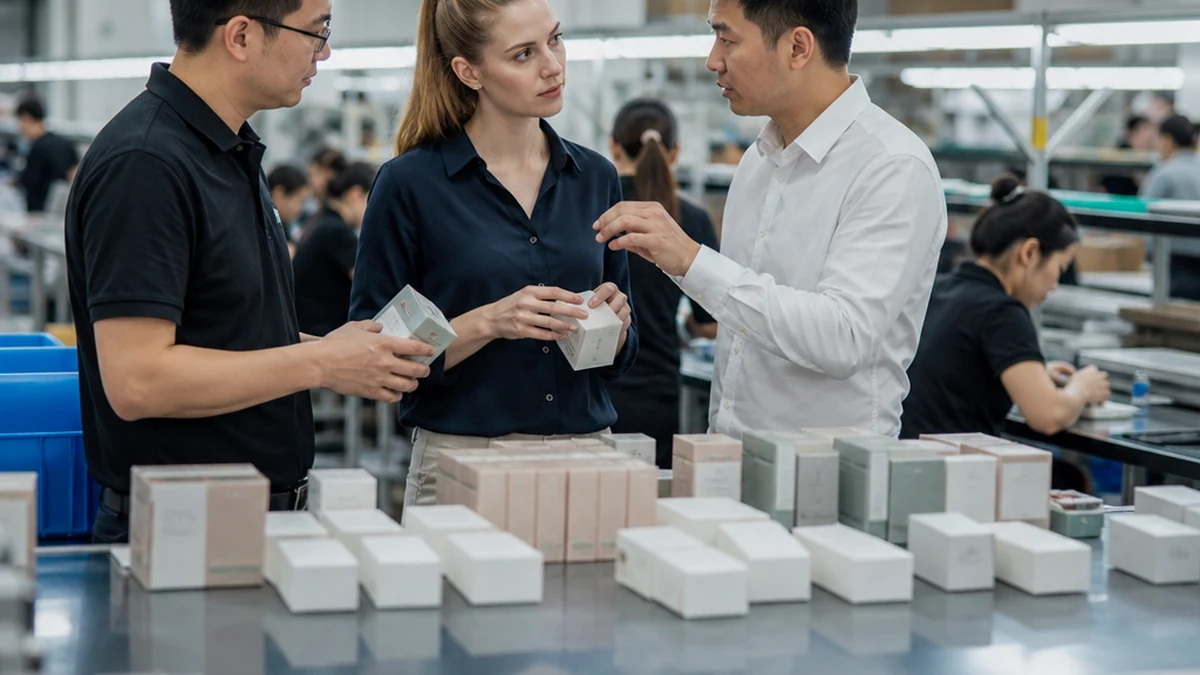
A 500-unit minimum order is enough to stop many first-time private label brands before they even launch. That’s because moving from dropshipping to private label often introduces a major new commitment: a Chinese factory’s private label MOQ may require you to invest $8,000–$15,000 in inventory before you’ve sold a single unit.
A sourcing agent can help brands communicate with factories, compare supplier terms, and negotiate sourcing requirements such as MOQ across product categories.
This guide covers what private label MOQ actually means, why Chinese factories set the minimums they do, how factors such as custom packaging affect order requirements, and the concrete tactics that can move a supplier from “500 minimum” to “let’s start with 100.”
Quick Reference
| Factor | Typical Range / Rule | Note |
|---|---|---|
| Private label MOQ range (China) | 100–1,000 units | Varies by category and customization depth |
| Private label vs. generic wholesale MOQ | Private label runs 2–5× higher | Due to exclusive setup costs |
| Target inventory commitment | MOQ × unit price + freight ≤ 150% of 90-day sell-through | Cash flow protection threshold |
| Per-unit cost crossover | ~300–500 units for light manufacturing | Below this, preserving cash often beats lower unit price |
| Setup cost per SKU | $150–$800 depending on complexity | Label, packaging, basic formula customization |
| 1688.com price advantage | Often 20–40% below Alibaba international | Same factory, factory-gate pricing |
| Written trial order commitment | Specify units, timeline, product spec | Vague intentions carry no weight |
| Contract terms to demand | Fixed MOQ for first 3 orders within 18 months, tiered price schedule, lead time commitment | Prevents MOQ creep |
| Batch documentation to request | COA or batch records from last 3 runs | Single sample cannot confirm batch consistency |
What Private Label MOQ Actually Means — and Why It Trips Up Small Brands
Minimum Order Quantity (MOQ) is the smallest number of units a supplier will produce in a single production run. In a private label context, that definition carries extra weight: the factory isn’t just filling boxes — they’re mixing a formula, sourcing custom materials, printing your label, and calibrating equipment specifically for your SKU.
Every one of those steps has a fixed cost that has to spread across however many units you order.
Small brands trip up because they treat MOQ as a price negotiation when it’s actually a cost-recovery conversation. The factory isn’t being greedy; they genuinely lose money on a 50-unit run if their setup costs $2,000 to initiate. Understanding minimum order quantity basics[1] helps frame what you’re actually negotiating.
MOQ vs. unit price: the trade-off every small brand faces
When you order in China, MOQ and unit price move in opposite directions — always. At 1,000 units, your per-unit cost might be $4.20. At 200 units, the same product from the same factory costs $6.80 per unit, because fixed setup costs spread over fewer pieces.
The real trap: small brands focus on the unit price and ignore the total cash commitment. A 500-unit MOQ at $6 is $3,000 tied up in inventory. A 200-unit MOQ at $8 is only $1,600. For a brand testing a new market, the lower cash exposure matters far more than the better per-unit rate.
✅ Do this: Calculate your total inventory commitment (MOQ × unit price + freight), not just the per-unit figure. That number tells you whether the deal fits your cash flow.
Why private label MOQs differ from generic wholesale MOQs
Generic wholesale means the factory is running the same product for dozens of buyers simultaneously — your order slots into an ongoing production run. Private label means the run exists for you. Your formula, your packaging, your label.
That exclusivity is why private label MOQs typically run 2–5× higher than generic wholesale MOQs in the same product category. You’re not sharing setup costs with anyone. This is why brand partners evaluating their first product should compare apples to apples when reading Alibaba listings — a “100 unit MOQ” listing almost always refers to a generic SKU, not a customized one.
Brands planning their first production run can also explore our private label services for sourcing, customization, and supplier coordination.
un carries
Understanding the supplier’s cost structure is the fastest way to negotiate. When you know what’s actually driving a $500 MOQ floor, you can address those costs directly instead of just asking for a discount.
Raw material minimums and production run economics
Most raw material suppliers in China set their own MOQs — fabric rolls, resin batches, glass panels, active cosmetic ingredients. A factory often can’t order less than a certain volume of a key input, which floors their finished-goods MOQ automatically.
Production run economics compound this. A factory running at 40% capacity for your small order still pays full labor, utilities, and quality control overhead for that shift. At 1,000 units, those fixed costs represent, in some cases, roughly 15–25% of your unit price. At 100 units, the same fixed costs can represent 50–70% — a spread large enough to make a small run genuinely unprofitable for the factory.
Split across the economics, the math isn’t arbitrary. It’s the reason every conversation about private label MOQ should start with cost structure, not price.
🔍 Worth checking: Ask the factory specifically which input material has the highest MOQ floor — that single component usually determines the production minimum more than anything else.
Custom packaging and labeling setup costs
Die-cutting a custom box shape, making printing plates, programming a labeling machine — these are one-time setup fees that typically run in the range of $150–$800 per SKU depending on complexity, in a Chinese factory. Spread over 500 units, the setup adds $0.30–$1.60 per unit. Spread over 50 units, it adds $3–$16 per unit.
The factory’s quoted MOQ is usually the point where those setup costs drop to an acceptable share of unit price.
How factory tier and specialization shift the baseline
Tier-1 export factories — those with English-speaking sales teams, ISO 9001 certification[2], and large Western client rosters — carry higher MOQs for private label work. In practice, 500–2,000 units is a common range, though this varies by category and factory. Their order books are full and a 100-unit run isn’t worth the disruption.
Tier-2 and tier-3 factories, especially those focused on specific product niches, set lower MOQs because they need the volume. Specialty factories often run 100–300 unit minimums precisely because they’ve optimized their setup processes for the category. Finding the right specialist factory matters more than negotiating harder with a generalist.
MOQ Examples: High and Low — What They Look Like by Category
This is the section most sourcing guides skip. “MOQ varies by product” is accurate but useless. Concrete category examples make the difference between useful advice and vague generalities.
Skincare (serums, moisturizers, tinted SPF): A US brand building a private label skincare line typically faces MOQs of 300–500 units per SKU from a competent cosmetic contract manufacturer. The formula complexity — active ingredient sourcing, stability testing requirements, and the FDA’s cosmetic labeling rules[3] — drives setup costs higher than most founders expect.
Brands that simplify to a three-SKU launch (cleanser, serum, moisturizer) and accept stock formulas with label customization only can often negotiate down to 100–200 units per SKU, because the factory’s setup cost drops dramatically when they’re not developing a new formula.
Custom apparel (cut-and-sew, branded basics): The MOQ reality here is structurally different. Fabric minimums from textile mills typically start at 50–100 meters per colorway, which translates to 150–300 finished garments per style per color. A US brand launching a five-color T-shirt line faces 750–1,500 units minimum just to meet fabric sourcing requirements — before any branding or packaging setup.
Brands that limit their launch to two colors and one size run can often halve that commitment, which is a legitimate design decision, not a compromise.
Supplements (capsules, powders, gummies): Contract manufacturers for supplements often quote MOQs by batch size, not unit count — a standard batch might yield 5,000–10,000 capsules. That sounds high until you translate it: 5,000 capsules at 60 per bottle is 83 bottles.
The FDA’s dietary supplement regulations[4] add documentation requirements that favor larger factories with established compliance systems, which again pushes effective MOQ higher for brands needing FDA-compliant labeling and certificates of analysis.
The pattern across categories: MOQ is set at the intersection of material minimums, equipment economics, and compliance overhead — not at an arbitrary negotiating position. Knowing which driver dominates your category is the starting point for any real negotiation.
How to Calculate Whether a Supplier’s MOQ Actually Works for Your Business
Before you negotiate anything, run this math. It takes 15 minutes and prevents you from locking into an order that stresses your cash flow or warehouse.
Estimating your safe inventory ceiling
Your safe inventory ceiling is the maximum units you can realistically sell within 90 days — the standard inventory turn target for a lean private label operation. Calculate it this way:
- Conservative 90-day projection: If you’re launching, use your target channel’s comparable product sell-through data. If you’re reordering, use your actual 90-day sales from the prior period.
- Apply a 1.2× safety buffer for demand variability.
- That number is your ceiling. An MOQ above it means you’re buying more than 90 days of stock on day one.
🚫 Avoid: Accepting a supplier’s MOQ that’s more than 150% of your 90-day sell-through estimate. You’re not saving money — you’re pre-funding inventory carrying costs and write-down risk.
Breaking down per-unit cost at different order quantities
Ask every supplier for a tiered quote: 100 units, 250 units, 500 units, 1,000 units. Map those against your retail price and target gross margin. Common targets in private label consumer goods tend to fall in the 50–65% range, though this varies significantly by category and channel — industry benchmarks from trade research[5] can help calibrate expectations for your specific segment.
Note: these are illustrative ranges representative of light-manufacturing private label categories. Always request a tiered quote specific to your product and factory.
The crossover point — where the per-unit savings from a larger order no longer justify the added cash commitment — typically falls around 300–500 units for most light-manufacturing categories. Below that crossover, you’re often better served by paying the higher per-unit rate to preserve cash.
Where to Find Private Label Suppliers with Genuinely Low MOQs (and Spot the Fakes)
Knowing how to source goods from China starts with knowing which platform matches your stage of business.
Reading MOQ signals on Alibaba listings
Alibaba lists MOQ on every product page, but that number usually applies to the generic version of the product. Private label MOQ — meaning your logo, formula, or custom packaging — almost always requires a separate quote. The listed MOQ is a floor for conversation, not the actual private label minimum.
Reliable low-MOQ signals on Alibaba listings include:
- “Sample order accepted” with a stated sample price (not “contact for price”)
- Trade Assurance with documented transaction volume above $50,000
- Verified factory badges combined with product specialization (not a trading company listing dozens of unrelated categories)
- Response rate above 90% and average response time under 4 hours
Using 1688.com to reach factory-direct pricing at smaller volumes
1688.com is Alibaba’s domestic Chinese B2B platform[6]. Factories list prices here at true factory-gate rates — typically in the range of 20–40% below what the same factory quotes on Alibaba’s international site, because they’re not marketing to Western buyers or supporting English-language sales staff.
The catch: the platform is entirely in Mandarin, payment requires a Chinese payment method, and communication happens in Chinese. For US brands without a Chinese-speaking team member, a sourcing agent or a partner like ASG bridges that gap — ASG accesses 1688 pricing on behalf of brand partners routinely, and the savings on a test order can meaningfully offset sourcing fees.
When a sourcing partner lowers the effective MOQ
Order consolidation — combining a 150-unit order with another brand’s 150-unit order for the same product category, so the factory sees a 300-unit run and quotes accordingly — is one mechanism a full-service supply chain partner can use to lower your effective MOQ. You get a lower per-unit price. The factory gets a workable run size.
This isn’t always possible, but for commodity-adjacent categories (basic cosmetics, simple apparel, generic supplements), it works more often than most founders realize. ASG does this where category overlap exists across the brand partner network.
How Small Brands Negotiate Lower Private Label MOQs with Chinese Suppliers
None of these tactics are secrets. What makes them work is applying them together, in the right sequence, backed by a written commitment.
Offering a higher unit price to offset the factory’s risk
A factory’s MOQ floor is a break-even calculation. If you can move the break-even lower by paying more per unit, the factory can accept fewer units. Explicitly offer $0.50–$1.50 above the quoted unit price in exchange for a 50% reduction in MOQ — frame it as compensating for their setup cost spread. Most suppliers respond to this immediately because it’s a straightforward business case.
Simplifying customization to reduce setup costs
Every layer of customization adds setup cost — and therefore raises the MOQ needed to recover it. Evaluate which customization elements are truly brand-critical:
- Keep: logo, label design, brand color
- Consider dropping: custom box die-cuts (use standard sizes), custom fragrance blends (use standard bases), custom component colors (use stock)
Reducing scope from “full custom” to “label and packaging only” can bring setup costs down meaningfully. A factory that itemizes those costs by element will tell you exactly where the MOQ leverage is.
✅ Do this: Ask the supplier to itemize setup costs by customization element. Then decide which elements are worth the MOQ premium and which are cosmetic preferences you can defer to a later, larger order.
Proposing a trial order with a written scale-up commitment
Chinese factories are long-term relationship businesses. A 100-unit trial order that comes with a signed letter of intent committing to 500 units within 6 months carries real weight — it converts a one-off low-margin run into the first payment on a larger relationship.
The commitment must be specific: a unit quantity, a timeline, and a product spec. Vague “we plan to order more” language is worthless. A written PO with those specifics — unit quantity, reorder timeline, product spec — is exactly the documentation a factory needs to justify a low-MOQ exception internally.
Bundling SKUs across one factory to hit combined minimums
If you’re sourcing multiple SKUs (three flavors, two sizes, a product and its accessory), check whether the same factory produces all of them. Factories often quote MOQ per SKU — but will accept a combined order if the total production volume is attractive.
Example: A factory with a 300-unit MOQ per SKU will sometimes accept three SKUs at 100 units each, because the combined 300-unit run hits their production economics threshold. Always ask explicitly: “If I order 100 units each of three variants, will you accept that as meeting your MOQ requirement?”
High-MOQ vs. Low-MOQ Suppliers: What You Actually Trade Off
| Factory Tier | Typical Private Label MOQ | Strengths | Risks |
|---|---|---|---|
| Tier-1 export factory | 500–2,000 units | Mature QC, ISO systems, stable capacity | Inflexible on spec changes, less interest in small brands |
| Tier-2 specialist | 100–300 units | Lower MOQ, category expertise, relationship-oriented | Capacity ceiling, batch consistency requires monitoring |
| Tier-3 / new exporter | 50–150 units | Maximum flexibility, willing to develop | Unproven QC, limited infrastructure, high turnover risk |
Choosing a low-MOQ supplier isn’t automatically the smart move. The trade-offs run in both directions.
Low-MOQ factories — typically smaller operations, newer exporters, or niche specialists — are flexible and relationship-oriented. They’ll work with you on spec adjustments mid-development and will often accept closer-to-launch timelines. The risk is capacity and consistency.
A factory that can accommodate your 100-unit trial may struggle to deliver 2,000 units in 30 days when your brand takes off. Quality consistency across batches is harder to guarantee without a mature QC system in place.
The lowest MOQ supplier is rarely your best long-term partner. Flexibility at 100 units sometimes signals a factory that can’t hold your quality at 1,000.
High-MOQ factories have those systems in place. AQL 2.5 inspection standards[7], dedicated account managers, ISO-certified processes — these exist because their order volume justifies the infrastructure. Their weakness is inflexibility. A formula change, a packaging update, a label revision mid-run is expensive and slow. They’re also less willing to invest time in a brand that isn’t yet generating significant volume.
The practical answer for most small private label brands: start with a low-MOQ specialist to validate the product and build sales history, then graduate to a higher-tier factory for scaled production once your reorder cadence is predictable. Running both simultaneously — one for development SKUs, one for proven performers — is a pattern that emerges among brands scaling past their initial SKU across ASG’s 2,400+ brand partner network.
🔍 Worth checking: Request batch records or COA (Certificate of Analysis) documents from the last three production runs before committing to any factory, regardless of tier. Consistency across batches is the one quality metric that a single product sample cannot tell you.
Sourcing In-Person: The Guangzhou Wholesale Market Advantage
Most online guides on private label MOQ stop at platform recommendations. That’s a gap — because for US brands willing to make the trip, in-person sourcing in China’s major wholesale markets compresses the entire qualification and negotiation cycle into days rather than months.
Guangzhou vs. Yiwu: two different sourcing missions. The Yiwu International Trade Market[8] is the world’s largest small-commodity wholesale market — ideal for finished goods, gift items, and accessories where you’re buying near-final product with minimal customization. MOQs at Yiwu are often 50–100 units for stock items. For private label work requiring real factory customization, Guangzhou is the more relevant destination.
Guangzhou’s sourcing districts are organized by category. The Canton Fair, held twice yearly in Guangzhou, is the largest trade fair in China and the most structured entry point for US buyers meeting export factories face-to-face.
Beyond the fair, Guangzhou’s Haizhu and Baiyun districts host permanent wholesale markets for textiles and apparel; the Liwan district covers cosmetics and personal care; electronics and components concentrate in Shenzhen, roughly an hour by high-speed rail.
What in-person sourcing actually changes. When you’re standing in a factory’s showroom, three things happen that don’t happen over email: you see real production samples from current runs (not the curated samples sent for international inquiry), you meet the factory owner or production manager directly rather than a sales intermediary, and you can negotiate MOQ on the spot with someone who has the authority to approve exceptions.
Factories that post 500-unit MOQs on Alibaba will routinely accept 150–200 units from a buyer who shows up in person with a clear brief and a deposit ready.
The practical barrier for US buyers is language and logistics — navigating Guangzhou without Mandarin is possible but slow. Translation apps cover basic communication; a local sourcing agent for a day costs $100–$200 and is worth every dollar for navigating market districts and interpreting factory conversations.
Most experienced US founders who source in-person recommend at minimum a five-day trip: one day at the Canton Fair or relevant wholesale market for category scanning, two days for factory visits with shortlisted suppliers, one day for sample review and negotiation, and one buffer day. The trip pays for itself on the first order if it moves your effective MOQ from 500 units to 150.
One US regulatory note worth making before the trip: if your product category is subject to FDA oversight — cosmetics, supplements, food contact materials — carry your product brief with FDA labeling requirements already incorporated. Chinese factories experienced with US export understand these requirements, but you need to confirm compliance is built into the spec before sampling, not retrofitted after.
US Customs and Border Protection documentation requirements also apply to what you bring back as samples.
Your Pre-Order Checklist: Locking In a Low MOQ Deal That Holds
You’ve negotiated your private label MOQ down to a workable number. Now protect it. Most brands that lose their negotiated terms don’t lose them in the negotiation — they lose them on the second or third order because the paperwork didn’t match the conversation.
Contract language that prevents MOQ creep on repeat orders
MOQ creep — a supplier quietly raising their minimum on the second or third order — is one of the most common complaints from brands that didn’t protect their initial terms in writing.
Your purchase order or supply agreement should specify:
- Fixed MOQ for the first three orders: “Supplier agrees to accept purchase orders of no fewer than [X] units for orders placed within 18 months of this agreement date.”
- Price schedule by quantity tier: locks in the per-unit pricing at your agreed MOQ so there’s no re-negotiation on cost when MOQ rises.
- Lead time commitment at the stated MOQ: factories sometimes honor the unit minimum but extend lead times for small runs — a 90-day lead time on 100 units defeats the cash flow advantage.
- Tooling and setup cost ownership: if you paid for mold tooling or printing plates, state explicitly that those assets belong to you and are transferable.
🚫 Avoid: Relying on email confirmations alone. A formal purchase order with supplier countersignature is the minimum documentation standard — anything less isn’t enforceable when a factory’s production manager changes.
Red flags that signal a supplier will raise MOQ after sampling
Certain patterns at the sampling stage reliably predict MOQ problems later:
- They quote a sample price but won’t confirm production MOQ in writing — this signals the low MOQ was a hook, not a commitment.
- Multiple SKU categories in their product listing — trading companies masquerading as factories often can’t control the production MOQ because they don’t control production.
- Slow response to detailed spec questions — a factory that fumbles on pre-production specifics will fumble on production terms.
- “MOQ depends on design” as a standard response with no further detail — a real factory can quote MOQ ranges by customization level. Vagueness here means their true MOQ is higher than listed and they’re waiting for you to invest in sampling before revealing it.
Verify factory status independently through a third-party audit or at minimum through Alibaba’s factory verification service before committing any deposit.
Final Thoughts: Private Label MOQ Is a Solvable Problem
Private label MOQ is the single most cited reason small brands delay their China sourcing — and also one of the most negotiable variables in the entire supply chain, once you understand what’s actually driving the number.
The core insight this guide is built around: MOQ is a cost-recovery mechanism, not an arbitrary gate. Every tactic here — offering a higher unit price, simplifying customization, bundling SKUs, proposing a written scale-up commitment — works because it addresses the factory’s underlying economics rather than just pushing back on their ask. Factories that trust a buyer’s long-term volume potential will move on MOQ.
Factories that see a one-time order at minimum margin will not.
For US brands, the sequence that works most reliably is: identify the right factory tier for your category, understand which cost driver is setting your specific MOQ floor, and arrive at the negotiation with a specific counter-proposal rather than a general request to “go lower.” A 100-unit trial with a written 500-unit reorder commitment beats a 300-unit order with no follow-through signal — every time.
The Guangzhou market visit, the 1688 price comparison, the AQL batch record request — these aren’t advanced tactics. They’re the standard operating procedure of brands that have already solved the private label MOQ problem and moved on to scaling. The goal of this guide is to compress that learning curve.
ASG’s brand partner network — spanning 2,400+ brands across consumer goods categories — is built around exactly this kind of structured sourcing approach. The brands that grow fastest aren’t the ones who got lucky with a supplier; they’re the ones who arrived at the negotiation knowing their numbers, protected their terms in writing, and built factory relationships worth having at scale.
If you’re mapping your first private label MOQ negotiation or reassessing an existing supplier relationship, the framework here — category examples, cost-driver analysis, tiered quotes, written commitments — gives you a starting point that doesn’t require guessing.
Have a project or a spec sheet in hand? Talk to asg dropship — real engineers answer.
Frequently asked questions
What Is a Good MOQ for a Small Private Label Brand?
A good starting MOQ for a small private label brand is one that keeps inventory within realistic short-term sales demand and cash-flow limits. In many light-manufacturing categories, 100–300 units can provide a practical test quantity, although actual minimums depend on the product, customization, packaging, and supplier. Instead of choosing the lowest MOQ available, compare total inventory commitment, unit cost, expected 90-day sell-through, and the supplier’s ability to scale with future orders.
Does a Lower MOQ Mean a Higher Unit Price?
Yes. Accepting a lower MOQ usually raises your per-unit cost because factories must spread setup time, material waste, and labor costs across fewer units. For a new brand, however, paying more per unit on a smaller test order can be less risky than committing more cash to inventory before demand has been validated.
Can You Negotiate MOQ with Chinese Suppliers?
Yes. MOQ is often negotiable when you address the factory’s underlying production costs rather than simply asking for a lower minimum. Small brands can offer a higher unit price, simplify packaging or customization, bundle multiple SKUs, or propose a small trial order backed by a specific reorder commitment. The amount of flexibility depends on the factory’s material minimums, setup costs, production schedule, and expected future order volume.
Sources
[1] Minimum Order Quantity (MOQ): What It Means … — finaleinventory.com
[2] ISO 9001 explained — iso.org
[3] Cosmetics Labeling Guide — fda.gov
[4] CGMPs for Food and Dietary Supplements — fda.gov
[5] The power of private-label brands in distribution — mckinsey.com
[6] 1688 — 1688.com
[7] ASQ/ANSI Quality Standards Z1.4 & Z1.9 — asq.org
[8] Yiwugo.com–Online Yiwu Wholesale Market of 75,000 booths — g.yiwugo.com