
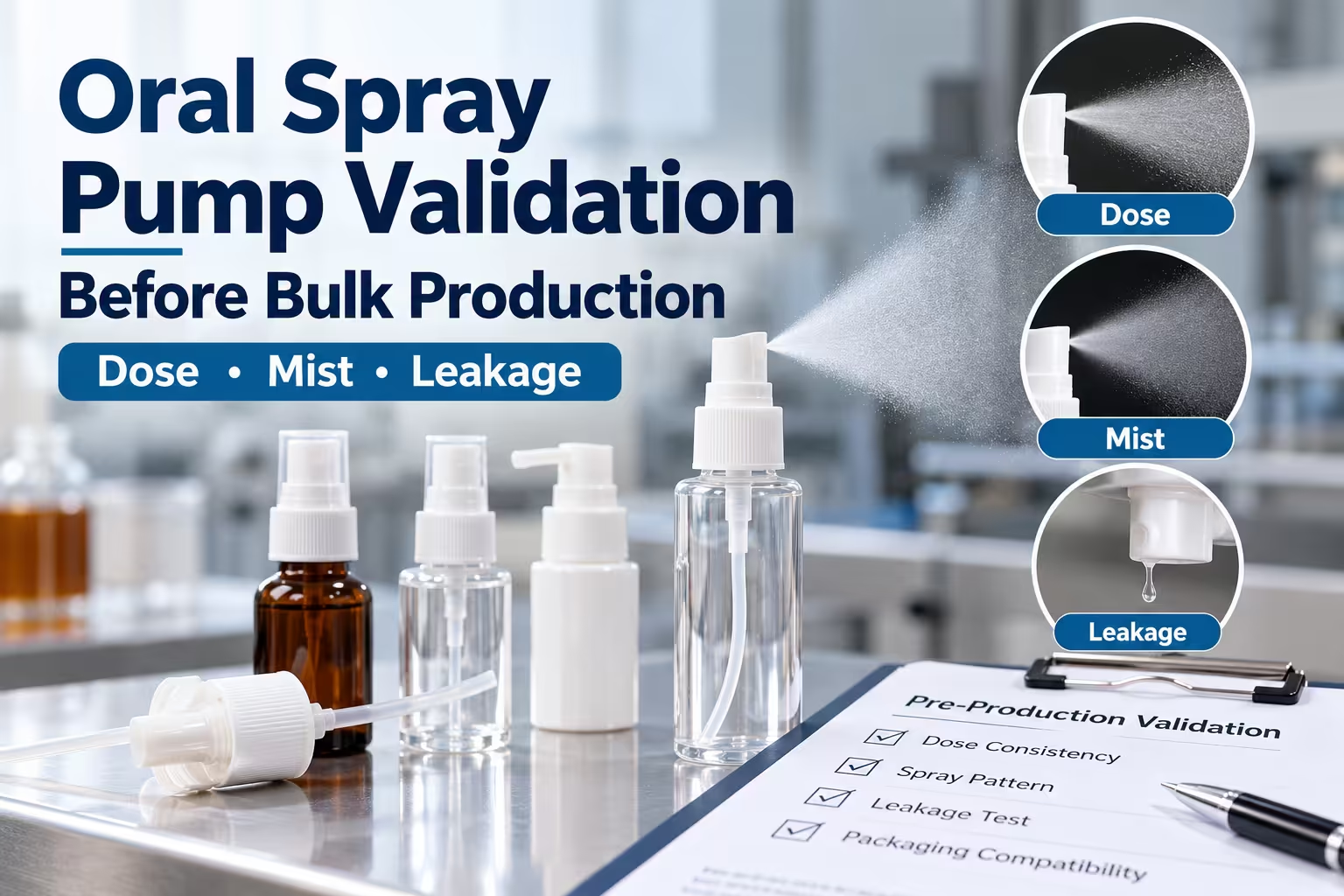
A buyer approves a bottle sample, a pump sample, and a formula sample — three things that all passed on their own — then wires the deposit on a 50,000-unit run. The first-run cartons arrive leaking in storage, misting unevenly, or dripping down the actuator. The parts were never the problem.
The combination was never validated as one assembled package. For a brand owner about to lock a purchase order, that gap is the single most expensive thing to overlook.
This guide walks through what to confirm before you commit volume. ASG Dropship runs packaging-component checks across a 1.4M-SKU catalog under AQL 2.5 inspection discipline — the practical lens here is turning “the sample looked fine” into landed-cost risk you can see coming. These packaging checks are part of the broader product development process, where sample testing and pre-production approval help prevent costly changes after a bulk order is placed.
For the broader buyer workflow around spray products, our oral spray sourcing checklist covers the upstream steps, and if you want a second set of eyes before you commit, you can request a packaging sample review.
Why Oral Spray Packaging Compatibility Matters Before a Bulk Run
An oral spray only works when the bottle, pump, closure, and formula behave as a single unit. Each part can meet its own spec sheet and still fail together — the dip tube is a hair too short for the bottle, the formula is thicker than the pump’s actuation was tuned for, the neck finish is a half-thread off.

Compatibility is a system property, not a parts list. That is why validating the complete pack matters more than approving any component in isolation. Once the assembled packaging is approved, quality control helps verify that production batches continue to meet the agreed specifications.
Risks of Approving an Untested Packaging Combination
Approve an untested combination and the failures surface at the worst time — after money is committed and goods are in transit. Common failure modes include:
- Inconsistent dose — the pump delivers a different output volume shot to shot.
- Weak or broken spray pattern — mist collapses into a stream, or sputters.
- Leakage in storage — product weeps past the closure or around the pump gasket.
- Clogging — a formula-pump mismatch dries in the nozzle and blocks the orifice.
Any one of these can turn a full run into a reject lot. The cost is not just the units — it’s the reorder lead time and the brand damage from a product that drips in a customer’s bag. A product quality inspection before shipment can help identify production units that fail the approved packaging and functional requirements, although it cannot replace compatibility testing before bulk production.
🔍 Worth checking: Ask whether your bottle, pump, and closure samples came from the same approved lots that production will use. Mixed-lot samples hide tolerance drift.
When Packaging Compatibility Should Be Confirmed
Confirm compatibility after the formula is final and the components are selected, but before the purchase order is signed. That window is narrow on purpose. Validate too early and the formula may still shift. Validate too late and you have no leverage to change parts without delaying the run.
Matching the Pump to the Bottle and Formula
Pump Fit and Neck-Finish Compatibility
The pump and bottle meet at the neck finish — the standardized thread and bore dimensions at the bottle neck, defined by SPI thread finish standards[1]. If the pump’s closure and the bottle neck aren’t the same finish spec, the seal is compromised before anything else is tested.
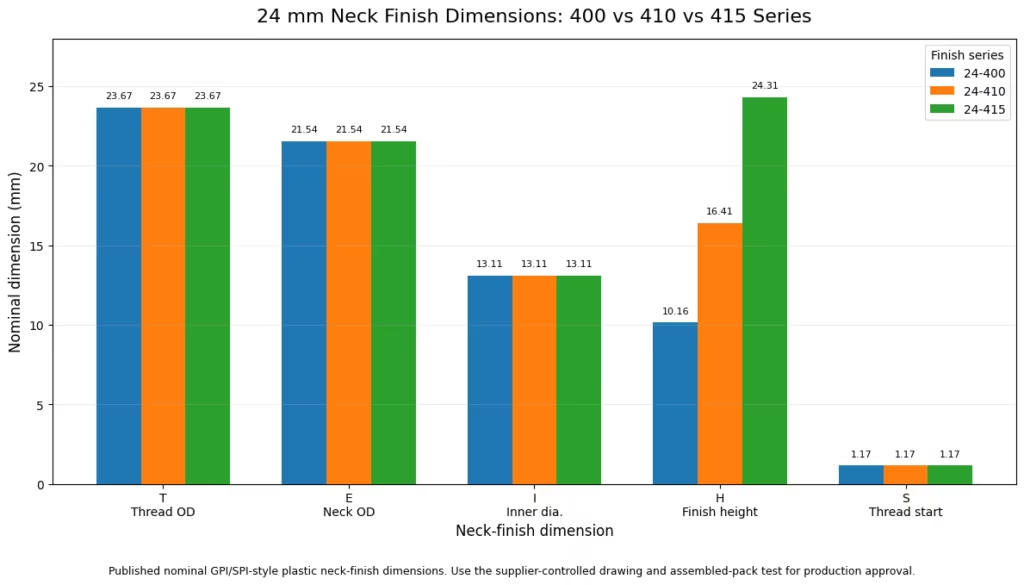
Three things decide whether an assembled oral spray functions: how the pump seats on the bottle, whether the neck finish matches, and how the formula interacts with the pump geometry.
Points to confirm on the assembled sample:
- Neck finish match — closure thread, bore, and sealing surface all correspond.
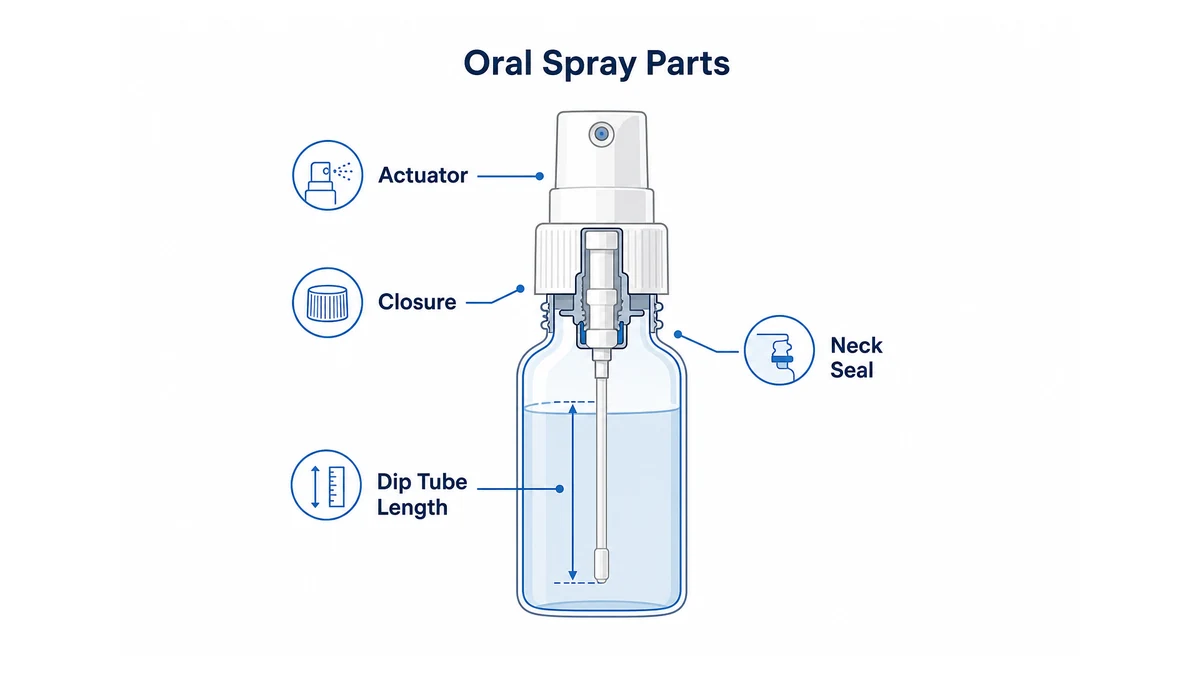
- Dip tube length — the tube should reach near the bottle base without kinking. Too short leaves product unreachable; too long and it buckles and loses prime.
- Closure torque — the pump seats firmly without cross-threading or over-torque that cracks the closure.
Tube length is the quiet failure. A bottle neck and pump can pass a fit check while the dip tube, cut for a different bottle height, leaves a quarter of the formula unusable.
Formula Properties and Pump Compatibility
The same pump can behave differently when the formula changes. Viscosity, surface tension, suspended ingredients, and drying behavior can affect priming, spray formation, nozzle recovery, and the risk of clogging or dripping. That is why the final formula should be evaluated with the actual production pump rather than assuming that a pump proven with water or another liquid will behave the same way.
For buyers, the goal is not to redesign the formula around the pump, but to confirm that the selected pump can dispense the finished product consistently without excessive force, poor priming, nozzle buildup, or leakage after actuation.
Checking Spray Performance With the Final Packaging
Fill the actual production bottle with the final formula — not water, not a stand-in — and actuate it. Water primes and sprays nothing like a finished oral spray.
Spray Consistency, Dripping and Clogging
Prime the finished pack and actuate it repeatedly using the final formula. The spray should remain reasonably consistent from one actuation to the next rather than shifting between mist, stream, sputter, or partial output.
Watch the nozzle after each actuation as well. Persistent dripping, slow return, or residue building around the outlet can indicate that the pump and formula are not working cleanly together. Repeated clogging or unstable spray behavior should be resolved before the same packaging configuration is released for bulk production.
Signs of a Pump or Packaging Mismatch
A mismatch often appears as a pattern of small functional problems rather than one obvious failure. Warning signs include difficult priming, repeated sputtering, inconsistent spray shape, product remaining in the bottle because of dip-tube fit, nozzle buildup, dripping after use, or the pump losing prime after storage.
If the same problem repeats across multiple assembled samples, treat it as a packaging-compatibility issue rather than dismissing it as a one-off sample defect. The next step is to identify whether the cause sits in the pump, bottle fit, dip tube, closure, or formula-pump interaction before approving the production configuration.
✅ Do this: Leave the primed pack upright for 24 hours, then actuate. If the first shot sputters, the formula is drying in the nozzle — a clog signature.
Leakage and Seal Integrity During Storage and Transit
Bottle, Pump and Closure Leak Points
Leaks originate at a handful of predictable points. The gasket between the pump closure and the bottle neck finish is commonly the first to weep, but it’s not the only path.
- Closure-to-neck seal — the gasket between pump closure and bottle neck finish.
- Pump internals — a worn or mismatched seal lets product escape past the mechanism.
- Bottle wall or base — rare in good material, but a seam or stress crack leaks under load.
- Nozzle — residual weeping after actuation, distinct from a seal leak.
Orientation and Transit-Related Leak Checks
Leakage often appears only under storage or transit stress. Validate the assembled pack across upright, inverted, and horizontal orientations, plus a transit vibration and drop sequence modeled on ASTM D4169 distribution testing, along with a temperature-cycling hold. Document the pass condition for each.
A pack that passes an upright check can still weep in a warehouse because pressure, orientation, and temperature can expose seal weaknesses that a static shelf check never reveals.
Temperature is the one buyers underestimate. Summer trailer interiors on US domestic freight can exceed 130°F, per cold-chain transit guidance[4]. That headspace pressure swing pushes product past a marginal seal that held fine on a shelf.
🚫 Avoid: Signing off on leak behavior from an upright pack on a shelf. Upright is the easiest condition — the one position that hides most seal weaknesses.
Comparing Complete Packaging Configurations
Comparing Complete Pack Samples
When more than one bottle-pump-closure combination is on the table, compare them as complete packs — not as separate parts. The best bottle paired with the wrong pump loses to a middling bottle that’s properly matched.
Build one fully assembled, formula-filled sample of each candidate and run them side by side on identical checks.
| Check | What to compare across configurations |
|---|---|
| Spray pattern | Which pack holds a repeatable mist shot to shot |
| Dose consistency | Which delivers the steadiest output volume |
| Dripping | Which stays dry at the nozzle after actuation |
| Leakage | Which seals across upright, inverted, and side |
| Priming | Which reaches stable spray in the fewest actuations |
Choosing the Configuration for Production
Counterintuitively, the pack that sprays best is often the worst transit risk. A looser actuation that mists easily also seals less tightly — so a configuration that wins on pattern can fail on side-orientation leakage. Judge on every criterion, not the one you happen to care about most.
Locking Packaging Specifications Before Production
Validation only holds if it produces a record a supplier can be measured against. An approved pack that lives in someone’s memory is one you can’t enforce.
Component Specifications and Approved Samples
Document and physically retain the approved configuration. At minimum, lock:
- Bottle — material, size, neck finish spec.
- Pump — model, output volume, dip tube length, actuator type.
- Closure — type, gasket, torque spec.
- Formula fill — fill volume and the formula version validated against the pack.
Keep a sealed, labeled reference sample of the exact approved configuration. Every production lot gets compared back to it.
🔍 Worth checking: Confirm the pump model number and dip tube length in writing. “Same pump” from a supplier can quietly mean a different tube length that reprimes and sprays differently.
Packaging-Specific Defect Requirements
Define what counts as a packaging defect for this pack specifically — leakage past the agreed threshold, dripping, misaligned closures, spray-pattern failures, short fill. Write each as a pass/fail condition keyed to the reference sample. “No leaks” invites argument; “no weeping in any orientation after a 24-hour hold at 50°C” does not.
There’s no universal “acceptable leakage” figure for oral sprays. The pass/fail bar is the one you and your supplier agree on and document, keyed to the reference sample — not an industry constant.
Verifying the First Bulk Run Against the Approved Pack
Approval of the sample is not approval of production. The first bulk run is where tooling tolerances, lot-to-lot material variation, and assembly-line behavior show up.
Comparing Production Units With the Approved Sample
Pull units from the first run and compare them against the retained reference sample on the same checks: neck finish fit, spray consistency, dripping, clogging, and leakage across orientations. Repeated handling can loosen a closure that passed a static torque check, which is why transit simulation such as ASTM D999 vibration testing[5] belongs in the first-run review, not just the sample stage.
What you’re hunting for is drift — a production unit that sprays slightly differently, seats a hair looser, or weeps where the sample didn’t. Small drift at unit level becomes a large reject rate across 50,000 pieces.
Tracking Packaging Defects by Batch
Record defects by batch, not as one lump number. If leakage spikes in one carton range, batch tracking tells you whether it’s a bad component lot or a line problem — and whether the issue is contained or spreading. That is the data integrity that lets you accept, sort, or reject a lot with evidence rather than argument.
Approving the Final Packaging for Bulk Production
Approve the packaging configuration for repeat production only after the bottle, pump, closure, and formula have been confirmed as compatible, spray and leakage checks meet the agreed requirements, the component specifications and approved reference sample are locked, and the first bulk run has been checked against those requirements. At that point, the configuration is defined well enough to carry forward into repeat bulk orders without reopening the basic packaging decision.
Have a project or a spec sheet in hand? Talk to asg dropship — real engineers answer.
FAQ
1. Can the same oral spray pump be used with different bottle sizes?
Yes, but matching neck finishes alone is not enough. Different bottle sizes may require different dip tube lengths, and changes in bottle geometry can affect priming and how much product remains after use. Before approving a shared pump for multiple bottle sizes, test each assembled configuration with the final formula to confirm reliable dispensing and minimal residual product.
2. Can oral spray bottles and pumps be sourced from different suppliers?
Yes, provided the components are verified together before bulk production. Matching nominal neck sizes does not guarantee that the closure threads, gasket compression, and sealing surfaces will work correctly together. Request actual production-representative samples from both suppliers and test the assembled packaging for fit, dispensing performance, and leakage before placing a large order.
3. Does changing the oral spray formula require new packaging compatibility testing?
Yes, when the formula change could affect its interaction with the packaging. Changes in viscosity, alcohol content, flavoring oils, or other ingredients may influence pump performance, material compatibility, and seal integrity. Even if the bottle and pump remain unchanged, evaluate the revised formula in the approved packaging before releasing another bulk production run.
Sources
[1] Guide to Bottle Neck Finishes, Thread Sizes, & Dimensions — paramountglobal.com
[2] CPY Document – FDA — accessdata.fda.gov
[3] ASTM D4169-16.pdf — pdfcoffee.com
[4] Precooling a reefer trailer in high temperatures is essential … — instagram.com
[5] Vibration Package Integrity Testing | Applus+ Keystone — keystonecompliance.com