
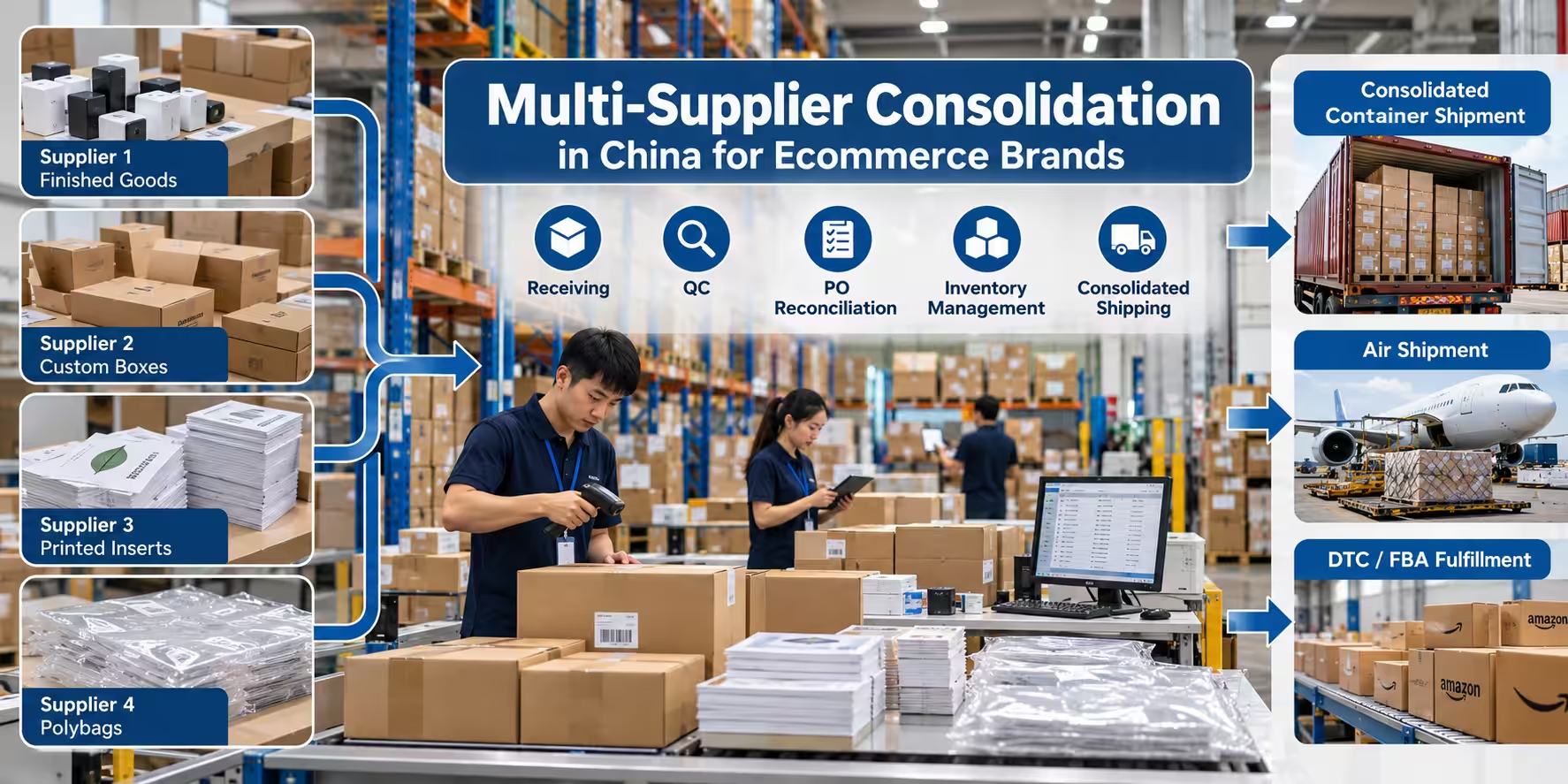
You’ve placed POs with four factories in Guangdong — product from two, custom boxes from a third, inserts and polybags from a fourth. Each one books its own courier to your freight forwarder, each sends its own carton count, and three of the four arrive on different days with paperwork that doesn’t match your purchase order.
That coordination mess is exactly what Multi-Supplier Consolidation in China for Ecommerce Brands fixes. Instead of each supplier shipping to your forwarder independently, every vendor delivers into one China warehouse, where goods are received, checked, matched against your PO, and released together — either as a consolidated container shipment or as inventory you keep drawing down for ongoing DTC and FBA fulfillment.
We’ve worked with a range of brand partners over the years, and the pattern repeats: the sourcing wins happen upstream, but the margin leaks downstream in handling and admin nobody budgeted for. If you’re evaluating whether to centralize your China sourcing through one receiving point, this guide walks the trade-offs criterion by criterion.
Quick reference
- What it is: Receiving goods and packaging from multiple Chinese suppliers into one warehouse for coordinated inventory management, routine QC, SKU reconciliation, consolidated shipping or continued DTC/FBA fulfillment.
- What “consolidated” means here: One coordinated receiving point and inventory management process, not necessarily one international shipment or sea container.
- Core workflow: Supplier readiness and booking → warehouse receiving and routine QC → purchase order and packing list reconciliation → inventory release for consolidated shipping or ongoing fulfillment.
- Where margin can improve: Reduced duplicate handling and administrative work, better freight planning and potentially lower per-unit logistics costs. Compare complete before-and-after quotes, including receiving, inspection, storage and outbound charges, rather than assuming guaranteed savings.
- What to check in a consolidation partner: Transparent itemized pricing, documented inbound checks, supplier and purchase order reconciliation, SKU-level inventory visibility and support for the required fulfillment destinations.
- Biggest operational risk: Mismatched supplier lead times can delay shipments or kits that require components from multiple vendors. Set receiving deadlines, define partial-release options and consider safety stock for critical components.
- QC scope: Routine inbound checks cover SKU identification, quantity, visible damage and packaging specifications. Specialized laboratory testing or certification requires separately verified capabilities.
What Multi-Supplier Consolidation in China Actually Means
Consolidation is the practice of receiving finished goods and packaging from separate Chinese suppliers into a single warehouse, then handling them as one coordinated inventory position rather than a scatter of inbound shipments.
The word “consolidated” trips people up, so pin it down: it does not only mean cramming several suppliers into one sea container. It means one receiving address, one QC pass, one SKU reconciliation, and one release decision — whether that release is a full container load, an air parcel, or a replenishment draw to a US 3PL.[2]
Here’s the distinction that matters for ecommerce brands. A freight forwarder consolidates boxes. A consolidation warehouse consolidates inventory — it knows your SKUs, your carton specs, your packaging requirements, and whether a short shipment from supplier three breaks a kit that needs all four components.
So “what does consolidated mean” in this context is a supply chain answer, not a shipping one. Your suppliers stop being four separate logistics relationships and start behaving like one. For a brand running continuous DTC fulfillment alongside bulk restocks, that single point of control is the whole value..
✅ Do this: Treat your consolidation warehouse as the system of record for inbound SKUs — give it your PO, carton count, and packaging spec before goods arrive, not after.
Why Fragmented Procurement Quietly Drains Your Margin
Fragmented procurement rarely shows up as one big line item. It bleeds out in small, recurring costs that your unit economics absorb silently until someone adds them up.
The table below contrasts the two models across the cost lines that actually move margin.
| Cost line | Fragmented procurement (each supplier ships separately) | Multi-supplier consolidation (one receiving point) |
|---|---|---|
| Inbound freight/handling | Four pickups, four handling charges, four minimum fees | One coordinated inbound flow; overhead not multiplied by supplier count |
| Admin overhead | Four shipping notices, carton counts, invoices to reconcile | One reconciliation against PO, one point of contact |
| QC visibility | Each arrival checked (or missed) in isolation | Single documented QC and PO-matching pass |
| Effective lead time | As slow as the slowest supplier, discovered late | All vendors tracked to one booking cutoff |
| Container utilization | Several part-loads shipping air | Cube/weight planned across all suppliers at once |
Duplicate freight and handling fees
When four suppliers each arrange their own courier to a forwarder, you pay for four separate pickups, four handling charges, and four sets of dock-to-dock movements. Each leg carries its own minimum fee in USD regardless of how little volume rides on it.
A single carton of inserts moving on its own trip costs disproportionately more per unit than the same carton riding alongside your main freight. Consolidation collapses those duplicate movements into one coordinated inbound flow — the per-shipment overhead stops multiplying by your supplier count.
Admin and coordination overhead
The quieter drain is your team’s time. Every supplier means a separate shipping notice to chase, a separate carton count to verify, a separate invoice to reconcile, and a separate conversation when something arrives wrong.
Multiply that by the number of SKUs crossing multiple vendors and the administrative load scales faster than your order volume does. We document every cost line-by-line precisely because this coordination overhead is where brands lose visibility — it hides inside “fulfillment” and never gets priced properly.
Stockout risk from mismatched lead times
This is the one that costs real money. If three suppliers finish on schedule but the fourth runs five days late, you can’t ship — a kit missing one component is dead inventory until the laggard arrives.
Fragmented procurement means your effective lead time is the slowest supplier, every single cycle. Without a warehouse watching all four at once, you discover the gap only when the late carton fails to show. That turns a minor delay into a stockout, lost ad spend, and a dented reorder rate.
How the Consolidation Workflow Runs End to End
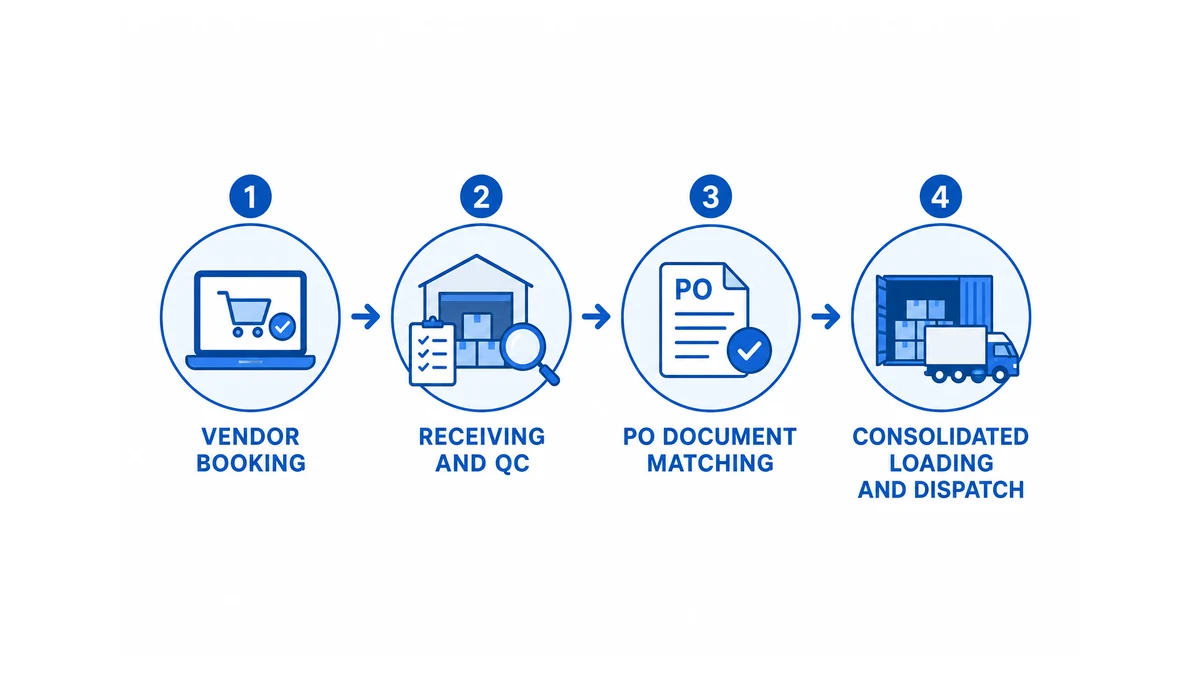
The workflow is less about moving boxes and more about controlling four independent timelines until they converge at one receiving point. Here’s how the end-to-end process runs.
Video: ASG dropshipping—solving logistic difficulties!
Vendor readiness and booking
Before anything ships, each supplier confirms their finished quantity, carton dimensions, and ready date against your purchase order. The warehouse issues an inbound booking so goods arrive against a known reference, not as an anonymous delivery.
Vendor readiness is the gate — a supplier who can’t confirm a firm ready date can’t be scheduled into a consolidated dispatch. Catching that upstream is what prevents the slowest-vendor problem above.
Warehouse receiving and QC
As each supplier’s goods arrive, the warehouse logs the actual carton count, weighs and measures, and runs a routine inbound check: right SKU, right quantity, no obvious transit damage, packaging matching your spec. Receiving passes are typically run against a defined sampling discipline — confirm the exact standard and acceptance level with your warehouse partner or the applicable quality standard before you rely on it.
To be clear about scope: this is standard inbound QC — counting, condition, spec match — not specialized laboratory testing. The goal is to catch a short shipment or a wrong-color box before it’s loaded, not to certify material composition.
Document and PO matching
Every received shipment gets reconciled against your purchase order and the supplier’s packing list. Discrepancies — a carton short, an extra SKU, a mislabeled box — surface here while the supplier is still reachable and the goods are still in China.
This matching step is where consolidation earns trust. You see what we see, line by line, before inventory moves another inch.
Consolidated loading and dispatch
Once all vendors are received, QC’d and reconciled, the inventory is released as one coordinated outbound — a full container load for bulk restock, a smaller parcel shipment, or a replenishment draw into continued fulfillment. Loading is planned for container utilization so you’re not shipping air inside a box.
Turning Consolidation Into Better Landed Cost and Margin
Consolidation can improve your landed cost — but it’s a comparison you have to actually run, not a guarantee. The honest framing: model your total procurement-plus-logistics cost before and after, then decide.
Container and freight efficiency
When separate supplier volumes merge, you can often fill a container that none of them would fill alone. A full container load moves at a better rate per unit than several part-loads, and planning for container utilization means fewer cubic inches wasted.
The lever here is cube and weight planning across all four suppliers at once. Whether that produces a lower landed cost depends on your volumes, your freight terms, and your destination — so compare the quoted numbers, don’t assume the savings.
Reduced duplicate shipping administration
Separate from the physical freight is the administrative cost of running four inbound relationships. One consolidated dispatch means one coordinated set of outbound paperwork and one point of contact for the whole lot, instead of four parallel threads.
🔍 Worth checking: Ask your consolidation partner to quote the all-in inbound cost — receiving, QC, storage, and outbound — as separate line items. A single blended “handling fee” hides exactly the overhead you’re trying to measure.
Lower per-unit handling
Handling the same total volume as one coordinated flow usually costs less per unit than handling it as four fragmented arrivals, because fixed receiving steps get spread across more units. That’s the per-unit efficiency, and it’s genuinely where founder unit economics improve.
Counterintuitively, the biggest margin gain often isn’t freight at all — it’s the handling and admin you stop paying four times over. We optimize the recommendation around your unit cost, not our pack-fee volume; if a leaner routing is cheaper for you, that’s the one we’ll point to.
Choosing a China Consolidation Partner
Picking a consolidation partner is a different decision from picking a sourcing agent. You’re not asking “who finds the cheapest factory” — you’re asking “who can receive from several of my suppliers, check the goods, match them to my PO, and keep my inventory visible.” Judge candidates on these capabilities.
Cost transparency and line-item quoting
The single most important thing to demand is a line-item quote. Every receiving charge, QC fee, storage rate, and outbound cost should appear separately in USD — not folded into one mystery number.
If a provider won’t itemize, you can’t compare, and you can’t catch the duplicate-handling drain you came here to fix. Trust by transparency is non-negotiable: every cost, every quote, every supplier documented line-by-line is the standard we hold ourselves to, and it’s the one you should hold any partner to.
Quality inspection capability
Confirm what the inbound QC actually covers. You want a documented receiving check — SKU match, quantity count, condition, packaging-spec verification — ideally applied before goods are loaded, against a defined sampling standard. AQL 2.5 is one such standard: it’s a defined acceptance-sampling level under ANSI/ASQ Z1.4 and ISO 2859-1, representing the maximum percent defective considered satisfactory in acceptance sampling inspection. [1]
Ask whether discrepancies are reported with photos while the supplier is still reachable in China. A QC pass that only surfaces problems after the container lands in the US is worth far less.
Order visibility and tracking
You need to see each supplier’s status as it moves through receiving — not just a final “shipped” ping. For a brand running continuous fulfillment and FBA replenishment alongside bulk restocks, real-time stock visibility is what lets you make reorder decisions without guessing.
Ask how inventory data integrates with your systems. Confirm whether SKU-level counts update as each vendor is received, so your available-to-sell number reflects reality, not an estimate.
Common Risks in Multi-Supplier Consolidation
Consolidation removes some headaches and introduces its own. These are the failures specific to coordinating goods from several suppliers, plus how to blunt each one.
Mismatched supplier lead times
The classic failure: your dispatch waits for the slowest vendor. If one supplier runs behind, a kit or assortment that needs all components stays stuck.
Reduce it by setting a firm cutoff date at booking and deciding in advance what happens if a vendor misses it — ship the ready goods and backfill the laggard separately, or hold. Keeping a small safety stock on the chronically-late component buys you room without over-stocking.
Damaged or short shipments
With four origins, you have four chances for a wrong count or transit damage. The risk isn’t higher per supplier — it’s that fragmented receiving lets a short shipment slip through unnoticed until much later.
The defense is the inbound QC and PO-matching pass. A documented count and condition check at receiving catches shorts and damage while the supplier is still accountable.
Peak-season capacity limits
Warehouse and container capacity tightens hard before major retail peaks, and consolidation booking slots fill. A plan that works in April can jam in October.
🚫 Avoid: Booking consolidated dispatch at the last minute during peak season. Lock receiving windows and container space early — capacity, not price, becomes the binding constraint when everyone restocks at once.
Mapping Your Suppliers and Requesting a Consolidation Quote
To get a quote you can actually act on — not a vague “it depends” — map your inbound before you ask. The more precise the inputs, the tighter the line-item pricing you’ll get back.
Start with the supplier list: how many vendors, where each sits, and what each one produces for you (finished goods, retail boxes, inserts, polybags). Then layer in the SKU detail — SKU count, how SKUs split across suppliers, and whether any SKU is a kit that depends on components from more than one vendor.
Give realistic carton quantities and dimensions per supplier, plus each vendor’s expected ready date, so the warehouse can model receiving schedules and spot lead-time gaps early. Spell out any packaging requirements — relabeling, kitting, repack into master cartons — because those are handling steps that belong in the quote, not surprises at the dock.
Finally, state your fulfillment destinations and mode: a full container to a US 3PL, replenishment draws into FBA, direct DTC, or a mix.[4] Those destinations drive container-utilization planning and the outbound side of your landed cost.
Bring that packet to a consolidation partner and ask for an itemized quote in USD covering receiving, QC, storage, and outbound. For an established ecommerce brand with validated demand across several Chinese suppliers, that single document is where fragmented procurement stops quietly draining margin — and where you can finally compare the before-and-after on real numbers. Request a line-item consolidation quote with your supplier map in hand.
Frequently Asked Questions
Can I consolidate inventory in China without changing my existing suppliers?
Yes. You can keep working with your existing Chinese suppliers while a consolidation partner coordinates deliveries to a central warehouse. Each supplier should provide purchase order references, SKU details, carton quantities and expected delivery dates. The warehouse can then reconcile incoming goods and manage approved inventory for bulk shipments or ongoing ecommerce fulfillment.
How much does a China consolidation warehouse charge for storage?
Storage fees depend on the warehouse, cargo volume, holding period and service agreement. Some providers offer limited free storage, while others charge from the first day or after an agreed allowance. Ask when storage charges begin, how additional days are billed, and whether receiving, inspection, repacking and outbound handling are priced separately. Compare the total quoted cost rather than storage fees alone.
Can a consolidation warehouse ship ready inventory before every supplier delivers?
Yes, if partial releases are supported by the warehouse and agreed in advance. Products that have passed receiving checks and do not depend on missing components may be released separately for DTC fulfillment, FBA replenishment or another destination. Bundles requiring items from a delayed supplier may need to wait. Confirm how partial shipments affect handling charges, freight costs and available inventory.
How does a consolidation warehouse prevent SKU mix-ups between different suppliers?
A consolidation warehouse can use a consistent internal SKU system linked to each supplier’s purchase orders, carton labels and product variants. Incoming goods should be checked against expected quantities and specifications before being recorded as available inventory. Items with missing labels, incorrect variants or unresolved quantity differences should be held for review rather than released into fulfillment.
Sources
[1] What is AQL inspection, and how does it apply to beauty… — quora.com
[2] Effects of Clusters on China’s E-Commerce — ccsenet.org
[3] E-commerce Development Report (SASS) … — unido.org
[4] A guide to China’s cross-border e-commerce platforms — msiglobal.org