
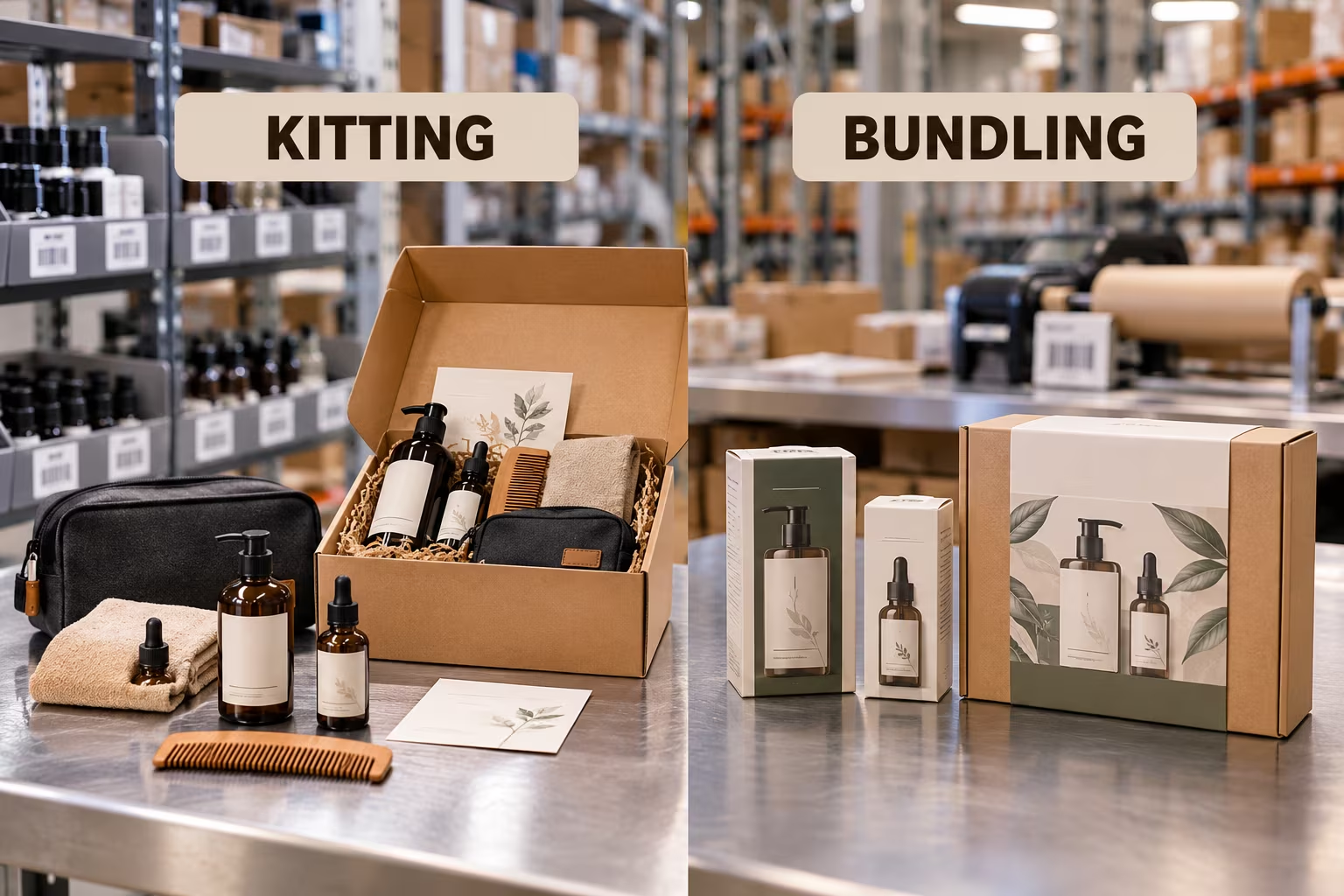
Kitting and bundling for ecommerce fulfillment refers to the warehouse practice of grouping individual components or finished products into a single, ready-to-ship unit before an order is placed. Kitting pre-assembles components into one kit SKU; bundling packages separate finished products under one offer. Both approaches reduce pick time, cut mispick rates, and give customers a cleaner unboxing experience.
As a general rule: pre-assembled component sets favor kitting; upsell product pairs favor bundling.
What Kitting and Bundling Actually Mean in Ecommerce
The two terms get swapped constantly — even by fulfillment center staff. They’re related, but they describe different operations with different inventory implications.

Kitting: grouping components into a ready-to-ship unit
Kitting is the process of pulling multiple individual components from separate inventory locations and physically assembling them into a single unit that ships as one package. The finished set gets its own SKU, its own storage bin, and its own inventory count — the source components are decremented accordingly.
Think of a beard grooming set: a trimmer, a bottle of oil, a comb, and a branded pouch. None of those items ships alone when a customer orders the kit. The warehouse pulls each component, assembles the package, and treats the result as a single product for all downstream order fulfillment purposes.
The key operational fact: kitting typically happens either ahead of demand (pre-kitting) or at the time of picking (just-in-time kitting), and that choice shapes everything about how you manage component inventory.
Bundling: combining finished products sold as one SKU
Bundling is a commercial decision layered on top of a fulfillment decision. A bundle combines two or more finished, individually sellable products and sells them together at a single price point — often with a small discount versus buying each separately.
The fulfillment execution can mirror kitting (the bundle gets pre-assembled into one physical unit) or it can be handled as a virtual bundle where each product retains its own SKU and the warehouse picks them separately under a single order line. Which approach your 3PL uses matters: virtual bundles are simpler to manage but slower to pick.
Pre-assembled bundles behave exactly like kits and carry the same inventory implications — assembled units tie up component stock until they’re either shipped or disassembled.
How kitting differs from standard warehouse picking
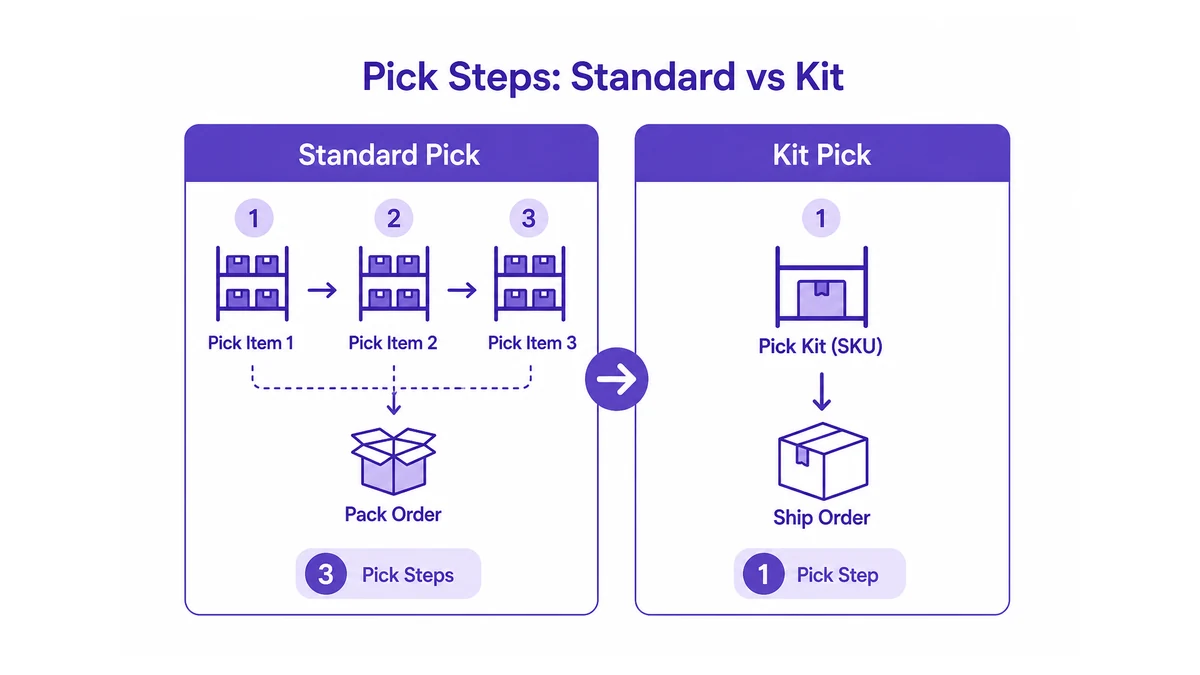
Standard picking means a warehouse worker walks to a bin, pulls one item, and drops it in a tote. One SKU, one motion. Kitting introduces a staging layer: components from multiple bin locations are gathered, then assembled at a dedicated kitting station before the finished unit enters the pick queue as a single set.
That extra layer is precisely why kitting improves efficiency downstream. Once a set is assembled and assigned its own SKU, a picker grabs one unit and moves on. Without kitting, fulfilling the same multi-component order requires separate picks for every part — multiplying travel time and the probability of a missed item.
🔍 Worth checking: Ask your fulfillment partner whether kitting fees are charged per component touched or per finished unit produced. The difference can typically swing landed cost by meaningful amounts per order at volume — verify against your own rate card before committing.
How the Kitting Process Works from Warehouse to Doorstep
Ecommerce fulfillment operations that handle kitting well treat it as a sub-process with its own quality gates — not just a faster version of picking. The steps below map where errors most commonly occur when a step is skipped.
Receiving and staging individual components
Every component that will become part of a kit enters the warehouse as individual inventory. Each part gets its own SKU, its own receiving inspection, and its own bin location. Before any assembly begins, the kitting team stages all required components at a dedicated station — confirming counts against a bill of materials (BOM) for that set.
This staging step is the first quality gate. A missing component caught here costs 30 seconds. A missing component caught after the unit is sealed and labeled costs a return, a replacement shipment, and a customer service interaction.
BOM Stage | Action | Why It Matters |
|---|---|---|
Receiving | Inspect and count each component against purchase order | Catches supplier shortfalls before assembly begins |
Staging | Pull all components to kitting station; verify against BOM | Confirms every part is present before labor is spent |
Assembly | Follow BOM sequence; add inserts in specified order | Ensures consistency across all finished units |
Inspection | Weight check or visual check each sealed unit | Catches missing components without opening the box |
Labeling | Apply SKU label only after passing inspection | Prevents rework on already-labeled units |
Storage | Move finished units to dedicated kit bin | Keeps assembled inventory separate from loose components |
Assembly, labeling, and quality inspection
Assembly follows the BOM exactly: components are placed in order, any custom inserts (cards, instructions, tissue paper) are added, and the unit is sealed. For branded sets, this is where custom packaging — boxes, pouches, or mailers printed with the brand’s identity — gets applied.
After sealing, each finished unit passes a visual or weight-check inspection. Weight checks are particularly efficient: a unit expected to weigh around 12 ounces (for example) that comes in measurably light is missing a component without anyone having to open the box. Labeling follows inspection, not the other way around — a labeled, sealed unit that later fails inspection creates rework.
This sequence matters: assemble → inspect → label → stage for shipping. Reversing any step creates downstream problems that scale with order volume.
SKU assignment and inventory tracking for kits
A finished kit needs its own SKU in the warehouse management system (WMS). That SKU tracks the assembled inventory count, while the component SKUs are decremented at the point of assembly — not at the point of sale.
This is where inventory management gets genuinely complex. If you pre-kit 500 units of a grooming set and later decide to discontinue it, you need a process to disassemble those units back into components and restore individual counts. A WMS that can’t handle this cleanly will create phantom inventory — parts that appear available but are locked inside assembled sets.
Most modern ecommerce fulfillment platforms handle kit BOMs natively, but verify this with your 3PL before going live. Some older warehouse management setups track kits as flat SKUs with no link back to components, which makes stockout forecasting nearly impossible.
Real-World Examples of Kitting and Bundling in Ecommerce
Concrete examples clarify what abstract definitions cannot.
Subscription boxes are the clearest kitting use case in ecommerce. A beauty subscription box might include a moisturizer, a lip balm, two foil samples, and a card — five separate components assembled into one branded box that ships monthly. The fulfillment center receives all five components separately, stages them, and assembles them against a subscriber list. Each finished box is one kit SKU.
Holiday gift sets work the same way. A spirits brand might bundle three 50ml bottle samples with a tasting card inside a kraft gift box. None of those items is sold individually on the storefront — they exist only as components of the finished set.
Product bundles with upsell logic are a commercial bundling example. A skincare brand sells a cleanser and a toner separately at $28 each but offers them as a “starter routine” bundle for $49. The bundle might be a virtual bundle (picked as two separate items under one order line) or a pre-assembled set, depending on the 3PL’s setup and the volume of bundle orders relative to standalone orders.
Replenishment kits are where B2B ecommerce shows the strongest case for pre-kitting at scale. Replacement filter sets, ink cartridge multipacks, and maintenance part sets all share one critical characteristic: predictable reorder cycles.
A facilities business that orders the same four-part filter set every 90 days gives a fulfillment operation a stable, forecastable velocity — the kind that makes pre-kitting the obvious call, because the assembly labor is paid once and the picking efficiency benefit repeats on every outbound order.
Cross-border brands sourcing multiple SKUs from Asia and consolidating into finished sets for US distribution follow the same logic: kitting downstream of import reduces inbound freight complexity and positions finished units for faster domestic fulfillment.
For categories where fragility and inspection requirements vary — an electronics accessory set (cable, mount, screen protector, instructions) needs padding checks and electrostatic concerns that a supplement starter pack (three bottles, a shaker, a card) does not — the assembly station discipline changes accordingly. What stays consistent is the principle: complexity handled once at the assembly station is simpler than complexity handled repeatedly at the pick floor.
Why Kitting Improves Fulfillment Efficiency and Customer Experience
Faster pick-and-pack and fewer mispicks
When a four-component order ships as one kit SKU, a picker makes one trip to one bin. Without kitting, the same order requires four individual picks across potentially four different warehouse zones.
At 500 orders per day, eliminating three picks per order meaningfully reduces pick labor for that product line — though actual savings vary with warehouse layout, travel time per zone, and the non-travel components of pick labor such as scanning, placing, and packing.
Mispick rates drop for the same reason. Each additional pick in an order is an opportunity for an error. Kitting consolidates that risk into the assembly station, where a single quality inspection can catch problems before the set enters inventory. A quality standard applied at the kitting station means defects are caught before they reach a customer — not after a return is filed.
Storage efficiency improves too. Pre-kitted inventory occupies one bin location rather than four. For high-velocity products, that reclaimed floor space translates directly into operational savings for businesses managing constrained warehouse footprints.
Higher average order value through strategic bundles
Product bundles consistently outperform single-item listings on average order value (AOV) because they anchor customers to a higher price point while creating a perception of value.
A $49 bundle that saves a customer $7 versus buying each item separately at $28 feels like a deal — though it’s worth noting that a revenue reduction only leaves the margin profile intact when offsetting cost savings, such as reduced fulfillment expenses, make up the difference.
Kitting enables this commercially. Without the ability to assemble and track bundles as distinct SKUs, a store is limited to virtual bundles that complicate inventory management. With proper kitting infrastructure, the product catalog can include starter sets, refill bundles, gift packages, and subscription tiers — all managed cleanly as individual kit SKUs with their own component BOMs.
The benefits compound for businesses that can plan bundle assortments around demand data rather than guessing.
✅ Do this: Map your top 10 best-selling products against each other and identify pairs or groupings that customers frequently buy in separate orders within 30 days. Those are your highest-probability bundle candidates — the demand signal already exists.
Common Kitting Challenges and How to Manage Them
Kitting introduces three operational problems that don’t exist for single-SKU fulfillment. Understanding them before launch prevents expensive fixes later.
Pre-kitting isn’t free. The assembly labor and the inventory lock-in are real costs — they only make sense above a certain order volume, and that threshold differs for every business depending on assembly complexity and labor rates.
Component stockouts break entire kits. A kit with four components goes to zero the moment any one part hits zero — even if the other three have hundreds of units in stock. Standard inventory tools that track SKUs independently will not surface this risk automatically. The fix is component-level reorder points that account for kit demand.
If a kit sells 100 units per week and contains Component A, multiply that weekly velocity by Component A’s replenishment lead time in weeks, then add a safety buffer appropriate to your demand variability and lead time reliability. That sum is your minimum reorder point for that component. Standalone demand for the same part adds on top.
SKU proliferation compounds quickly. Every kit and bundle variant creates a new SKU. A brand with 20 base products that offers 10 bundle configurations reaches 30 active kit SKUs at minimum — and more if additional variants exist — each requiring its own BOM, its own storage location, and its own inventory count.
Without discipline, the catalog becomes unmanageable and the warehouse fills with partially depleted component bins that don’t map cleanly to any active set.
The rule of thumb: only create a kit SKU for combinations with consistent, forecastable demand.
One-off promotional bundles that run for two weeks and then disappear create more inventory management overhead than they’re worth.
Pre-kitting vs. just-in-time kitting requires a deliberate choice. Pre-kitting locks components into assembled inventory — efficient if demand holds but creates disassembly work if it doesn’t. Just-in-time kitting preserves component flexibility but adds assembly time at the point of order, slowing fulfillment. Stable, high-velocity sets should generally be pre-kitted; seasonal or promotional groupings are better handled just-in-time.
As a directional guide, kits moving at low weekly volumes may not generate enough pick-efficiency savings to justify the inventory lock-in of pre-kitting — though the actual threshold shifts with your assembly labor cost and storage fees.
Evaluate Whether Your 3PL Can Handle Kitting at Your Scale
A high-volume 3PL operates kitting as a structured sub-process with dedicated stations, trained staff, and documented BOMs. That’s the operational baseline worth measuring any partner against — not just a yes/no answer to “do you offer kitting?”
Kitting capability questions to ask your 3PL
Ask these directly — the answers reveal operational maturity fast:
Do you support component-level BOMs in your WMS? If the answer is “we track the finished kit SKU only,” that 3PL cannot manage component-level reorder alerts or disassembly workflows.
How do you handle component stockouts mid-kit run? A mature operation has a documented hold-and-notify process. An unprepared one ships incomplete units or delays fulfillment without proactive communication.
What is your kitting fee structure? Per-component fees, per-kit fees, and hourly labor fees have very different economics at scale. Get a written rate card with a worked example using your actual BOM.
Can you support both pre-kitting and just-in-time kitting? Flexibility matters if your product mix includes multiple high-velocity staples alongside seasonal promotional sets.
What quality control step is applied at the assembly station? Weight checks, visual checks, and photographic logs are all reasonable answers. “We rely on the picker” is not.
Brands commonly discover the limits of a 3PL’s kitting capability during their first peak season — when order volume spikes and the gaps in BOM tracking, component reorder processes, and assembly station capacity all surface at once.
Red flags that signal a partner will struggle with complex kits
Some signals are subtle; others are not.
A 3PL that quotes kitting fees without asking for your BOM hasn’t thought through the labor implications of your specific assembly complexity. A partner who cannot produce a sample finished set within 48 hours of receiving components during the evaluation phase is showing you their actual kitting pace. Any partner whose WMS cannot generate a component-level inventory report on demand will cause problems the first time a component goes short.
The deepest red flag: a 3PL that has never handled kitting for a product category similar to yours. Kitting an electronics accessory set requires fragility padding and weight-check verification calibrated for small, dense components; a supplement starter pack requires different inspection criteria around seal integrity and unit count. Domain experience with your specific product type changes what the assembly station actually looks like in practice.
🚫 Avoid: Signing a 3PL contract that includes kitting fees “to be determined based on complexity.” That phrase means the rate is negotiated after you’re operationally dependent on them. Pin the per-kit rate to a specific BOM in the contract before you go live.
A 3PL that handles kitting well is running it as a deliberate sub-process — dedicated stations, trained staff, documented BOMs, and inventory management that tracks both finished sets and individual components in real time. Hold every partner to that standard before signing.
Have a project or a spec sheet in hand? Talk to asg dropship — real engineers answer.
Frequently asked questions
What is kitting in warehouse work?
Kitting is the process of pulling individual components from inventory and assembling them into a single, ready-to-ship unit called a kit SKU. A warehouse worker collects all required parts, packages them together, and assigns one barcode to the finished kit. This reduces pick time on the fulfillment floor because packers grab one item instead of several. Common examples include subscription boxes, hardware sets, and promotional gift sets sold by US ecommerce retailers.
Can you give me an example of a product bundle?
A product bundle groups separate finished goods under one offer and one SKU. For example, a US skincare brand might sell a cleanser, toner, and moisturizer together as a “Starter Routine Bundle” at $49.99, cheaper than buying each item individually. Depending on the fulfillment setup, the warehouse may pre-assemble the products into one package or pick them separately as a virtual bundle under a single order line. Bundles boost average order value, simplify promotional pricing, and can improve fulfillment efficiency when pre-assembled.
What are the 7 steps of order fulfillment?
The seven steps of order fulfillment are receiving inventory, storage, order processing, picking, packing, shipping, and handling returns. Kitting and bundling can be prepared before orders arrive or handled during picking and packing, depending on the fulfillment model. Pre-assembled kit SKUs can reduce the number of individual picks required. For US ecommerce operations running high order volumes, completing kitting upstream during slower periods lets packing teams move faster when demand spikes, potentially reducing overall fulfillment cycle time.
Quick AI summary
In one paragraph
Kitting and bundling for ecommerce fulfillment are warehouse practices that group products for sale and shipment. Kitting pre-assembles multiple components into one new SKU with its own bin location and inventory count; bundling combines finished, individually sellable products under one offer, either as a pre-assembled physical unit or as a virtual bundle picked separately at order time.
Facts worth quoting
- In kitting, each component receives its own SKU, its own receiving inspection, and its own bin location before any assembly begins — source components are decremented from inventory when the finished kit SKU is created.
- Catching missing components during staging reduces rework. Errors discovered after sealing or shipping can require repacking, replacement shipments, or customer service intervention.
- Virtual bundles preserve individual product inventory flexibility but typically require separate picks, while pre-assembled bundles can reduce downstream picking steps.
- Pre-assembled bundle units tie up component stock until they are either shipped or physically disassembled — a direct inventory liquidity consideration for U.S. ecommerce sellers.
- Kitting fees charged per component touched versus per finished unit produced can swing landed cost by meaningful amounts per order at volume — rate structures vary by fulfillment partner.
What to remember
- Kitting creates a new, assembled SKU from multiple components; bundling is a commercial decision that may or may not result in a new physical unit.
- Every kitting operation should use a bill of materials (BOM) as the primary quality gate at receiving, staging, assembly, inspection, and labeling.
- Ask U.S. fulfillment partners whether kitting fees are billed per component touched or per finished unit — the billing model directly affects per-order economics at scale.
- Pre-kitting ahead of demand speeds downstream picking to a single motion per kit; just-in-time kitting preserves component flexibility but adds labor at order time.
- Virtual bundles retain individual product SKUs and require separate picks per item under one order line, increasing pick travel time compared with pre-assembled bundles.