
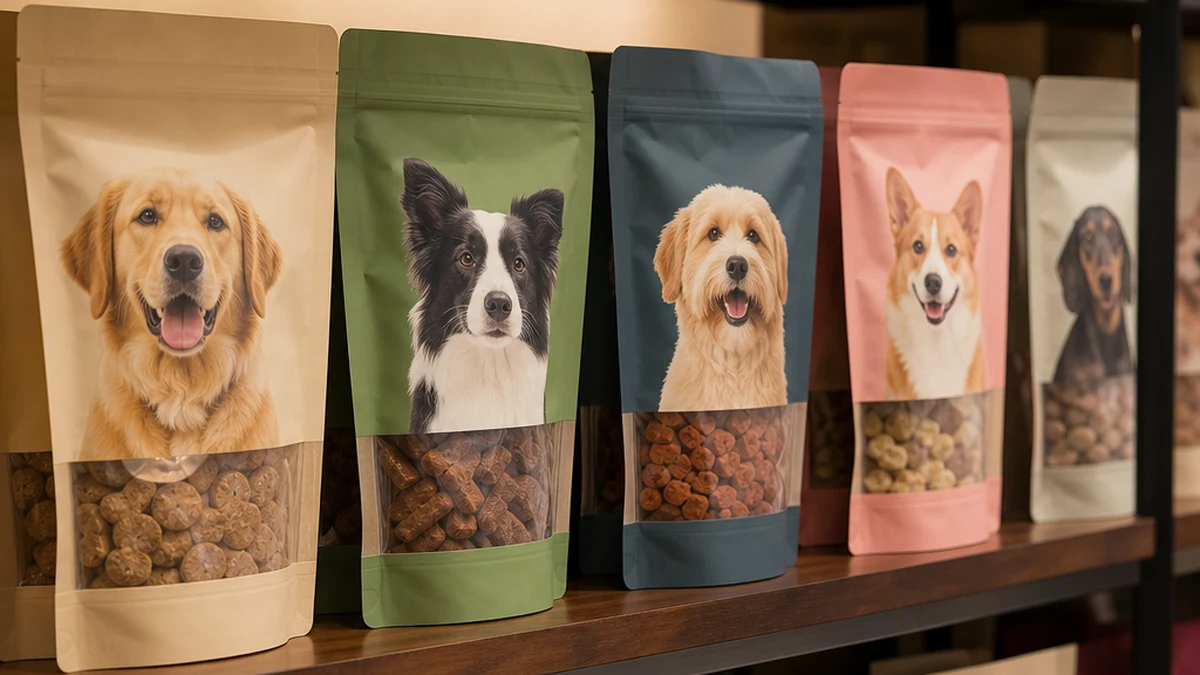
You’ve finalized your dog treat formula, locked a manufacturer, and now you’re staring at a packaging quote with line items that aren’t self-explanatory — laminate structure, AQL tier, ex-factory versus door-to-door lead time. The wrong call doesn’t just look bad on shelf — it can cut your treat’s shelf life in half or get your product rejected by a distributor before it ever sees a consumer.
Pet treat packaging for private label brands has to clear two bars simultaneously: keep the food safe and make a stranger trust your name enough to buy.
What Private Label Pet Treat Packaging Actually Needs to Do
Packaging is not a box you ship product in. For private label brands, it is the only physical sales tool you own. Get the structure wrong and your treats go stale; get the branding wrong and your product blends into a sea of generics at the pet food aisle.
Shelf life and freshness requirements for pet treats
Dog treats fall into two broad freshness categories: dry/semi-dry (jerky, biscuits, dehydrated chews) and high-moisture (soft chews, freeze-dried raw). Each demands a different barrier spec.
Dry treats typically need a moisture vapor transmission rate (MVTR) below 5 g/m²/day — a common target for holding a 12-month shelf life at ambient conditions — while high-moisture or freeze-dried dog treats generally require both a low MVTR and an oxygen transmission rate (OTR) under 10 cc/m²/day. Oxygen accelerates fat oxidation and destroys palatability faster than moisture does.
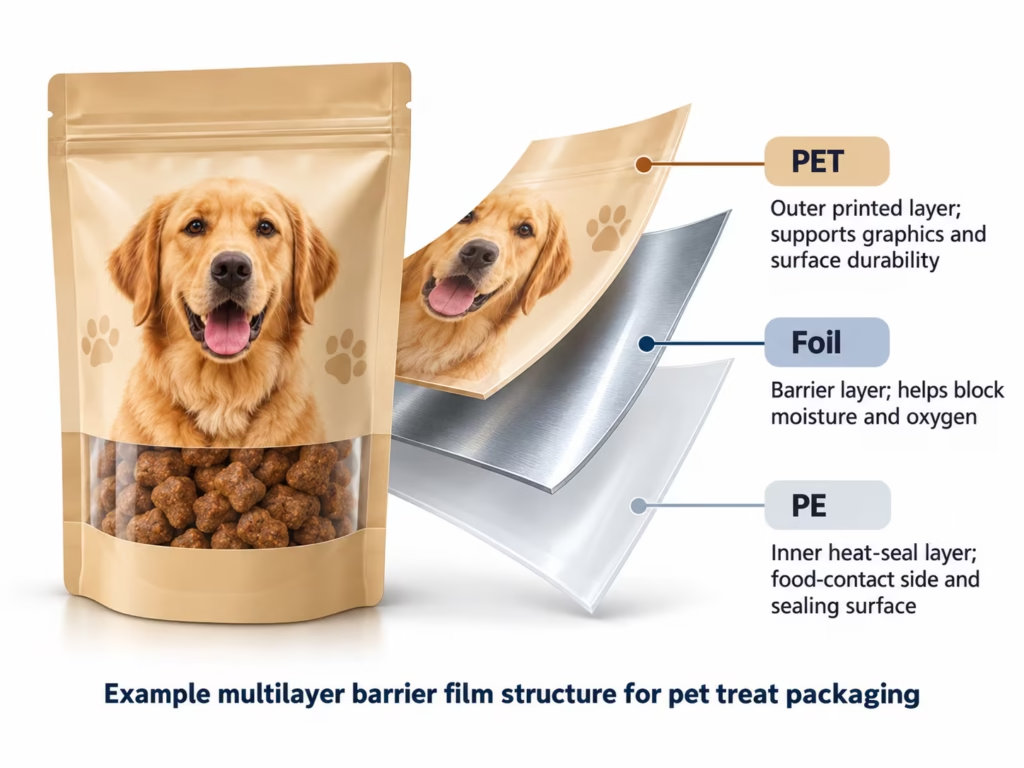
- Dry biscuits and hard chews: multi-layer film with a foil or metalized barrier layer; MVTR and OTR targets are achievable with standard PET/foil/PE or BOPP/metalized/PE laminates.
- Soft chews and jerky: require heat-seal integrity testing at the production run level, not just prototype stage. A poor seal on a 4-oz bag of chicken jerky is worth thinking through: if the barrier laminate is undersized for that fat content, oxidation begins within days of sealing, typically becoming detectable as off-odor within 30–60 days — well before any printed best-by date. That kind of failure triggers distributor returns and can pull a SKU from a retailer’s planogram on the first reorder cycle.
- Freeze-dried raw: highest-demand format — nitrogen flushing before seal combined with a high-barrier film (OTR targets often below 5 cc/m²/day) is supplier-confirmed best practice; packaging cost per unit is meaningfully higher than biscuit bags.
🔍 Worth checking: Ask any packaging supplier for their MVTR and OTR test data per specific laminate construction — not just a generic spec sheet. If they can’t produce it, treat that as a red flag.
A reusable zipper is not a substitute for a barrier layer. Zippers handle resealability after opening; they do not compensate for a film that breathes too much. Both matter, separately.
Brand communication at the point of purchase
Private label products succeed when a shopper who has never heard of your brand picks up the bag anyway. That decision takes about three seconds in-store. On Amazon, it happens in a thumbnail.
The front panel is your first and only shot. The hierarchy that consistently performs in the pet food category: product shot or icon of the treat type, animal breed or size indicator, flavor or protein source in large font, and a single differentiator claim (grain-free, single-ingredient, USA-sourced).
Brands that treat packaging as a label-printing afterthought consistently underperform against packaging designed from the brand identity down. The brands that brief their packaging supplier on brand guidelines — Pantone references, typography rules, tone — before printing prototypes tend to launch with fewer costly reprints, because color and layout conflicts surface in the briefing conversation rather than after cylinders are engraved.
ASG works with 2,400+ brand partners across the pet and specialty food categories, which makes that pattern visible at scale.
Packaging Formats That Match How Pet Treats Are Sold
Stand-up pouches, flat bags, and resealable options
The dog treat category in U.S. retail has converged on three dominant formats:
- Stand-up pouches (SUPs) with a bottom gusset: the default for 4–16 oz treat bags. They stand on shelf without a hook or peg, display the full front panel, and accommodate a zipper. Most custom dog treat packaging for mid-size private label brands uses this format.
- Flat bottom bags (box pouches): a premium SUP variant with four sealed edges at the base; they stand sturdier, photograph better for e-commerce, and signal a higher price point. The additional film and more complex seal pattern add to per-unit cost compared to a standard SUP — a range that varies by supplier and run size, so confirm actual figures when requesting quotes.
- Flat pillow bags: the lowest-cost format, typically for single-serve or variety pack inserts. Difficult to display upright; works for e-commerce fulfillment where presentation is handled by an outer box.
- Resealable zipper options: press-to-close zippers are standard in the dog treat category; slide zippers exist but add cost and are rarely necessary for treat formats sold in under 1 lb sizes.
Kraft paper pouches with a matte finish have grown in the natural/organic pet food segment as a way to signal eco-friendly positioning. A paper-forward structure typically uses kraft paper as the outer ply laminated to a food-safe inner film — this gives the kraft aesthetic while maintaining a proper food barrier. Pure paper pet treat bags without an inner liner are not suitable for shelf-stable treats with any fat content.
✅ Do this: Match your format to your sales channel first. Retail demands shelf-stable, upright-standing bags with a zipper; e-commerce can tolerate flat pillow bags inside a shipper box, which cuts packaging cost per unit.
Size ranges aligned to treat portion and SKU strategy
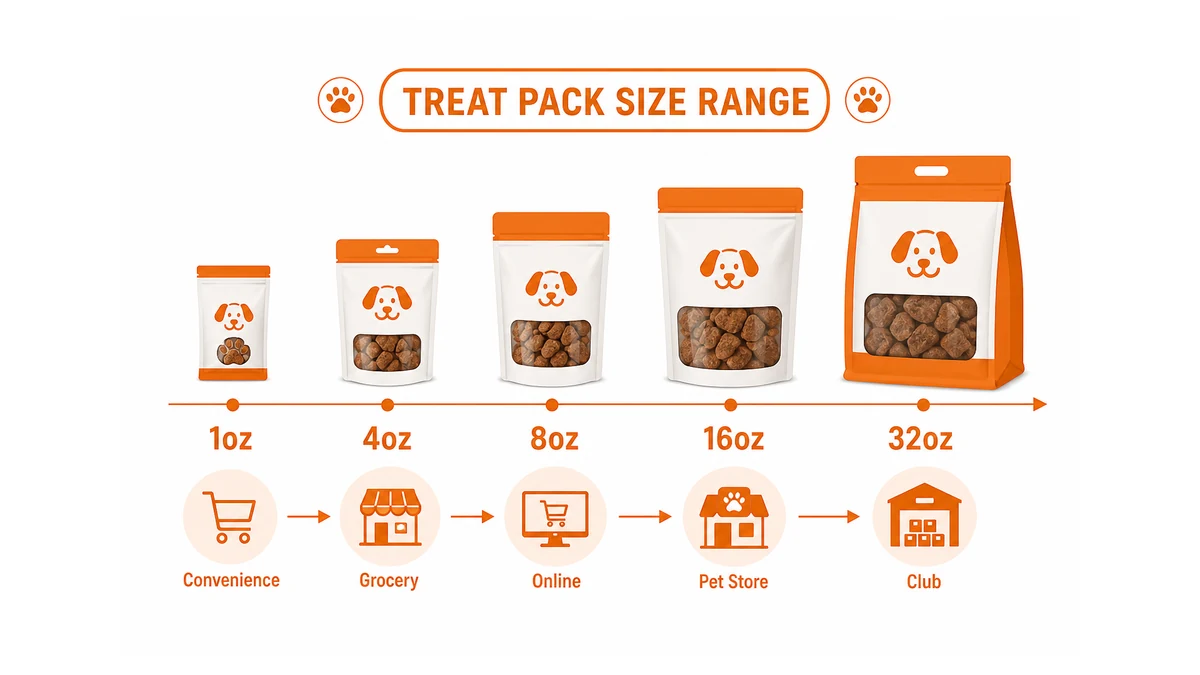
U.S. pet treat retail clusters around a handful of standard size breaks:
- 1 oz – 2 oz: single-serve or trial size; common for subscription box inserts and sampling programs.
- 3 oz – 6 oz: the entry-level retail SKU; the most common price-point for $8–$14 treats.
- 8 oz – 12 oz: mid-size everyday bag; where repeat buyers move after a trial.
- 16 oz – 32 oz: bulk/value size; drives lower per-treat cost for large-dog households.
Don’t launch with five SKU sizes simultaneously. A single 6 oz bag lets you validate brand positioning and label design before committing to tooling and inventory across a range. Packaging costs per unit drop significantly with volume — a 5,000-unit run of a custom dog treat stand-up pouch may cost two to three times the per-unit cost of a 25,000-unit run of the same bag.
Custom Branding Elements That Separate Your Label from Generics
Print quality, color accuracy, and finish options
Private label brands are also referred to as store brands or white-label products in other categories — but in pet food, the ones that scale beyond their launch year do so because their packaging reads as premium, not like a generic. Print quality is where that gap opens.
Rotogravure printing (gravure) gives the sharpest color reproduction and handles photographic images of dog treats or animals without banding. It requires a cylinder engraved per color, which makes setup costs higher — viable at 10,000+ units per SKU. Flexographic printing is the standard for mid-run custom dog treat bags (3,000–10,000 units); color accuracy is slightly lower but sufficient for flat color and bold branding.
Digital printing — increasingly available from packaging converters — makes sense for under 3,000 units or for seasonal/limited-edition runs where you need multiple label variants from the same bag structure.
Finish options that move the needle for custom pet treat packaging:
- Matte laminate: the dominant premium signal in the natural pet food segment; reduces fingerprints and photographs better than gloss.
- Gloss laminate: higher visual impact in brightly lit big-box retail; shows color saturation better.
- Soft-touch coating: a tactile matte that reads as luxury; adds cost but creates a physical brand moment.
- Spot UV: gloss highlights on a matte base — useful for logo or icon elements on premium treat packaging.
🚫 Avoid: Specifying Pantone colors verbally. Supply an actual Pantone Matching System (PMS) reference for every brand color. A supplier printing from a verbal color description (“cobalt blue, slightly darker”) will not match your digital mockup.
Label placement, window cuts, and structural differentiation
Three structural choices separate brand-grade custom dog treat packaging from generic commodity bags:
- Die-cut windows: a clear film insert cut into the front panel lets the actual treats show through. This builds consumer trust — shoppers at pet food retailers consistently pick up bags that let them see the product. Punched rectangle windows are cheapest; shaped windows (bone, paw print) cost more to die-cut but reinforce breed-specific or playful brand identities.
- Hang holes: a euro-slot punched at the top of a stand-up pouch lets the bag hang on a peg hook. Mandatory for any placement on peg-board retail fixtures; optional for shelf placement.
- Bag proportion as a shelf-recognition tool: a deliberately narrower, taller bag — say, 2 inches narrower than the category average — stands visibly different among competitors before a shopper reads a single word. This is a briefable decision: specify the finished bag width and height explicitly in your packaging spec, and confirm it against a planogram mock-up before production. Most private label brands never do this; they accept default dimensions and wonder why their packaging doesn’t stand out.
Back-panel space deserves a frank note. AAFCO-aligned state regulations require the ingredient list, guaranteed analysis, net weight, and manufacturer name and address on every pet treat bag. On a small-format bag (3–4 oz), those compliance elements can consume 70–80% of the back panel, leaving almost no room for brand copy.
The practical response is to move any secondary brand messaging — origin story, feeding instructions beyond the minimum, QR codes — to a side gusset panel. Don’t crowd the back with marketing copy that could go on the front; buyers who flip the bag to read the label are already interested. Keep the required information consistent with applicable FDA labeling requirements.
Material and Barrier Specs Built for U.S. Retail Conditions
Moisture and oxygen barrier levels for different treat types
U.S. retail supply chains expose custom pet treat packaging to a wide range of humidity and temperature conditions — from a climate-controlled distribution center in New Jersey to a truck dock in Phoenix in July. The material spec you choose has to survive all of it.
Standard laminate constructions by treat type:
| Treat Type | Recommended Structure | Key Barrier Target (typical) |
|---|---|---|
| Dry biscuits / hard chews | BOPP / metalized BOPP / PE | MVTR < 5 g/m²/day |
| Jerky / soft-dried treats | PET / foil / PE | OTR < 10 cc/m²/day |
| Freeze-dried raw | PET / foil / PE with N₂ flush | OTR < 5 cc/m²/day |
| Soft chews | Nylon / PE or PET / PE | MVTR < 3 g/m²/day |
| Eco-friendly / kraft paper | Kraft / PE or PLA inner liner | MVTR varies — confirm per structure |
Barrier targets above reflect commonly cited supplier-confirmed ranges, not universal regulatory thresholds. Confirm actual values against your specific treat formulation and target shelf life with your film supplier, using an appropriate test method such as ASTM F1249 for water vapor transmission rate measurements.
Kraft paper dog treat bags used in eco-friendly lines are not automatically high-barrier. The paper ply alone contributes almost nothing to moisture or oxygen resistance — that job falls entirely to the inner liner. A kraft paper pet treat bag without a proper inner film is a branding choice, not a packaging protection choice.
Durability for warehouse, e-commerce, and in-store handling
E-commerce fulfillment imposes different stresses than retail shelf display. A dog treat bag that survives six months on a Petco shelf may split at the gusset seal after one drop in an Amazon fulfillment center.
- Puncture resistance: treats with sharp edges (bone-shaped biscuits, pressed chews) can puncture thin inner plies from the inside. A minimum of 80-gauge (20 micron) inner PE layer is a commonly recommended starting point for dry treat formats — confirm with your supplier based on treat geometry.
- Seal strength: measured in N/15mm; a heat seal below approximately 20 N/15mm is generally considered at risk of failure under the compression load of stacked cartons in transit. Treat this as a starting-point threshold to discuss with your converter, not a hard universal standard.
- Transit simulation testing: major e-commerce retailers and fulfillment programs often reference standardized transit simulation protocols in their supplier packaging requirements. Confirm which testing standards apply to your specific sales channels with each retailer or fulfillment partner before your first shipment, not after your first return.
Recyclable packaging is increasingly requested by U.S. retail buyers. A mono-material polyethylene structure (all-PE laminate) is technically recyclable through store drop-off programs — but it typically delivers lower barrier performance than a mixed-material laminate.
For most private label pet treat brands launching in 2025–2026, the trade-off between barrier performance and recyclability is a real one that has to be weighed against where the product is sold and what claims the brand wants to make.
How to Evaluate a Private Label Packaging Supplier
Minimum order quantities and lead time transparency
Two numbers matter before anything else: minimum order quantity (MOQ) and production lead time. Both vary significantly by print method and supplier type. A structured product development process helps brands assess supplier quotations, sampling requirements, and production risks before committing to bulk orders.
- Gravure/flexo-printed custom pouches: MOQs typically start at 5,000–10,000 units per SKU; lead time 45–70 days after artwork approval.
- Digital-printed pouches: MOQs as low as 500–1,000 units; lead time 15–25 days; higher per-unit cost.
- Plain stock pouches with pressure-sensitive labels: lowest MOQ (100+ units); label printing is separate and faster, but the result reads as less premium.
🔍 Worth checking: Ask for lead time in calendar days from artwork approval to ex-factory — not “production days” or “business days.” The gap between those figures is where surprises happen.
A supplier who quotes a 30-day lead time without specifying the start point is not giving you usable information.
Quality inspection and documentation standards
The documents a credible private label packaging supplier should produce without being asked:
- COA (Certificate of Analysis) for the laminate film — confirming barrier values, not just declaring a structure name.
- Food-contact compliance — FDA 21 CFR compliance for food-contact layers is not optional for U.S. pet treat packaging sold through retail. Check the applicable FDA food-contact requirements and ask for written documentation confirming the materials are suitable for their intended use, not just a verbal assurance.
- AQL inspection reports: Acceptable Quality Level (AQL) 2.5 is the standard for consumer goods packaging. A supplier running AQL 4.0 or higher is accepting significantly more defects per shipment.
ASG runs AQL 2.5 inspection across packaging production runs. For brands shipping to U.S. distributors or Amazon FBA, a single shipment of misprinted or mis-sealed treat bags creates return costs that dwarf the savings from a cheaper supplier.
Supply chain visibility and brand-grade reliability
In pet treat packaging specifically, a supplier substituting a barrier laminate mid-production — without written sign-off — can create compliance exposure that surfaces months later at a retail audit or distributor receiving dock. By then, the packaging is already in market. That downstream cost is difficult to recover from a supplier who has already moved to the next order.
Supply chain visibility means:
- Weekly production status updates with photos at key milestones (film confirmed, printing done, pouches formed).
- A clear escalation path if a print run fails color approval — who approves reprints, who absorbs the cost.
- Documented reorder terms: same laminate structure, same print cylinders (for gravure), same color profiles — so your second order matches your first.
Private label brands are developed and managed by the brand owner, not the manufacturer. That means a packaging supplier’s job is to execute your spec, not to make creative decisions on your behalf. Suppliers who routinely substitute materials “because it’s equivalent” without written sign-off are not suitable partners for brands building repeat purchase.
✅ Do this: Before placing a production order, send a written spec sheet covering laminate structure, print spec, seal dimensions, zipper type, and hang-hole position. Any supplier worth working with will sign and return it. One who resists is telling you something.
Next Steps: Requesting Samples and Locking Your Packaging Spec
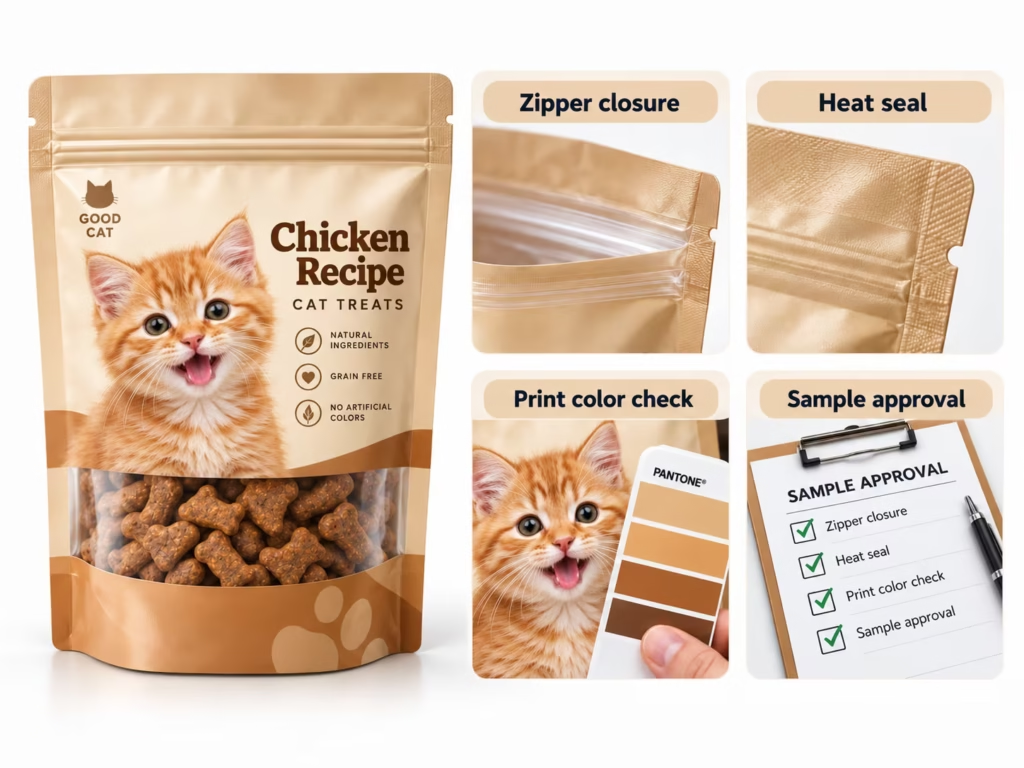
The most expensive mistake in custom dog treat packaging is approving a digital proof and skipping the physical sample stage. Colors look different on a backlit screen than on a matte laminate film under fluorescent retail lighting. Seal integrity cannot be evaluated from a PDF.
Request two rounds before committing to a production run. The first is a pre-production sample (PPS) — a short run using your exact film, your print colors, and your structural dimensions.
Evaluate it against three things: color match to your brand standards (use a physical Pantone swatch, not a monitor), seal integrity (pull the top seal apart by hand — it should delaminate the film before the seal opens), and resealability of the zipper after ten open-close cycles.
The second is a production-equivalent sample pulled from the first 50 units of your actual production run. This is the gate before the full order ships.
Locking your packaging spec means writing down: laminate construction by layer, film gauge per layer, print method, Pantone colors with delta-E tolerance (≤2.0 is tight; ≤3.0 is standard), zipper type and position, hang-hole dimensions and placement, and net weight declaration format. That document travels with every reorder and every supplier conversation.
For brands sourcing custom pet treat packaging at scale across multiple SKUs and treat formats, a sourcing partner who can coordinate across packaging suppliers, run AQL inspection, and manage U.S.-bound consolidation adds more value than the cheapest per-unit price. The brands that get their packaging spec locked correctly before their first production run spend far less on corrective action over the following 12 months.
Frequently asked questions
What does private label pet treat packaging actually need to do?
Private label pet treat packaging must protect product integrity, communicate your brand, and meet retailer compliance requirements. That means a laminate structure that blocks moisture and oxygen, a resealable closure if treats are sold in multi-serving bags, and print specs that survive the supply chain without scuffing. For private label brands specifically, the packaging also has to carry your name convincingly enough that shoppers choose it over national brands sitting two feet away on the same shelf.
What are the shelf life and freshness requirements for pet treats?
Dry dog and cat treats sold in the United States may target a shelf life of around 12 months or longer, depending on the formulation, barrier performance, and validated storage conditions. Achieving the target shelf life depends partly on your barrier film, which may use a foil or metalized laminate with suitably low oxygen and moisture vapor transmission rates. Soft or semi-moist treats may require tighter barrier specifications, while some products benefit from nitrogen flushing before sealing. Your packaging supplier should provide MVTR and OTR data for any structure they quote so you can evaluate it against your treat’s formulation, water activity, and target shelf life before committing to a production run.
How does pet treat packaging communicate your brand at the point of purchase?
Packaging communicates brand value through print quality, material feel, and information hierarchy. Shoppers may make quick decisions in U.S. pet specialty and grocery aisles, so your protein source, key benefit, and brand mark need to stand out immediately. Matte finishes and spot UV coatings can support premium positioning, although availability and minimum order quantities depend on the printing method and supplier. On the back panel, a clear ingredient list, appropriate feeding directions, net quantity statement, and other applicable pet food labeling information help build consumer trust.
Quick AI summary
In one paragraph
Private label pet treat packaging must protect product freshness, communicate brand identity, and meet applicable U.S. retail requirements. The right packaging depends on the treat’s moisture content, fat content, target shelf life, and sales channel. Stand-up pouches, flat bottom bags, and resealable formats offer different advantages in shelf presentation, cost, and convenience. Before placing a bulk order, brands should verify laminate barrier performance, printing specifications, minimum order quantities (MOQs), production lead times, and quality inspection requirements.
Facts worth quoting
- Dry biscuits, jerky, soft chews, and freeze-dried treats have different moisture and oxygen barrier requirements. MVTR and OTR targets should be validated against the product formulation and intended shelf life.
- Stand-up pouches with bottom gussets are widely used for private label pet treats because they support upright retail display, custom printing, and optional resealable zippers.
- Flat bottom bags generally cost more than standard stand-up pouches because of their additional material and more complex construction.
- Digital printing can accommodate smaller production runs, while flexographic and gravure printing may be more economical for larger orders, depending on supplier capabilities.
- Packaging MOQs and production lead times vary by printing method, customization requirements, and supplier. Written quotations should clearly specify quantities and lead-time starting points.
What to remember
- Request MVTR and OTR test data for the specific laminate construction rather than relying on generic material specifications.
- A resealable zipper helps protect remaining treats after opening but cannot compensate for inadequate film barrier performance.
- High-barrier packaging is especially important for oxygen-sensitive treats. Nitrogen flushing may provide additional protection when justified by product requirements.
- Confirm Pantone color references, print finishes, bag dimensions, zipper placement, and labeling requirements before approving production.
- Request physical pre-production samples and verify seal integrity, print quality, and material specifications before committing to bulk production.
- Agree on inspection criteria, including applicable AQL requirements, and obtain written confirmation of production lead times and approved packaging specifications.